Zucchius (crater)
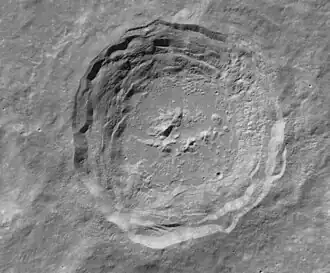 LRO image | |
| Coordinates | 61°24′S 50°18′W / 61.4°S 50.3°W |
|---|---|
| Diameter | 64 km (40 mi) |
| Depth | 4.81 km (2.99 mi)[1] |
| Colongitude | 52° at sunrise |
| Eponym | Niccolò Zucchi |

Zucchius is a prominent lunar impact crater located near the southwestern limb. Because of its location the crater appears oblong-shaped due to foreshortening. It lies just to the south-southwest of the crater Segner, and northeast of the much larger walled plain named Bailly. To the southeast is Bettinus, a formation only slightly larger than Zucchius.
The crater rim is symmetrical and shows little significant wear from impacts. The inner wall is terraced, and there is a group of small central peaks that forms a curving arc around the middle of the floor, making it a complex crater. The spectra of the central peak fits a noritic gabbro mineralogy, which originated from a depth of 6.4 to 9.9 km.[2] Due to its ray system, Zucchius is mapped as part of the Copernican System.[3]: Plate 11
To the northeast of Zucchius is the Schiller-Zucchius Basin, a Pre-Nectarian peak ring basin.[3]: Chapter 8 This basin has received the unofficial designation 'Schiller Annular Plain' among lunar observers.
Satellite craters
By convention these features are identified on lunar maps by placing the letter on the side of the crater midpoint that is closest to Zucchius.
| Zucchius | Latitude | Longitude | Diameter |
|---|---|---|---|
| A | 61.8° S | 56.0° W | 28 km |
| B | 61.8° S | 54.3° W | 25 km |
| C | 60.8° S | 45.2° W | 22 km |
| D | 61.4° S | 58.7° W | 26 km |
| E | 61.3° S | 60.6° W | 21 km |
| F | 60.1° S | 56.5° W | 8 km |
| G | 60.5° S | 57.2° W | 25 km |
| H | 61.0° S | 59.7° W | 14 km |
| K | 64.3° S | 58.0° W | 10 km |
References
- ↑ Joshi, Maitri P. (February 2017). "Physical properties of lunar craters". Research in Astronomy and Astrophysics. 17 (3). id. 24. Bibcode:2017RAA....17...24J. doi:10.1088/1674-4527/17/3/24.
- ↑ Cahill, J. T. S.; et al. (September 2009). "Compositional variations of the lunar crust: Results from radiative transfer modeling of central peak spectra". Journal of Geophysical Research. 114 (E9) E09001. Bibcode:2009JGRE..114.9001C. doi:10.1029/2008JE003282.
- 1 2 Wilhelms, Don E.; McCauley, John F.; Trask, Newell J. (1987). The geologic history of the Moon. USGS Professional Paper 1348. Washington: U.S. Government Printing Office. doi:10.3133/pp1348.
Sources
- Andersson, L. E.; Whitaker, E. A. (1982). NASA Catalogue of Lunar Nomenclature. NASA RP-1097.
- Blue, Jennifer (25 July 2007). "Gazetteer of Planetary Nomenclature". USGS. Retrieved 5 August 2007.
- Bussey, B.; Spudis, P. (2004). The Clementine Atlas of the Moon. New York: Cambridge University Press. ISBN 978-0-521-81528-4.
- Cocks, Elijah E.; Cocks, Josiah C. (1995). Who's Who on the Moon: A Biographical Dictionary of Lunar Nomenclature. Tudor Publishers. ISBN 978-0-936389-27-1.
- McDowell, Jonathan (15 July 2007). "Lunar Nomenclature". Jonathan's Space Report. Archived from the original on 8 February 2012. Retrieved 24 October 2007.
- Menzel, D. H.; Minnaert, M.; Levin, B.; Dollfus, A.; Bell, B. (1971). "Report on Lunar Nomenclature by the Working Group of Commission 17 of the IAU". Space Science Reviews. 12 (2): 136–186. Bibcode:1971SSRv...12..136M. doi:10.1007/BF00171763. S2CID 122125855.
- Moore, Patrick (2001). On the Moon. Sterling Publishing Co. ISBN 978-0-304-35469-6.
- Price, Fred W. (1988). The Moon Observer's Handbook. Cambridge University Press. ISBN 978-0-521-33500-3.
- Rükl, Antonín (1990). Atlas of the Moon. Kalmbach Books. ISBN 978-0-913135-17-4.
- Whitaker, Ewen A. (1999). Mapping and Naming the Moon. Cambridge University Press. ISBN 978-0-521-62248-6.
- Wlasuk, Peter T. (2000). Observing the Moon. Springer. ISBN 978-1-85233-193-1.
External links
- Jean-Luc Josset & Bernard H. Foing (1 June 2006). "SMART-1 close-up on Zucchius crater's central peaks". European Space Agency. Retrieved 16 June 2006.
| Physical properties |  | |
|---|---|---|
| Orbit | ||
| Surface and features | ||
| Science | ||
| Exploration | ||
| Time-telling and navigation | ||
| Phases and names | ||
| Daily phenomena | ||
| Related |
| |
