Yellow-vented bulbul
| Yellow-vented bulbul | |
|---|---|
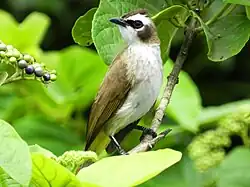 | |
| Nominate P. g. goiavier in Santa Maria, Luzon, Philippines | |
Scientific classification  | |
| Kingdom: | Animalia |
| Phylum: | Chordata |
| Class: | Aves |
| Order: | Passeriformes |
| Family: | Pycnonotidae |
| Genus: | Pycnonotus |
| Species: | P. goiavier |
| Binomial name | |
| Pycnonotus goiavier (Scopoli, 1786) | |
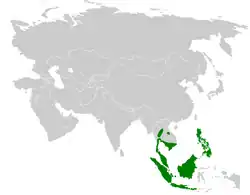 | |
| Range in green | |
| Synonyms | |
| |

The yellow-vented bulbul (Pycnonotus goiavier), or eastern yellow-vented bulbul, is a member of the bulbul family of passerine birds. It is a resident breeder in southeastern Asia from Indochina to the Philippines. It is found in a wide variety of open habitats but not in deep forests. It is one of the most common birds in cultivated areas. They appear to be nomadic and roam from place to place regularly.
Taxonomy and systematics
The yellow-vented bulbul was originally classified in the genus Muscicapa.
Six subspecies are accepted:[2]
- P. g. jambu - Deignan, 1955: southern Myanmar to southern Indochina
- P. g. analis - (Horsfield, 1821) (protonym Turdus analis): Malay Peninsula, Sumatra and nearby islands, Java, Bali, Lombok and Sumbawa
- P. g. gourdini - G. R. Gray, 1847 (as "yourdini", orthographic error[2]): Borneo, Maratua and Karimunjava Islands
- P. g. goiavier - (Scopoli, 1786): northern and north-central Philippines (Luzon, Mindoro, West Visayas)
- P. g. samarensis - Rand & Rabor, 1960: central Philippines (East Visayas)
- P. g. suluensis - Mearns, 1909: southern Philippines (Mindanao and Sulu Archipelagos)
Behaviour and ecology


The yellow-vented bulbul is adapted to human environments and even nests in gardens from low bushes to high trees. It builds a well-camouflaged but fragile, loose, deep, cup-shaped circular nest from grass, leaves, roots, vine stems, and twigs. The nest is untidy on the outside, but neatly lined with plant fibres. It lays 2–5 eggs between February and June.
The yellow-vented bulbul eats berries and small fruit. It also sips nectar, nibbles on young shoots, and consumes some insects.
References
- ↑ BirdLife International (2016). "Pycnonotus goiavier". IUCN Red List of Threatened Species. 2016 e.T22712731A94346183. doi:10.2305/IUCN.UK.2016-3.RLTS.T22712731A94346183.en. Retrieved 19 November 2021.
- 1 2 "Bulbuls". IOC World Bird List – Version 14.2. 2025. Retrieved 2025-11-09.
External links
