Yamina Méchakra
Yamina Méchakra | |
|---|---|
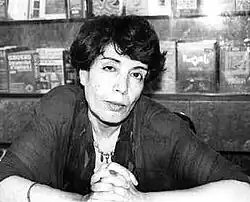 | |
| Born | 1949 Meskiana |
| Died | May 19, 2013 (aged 63–64) Algiers |
| Alma mater | University of Algiers |
| Writing career | |
| Genres | Fiction, psychiatry |
Yamina Méchakra (1949 in Meskiana – 2013 in Algiers) was an Algerian novelist and psychiatrist.[1]
Early life
Méchakra was born in 1949 in Meskiana in northern Aures. At age nine, she began writing; taking notes in a "log-book" that grew over time. Two events profoundly marked her childhood: her father was tortured by the French during the Algerian Civil War before her eyes, exposed in the street, attached to the barrel of a tank.[2][3] Little more is known of her life, although Kateb Yacine wrote in the preface to her book that she had a "cruel and troubled life".[4][notes 1]
Career
Méchakra began writing her first novel in 1973, while studying psychiatry at the University of Algiers. Her university thesis in literature was devoted to Apuleius of Madaurus.[notes 2] In Algiers, she met Kateb Yacine before his departure for Rome and Paris. Yamina Méchakra followed Yachine's style in writing, who gave her extended advice and guidance. She needed to rewrite three times to finish her first book, and "La Grotte éclatée" was published in 1979.[7] Yamina Mechakra argued that women was the source of the nation and the founding of an independent state.[8] Referring to the Berber queen known as La Kahina[notes 3], Kateb Yacine titled his preface of the novel as The Children of Kahina.
While she continued to write during the succeeding years, but did not publish, confiding to a reporter that she lost her manuscripts. In 1997, when she treated a young boy as a psychiatrist, she was inspired writing her second novel Arris, which was published in 1999.[4] Yamina Mechakra is also a committed author who supported the importance of a cultural revolution in Algeria in the process of decolonization.
Death
She died in Algiers on May 19, 2013, at the age of 64, following a long illness. On May 20, 2013, a memorial was held at the Palace of Culture,[10] and she was buried the same day in the cemetery of Sidi Yahia.[11]
Yamina Mechakra Prize
The Yamina Mechakra Literary Prize is an Algerian literary award established in 2018 in tribute to Mechakra. It aims to promote Algerian women's literature and rewards works written by women authors in Arabic, Tamazight (Amazigh), or French. The first edition was held in January 2019.[12][13][14] The prize was first announced in September 2018 by the Algerian Ministry of Culture and officially launched during the annual meetings of the “Mediterranean-Africa Meeting of Young Women Writers” (RAMAJE). The first award ceremony took place in January 2019 at the Palais de la culture Moufdi-Zakaria in Algiers.[12] The prize aims to promote Algerian women's writing in one of the two national languages: Arabic or Tamazight, in addition to French. The winners are selected by an all-female jury.[15] For the first edition, the chairs by language were Rabia Djelti (Arabic), Maïssa Bey (French), and Lynda Koudache (Amazigh).[15]
For the first edition, each laureate received a reward of 500,000 Algerian dinars.[16] The first ceremony was held at the Moufdi-Zakaria Palace of Culture in Algiers, in the presence of the then Minister of Culture, Azzedine Mihoubi.[17] The known laureates are:
| Year | Language | Laureate | Work | Notes |
|---|---|---|---|---|
| 2019 | Arabic | Djamila Talbaoui | Qalb El Isbani[18] | — |
| 2019 | French | Hédia Bensahli | Orages[17][19] | — |
| 2019 | Tamazight | Kayssa Khalifi | Ihulfan | Awarded posthumously[17] |
Works
- Mechakra, Yamina. "Ecrire femme" [Writing Woman]. Expressions algériennes (in French): 44–47. OCLC 949070766.
- La Grotte éclatée [The Exploded Cave] (in French). series: Lettres du Sud. Alger: SNED. 1979. OCLC 464501613.
{{cite book}}: CS1 maint: others (link)[20][21] - Arris: roman (in French). Paris: Marsa. 1999. ASIN B0046U4KYM. OCLC 44479653.
- Arris: roman, suivi du supplément collectif [Arris: Novel, followed by collective supplement] (in French). series: Algérie littérature/action. Paris: Marsa. 2000. OCLC 948996415.
{{cite book}}: CS1 maint: others (link)
Notes
- ↑ Kateb Yacine wrote the preface of La Grotte éclatée, and told that Méchakra dedicated the novel to her father as he writes: "She was born on the eve of the insurrection. When she hears talk of war, for the first time, she thinks it is a storm. In popular Arabic, ‘guirra’, means both a storm and revolutionary war, an unleashing of nature."[3]
- ↑ She wrote one novella as her narrative entitled "L'éveil du mont" published in 1976 in "al-Mujāhid al-thaqāfī" or "el-Moudjahid culturel".[5] In 1999, her novel Arris: romanin was published, as a book and as a literature in Algérie Littérature/Action.[6]
- ↑ The Berber queen known as La Kahina is the pioneering woman as a heroic warrior in Algeria, who fought against Arab invaders in the eighth century A.D.[9]
References
- ↑ "Yamina Mechakra". The New Oxford Companion to Literature in French.
- ↑ Lazreg, Marnia (2014-04-23). The Eloquence of Silence: Algerian Women in Question. Routledge. ISBN 9781134713301.
- 1 2 Pears, Pamela (2002). "Women Warriors and the Search for Identity in Post-colonial Algeria: La Grotte éclatée by Yamina Mechakra". Phoebe. 14 (1/2 Spring, Fall): 5. Archived from the original on 2016-04-18. Retrieved 2016-03-30.
- 1 2 Orlando, Valérie (2003-01-01). Of Suffocated Hearts and Tortured Souls: Seeking Subjecthood Through Madness in Francophone Women's Writing of Africa and the Caribbean. Lexington Books. ISBN 9780739105634.
- ↑ Caws, Mary Ann; et al., eds. (1996). Ecritures de femmes: nouvelles cartographies [Scriptures of women: new cartographies] (in French). New Haven & London: Yale University Press. p. 169.
- ↑ "Algérie littérature/action" (33–34). Paris: Marsa. 1999.
{{cite journal}}: Cite journal requires|journal=(help) - ↑ Fort, Pierre-Louis; Chaulet-Achour, Christiane (2013-12-17). La France et l'Algérie en 1962: De l'histoire aux représentations textuelles d'une fin de guerre [France and Algeria in 1962: from History to Textual Representations of the End of War] (in French). KARTHALA Editions. ISBN 9782811110475. OCLC 874058914.
- ↑ Mechakra, Yamina. "Ecrire femme" [Writing Woman]. Expressions algériennes (in French): 44–47. OCLC 949070766.
- ↑ Pears, Pamela (2002). "Women Warriors and the Search for Identity in Post-colonial Algeria: La Grotte éclatée by Yamina Mechakra". Phoebe. 14 (1/2 Spring, Fall): 1. Archived from the original on 2016-04-18. Retrieved 2016-03-30.
- ↑ The Moufdi Zakaria Palace of Culture is an exhibition and conference palace located on the plateau of Annasser in the town of Kouba, Algeria, named after Moufdi Zakaria, the Algerian poet, author of the Kassaman Algerian anthem. The site overlooks the city of Algiers.
- ↑ "Décès de la romancière algérienne Yamina Mechakra à l'âge de 64 ans" [Death of Algerian novelist Yamina Mechakra at the age of 64 years] (in French). Djazairess (Dzaers, Algeria Press). Retrieved 2016-01-30.
- 1 2 "Création du prix littéraire Yamina Mechakra". Radio Algérie (in French). 22 September 2018. Retrieved 14 November 2025.
- ↑ "Hommage à Yamina Mechakra". lexpression (in French). Retrieved 14 November 2025.
- ↑ "Yamina Mechakra, une étoile filante de la littérature algérienne". lalgerieaujourdhui.dz. 20 February 2024. Retrieved 3 January 2026.
- 1 2 "Prix Yamina Mechakra". Dhayen (in French). Retrieved 14 November 2025.
- ↑ "Valorisation des femmes creatrices par l'institutionnalisation de prix nationaux et internationaux pour la creation litte-raire et artistique portant le noms d'assia djebar, miriam makeba et yamina mechakra". unesco.org. Retrieved 3 January 2026.
- 1 2 3 "Le Prix Yamina Mechakra décerné à trois écrivaines". emb-argelia.pt (in French). 21 January 2019. Retrieved 14 November 2025.
- ↑ "Lauréate du prix Yamina Mechakra..Djamila Talbaoui : "Écrire le Sahara, c'est préserver une mémoire et un héritage"". sila.dz. 4 November 2025. Retrieved 3 January 2026.
- ↑ Bensahli, Hédia (2023). L'Algérie juive: l'autre moi que je connais si peu. ISBN 978-2-494387-05-8. Retrieved 3 January 2026.
- ↑ Pears, Pamela (2002). "Women Warriors and the Search for Identity in Post-colonial Algeria: La Grotte éclatée by Yamina Mechakra". Phoebe: Journal of Literature and Art. 14 (1/2 Spring, Fall). Archived from the original on 2016-04-18. Retrieved 2016-03-30.
- ↑ Jones, Christa (2011-01-01). "La Caverne algérienne chez Yamina Méchakra et Georges Buis: Lieu de résistance, de maternité ou de combat" [Women Warriors and the Search for Identity in Post-colonial Algeria: La Grotte éclatée]. Nouvelles Études Francophones. 26 (1). International Council of Francophone Studies / Conseil International d’Études Francophones (CIÉF): 135–149. doi:10.1353/nef.2011.0025. ISSN 2156-9428. S2CID 161474916.
External links
- Yamina Mechakra Untranslated Archived 2019-07-02 at the Wayback Machine, written by Jill Jarvis and published by Academia, Inc.
- Remnants of Empire in Algeria and Vietnam: Women, Words and War review by Claire Eldridge, University of St Andrews. Oxford Journals, Arts & Humanities (French History), volume 21, issue 3, pp. 372–373.