Xenia motif
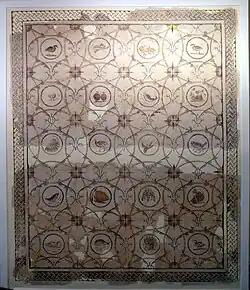
The xenia motif in Roman mosaic is a still life motif consisting of a grouping of various items, mostly edible, representing a generous offering (a xenia) from a wealthy host to guests. The items are often spread across different compartments in floor mosaic schemes. No doubt there were once paintings, but these have been lost.
Typical elements of a xenia motif include game hanging from hooks, fish, baskets of fruit (often overturned), and the like. Vitruvius lists specifically "poultry, eggs, vegetables, and other country produce".[1]
Xenia motifs are typically found in reception rooms.
The word xenia is Greek, and means hospitality; in Latin, it came to mean presents for guests, and later presents in general. It also came to include xenia epigrams.
Xenia epigrams
A xenia epigram is an epigram commemorating hospitality[2] or attached to a gift, sometimes represented in a xenia mosaic. Originally found in Latin literature, it was revived in the nineteenth century.
The 13th book of Martial's epigrams[3] is entitled Xenia, and catalogs the foods that might be given to a departing guest at the Saturnalia.[4]
Example
- Accept and wear this constant flower,
- Thus copied out by art.
- It blooms in Nature but its hour,--
- For ever in the heart.
- Affections into habits grown,--
- Lives fastened in one lot,--
- The flower has strengthened into stone
- We name "Forget me not."
Notes
- ↑ de Architectura, VI:7:4
- ↑ Isabelle Lefort, "Fieldwork: The 'Arlesian Woman' of Geographers?", Annales de géographie 687-688:5-6:468-486 (2012)
- ↑ "Martial, Epigrams. Book 13. Mainly from Bohn's Classical Library (1897)". www.tertullian.org. Retrieved 2026-08-19.
- ↑ Llewelyn Morgan, Neither Fish nor Fowl? Metrical Selection in Martial's Xenia , Harvard Studies in Classical Philology 103:385-406 (2007) JSTOR 30032228
References
- Katherine M.D. Dunbabin, Mosaics of the Greek and Roman World, Cambridge: 1999.
- Stella Grobel Miller, "A Mosaic floor from a Roman villa at Anaploga", Hesperia 41:3:332 (July 1972).
- Nathaniel Langdon Frothingham (1855). Metrical Pieces: Translated and Original. Boston: Croby, Nichols. p. 349.
xenia mosaic.