William S. W. Lim
William S. W. Lim | |
|---|---|
林少偉 | |
 Lim in 2013 | |
| Born | 19 July 1932 |
| Died | 6 January 2023 (aged 90) Holland Road, Singapore |
| Alma mater | |
| Occupations |
|
| Known for |
|
| Spouse | Lena Lim |
| Children | 2 |
| William S. W. Lim | |||||||||||||||
|---|---|---|---|---|---|---|---|---|---|---|---|---|---|---|---|
| Traditional Chinese | 林少偉 | ||||||||||||||
| Simplified Chinese | 林少伟 | ||||||||||||||
| |||||||||||||||
William Lim Siew Wai (Chinese: 林少偉;[1] 19 July 1932 – 6 January 2023), commonly known as William S. W. Lim, was a Singaporean architect and conservationist. Some of his noted designs included the Tanglin Shopping Centre (1972), the People's Park Complex (1973), and the Golden Mile Complex (1973), all in Singapore. Lim wrote and lectured on a wide range of subjects relating to architecture, urbanism, and culture in Asia as well as on current issues relating to the postmodern, glocality, and social justice. He was the author of Asian Alterity: With Special Reference to Architecture and Urbanism through The Lens of Cultural Studies (2008), as well as editor of Asian Design Culture (2009) and co-editor of Non West Modernist Past (2011).
Early life and education
Lim was born on 19 July 1932 in British Hong Kong;[2] his father was Richard Lim Chuan Hoe, a lawyer who served as deputy speaker in chief minister David Marshall's government.[3] Lim's older brother, Arthur, was an ophthalmologist and artist.[4] Lim graduated from the Architectural Association School of Architecture in London in 1955 and continued his graduate studies at Harvard University's Department of City and Regional Planning in the United States in the late 1950s as a Fulbright Fellow.[5][6]: 3
He had briefly worked for a year in London in their County Council. After completing his studies at Harvard, Lim returned to Singapore in 1957, where he did his apprenticeship at James Ferrie.[5][6]: 3 He told The Straits Times in 1997 that he never intended to be an architect, instead being a "process of elimination" as he "didn't want to become a lawyer, priest, teacher or doctor."[7]
Career
In 1960, he founded the architecture firm Malayan Architects Co-Partnership (MAC) alongside Chan Voon Fee and Lim Chong Keat. The three of them met at a seminar in the United Kingdom and decided to form a firm together when they returned to Malaya. They were against including their names for the firm's name, instead choosing a group name after being inspired by The Architects Collaborative. In the early days of MAC, they were unable to get any jobs and designed furniture.[6]: 2–3 In 1962, they won a S$3,000 (US$980) prize after submitting the winning design of the to-be-built Trade Union House (present-day Singapore Conference Hall).[8][9] Their design was praised by law minister K. M. Byrne, and the Trade Union House was constructed at a cost of S$4 million.[10]
Other competitions they participated in included a shopping centre for Ipoh in 1960, the University of Malaya's Great Hall and Administration Buildings in 1962, and the Negeri Sembilan State Mosque in 1963; they won first prize for the latter.[6]: 3 In 1965, he was a founding member of the Singapore Planning and Urban Research Group (SPUR), alongside architects Tay Kheng Soon, Chee Soon Wah, Koh Seow Chuan, and Edward Wong. He served as its first chairman from 1966 to 1968.[11][12] SPUR was known as an "independent think-tank" and frequently commented on issues regarding Singapore's urban planning from the 1960s to 1970s.[13]

In 1967, Lim founded architecture firm Design Partnership with Tay and Koh, following MAC's dissolution due to incompatibility between members.[3][6]: 6–7 In 1971, he attended the Second South Pacific Seminar in Fiji, where he presented a paper focusing on urbanisation and migration; he had previously presented papers at the 1967 Second Afro-Asia Housing Congress and at a 1970 UNESCO symposium.[14] In 1972, Lim was a part of the Design Partnership team who designed the People's Park Complex in Chinatown, which became known for its modern and brutalist architecture.[3][15] It was constructed over a period of years in the 1970s, spreading over 103,740 square feet (9,638 m2) and costing S$40 million (US$16.41 million).[16] The design for the People's Park Complex was the first to feature a multi-storeyed shopping centre with an atrium, which was subsequently repeated in other designs in Singapore.[7]
While designing the People's Park Complex, Lim also designed the Tanglin Shopping Centre, which was later developed by S. K. Chee Co. for S$7.5 million (US$3.05 million) and opened in 1972.[17] In 1973, Lim designed the sixteen-storey tall Golden Mile Complex with Tay and Gan Eng Oon, and it was completed in 1973. It similarly incorporated brutalist architecture and was described as a "vertical city".[3][18] Around this time, he also worked on Katong Shopping Centre.[7] The People's Park Complex and the Golden Mile Complex were Lim's most well-known buildings that he designed with Design Partnership.[5] In 1974, following Tay's departure from Design Partnership to start his own firm, Lim and Koh reestablished the firm as DP Architects in 1975.[5][3]

In 1975, Lim was reported to be working as a part-time lecturer on architecture at the National University of Singapore. He also supported the Area Licensing Scheme.[19] Around this time, Lim was growing uninterested in modernist architecture and began experimenting with post-modernism. This was seen in certain buildings he designed such as the Ken Thai House and Unit 8, built in 1979 and 1984, respectively. Lim described these as "disrupting the hierarchy" of structure and power displayed in modernist architecture, as shown in the layered space and nonconforming to the planning grids.[20] In 1981, he left DP Architects and started his own business – William Lim Associates – with Mok Wei Wei, Richard Ho, and Carl Larson.[5] Afterwards, he worked on the Church of Our Saviour in 1987, the Tampines North Community Centre in 1989, the Marine Parade Community Centre in 2000, and the Gallery Hotel in 2001.[20]
He was a founding member of the Singapore Heritage Society and a co-founder and chairman of Asian Urban Lab and President of the Architectural Association of Asia (AA Asia).[21] He was conferred an honorary degree of Doctor of Architecture by the Royal Melbourne Institute of Technology in 2002 and appointed honorary professor of Lasalle College of the Arts in 2005.[22][23] In 2003, Lim retired from William Lim Associates, and it was renamed to W Architects by Mok.[5] Lim wrote and lectured on a wide range of subjects relating to architecture, urbanism, and culture in Asia as well as on current issues relating to the postmodern, glocality, and social justice. He was the author of Asian Alterity: With Special Reference to Architecture and Urbanism through The Lens of Cultural Studies (2008), as well as editor of Asian Design Culture (2009) and co-editor of Non West Modernist Past (2011).[23]
Personal life
Lim was married to Lena Lim. The couple had two children: a son and a daughter.[3]
Lim died on 6 January 2023[a] at his home in Holland Road, Singapore, aged 90. He had previously suffered from COVID-19 in late-2022.[5]
Works
- 1972 – Tanglin Shopping Centre, Singapore
- 1973 – People's Park Complex, Singapore
- 1973 – Golden Mile Complex, Singapore
- 1987 – Church of Our Saviour (conversion), Singapore
- 2000 – Marine Parade Community Building, Singapore
- 2000 – Gallery Hotel, Singapore
 People's Park Complex, Singapore
 Golden Mile Complex, Singapore
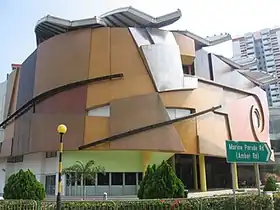 Marine Parade Community Centre, Singapore
 Gallery Hotel, Singapore
 Katong Shopping Centre, Singapore
 Singapore Conference Hall, Singapore
Bibliography
- Lim, William Siew Wai (1990). Cities for People : Reflections of a Southeast Asian Architect. Select Books. ISBN 981-00-1742-1. OCLC 851071649.
- Lim, William Siew Wai (1998). Contemporary Vernacular : Evoking Traditions in Asian Architecture. Select Books. ISBN 981-00-8370-X. OCLC 38464755.
- Lim, William Siew Wai (1998). Asian New Urbanism and Other Papers. Select Books. ISBN 981-4022-01-2. OCLC 231854270.
- Lim, William Siew Wai (2005). Asian Ethical Urbanism : A Radical Postmodern Perspective. World Scientific Pub. ISBN 981-256-313-X. OCLC 123237679.
- Lim, William Siew Wai (2008). Asian Alterity : With Special Reference to Architecture and Urbanism Through the Lens of Cultural Studies. World Scientific. ISBN 978-981-270-771-0. OCLC 845168576.
- Lim, William Siew Wai (2012). Incomplete Urbanism: A Critical Urban Strategy for Emerging Economies. World scientific. ISBN 978-981-4383-86-8. OCLC 800905300.
References
Notes
- ↑ There is some confusion with Lim's date of death. The Straits Times reported that his date of death was 6 January 2023.[5] However, Channel News Asia, based on a statement from the Singapore Heritage Society, reported that his date of death was on 7 January.[2]
Citations
- ↑ "我国先驱建筑师林少伟逝世 享年90岁". 8world (in Chinese (Singapore)). 8 January 2023 [7 January 2023]. Archived from the original on 7 January 2023. Retrieved 8 January 2023.
- 1 2 3 "Celebrated Architect William Lim Dies Aged 90". Channel NewsAsia. 7 January 2023. Archived from the original on 27 June 2023. Retrieved 7 January 2023.
- 1 2 3 4 5 6 Sajan, Chantal (4 March 2023) [3 March 2023]. "The Late William Lim: Pioneer Architect, Arts Patron, Heritage Champion and Social Activist". The Straits Times. ISSN 0585-3923. Archived from the original on 21 July 2025. Retrieved 21 July 2025.
- ↑ "2nd Book of Works to be Launched". The Straits Times. 4 July 1996. p. 6. Retrieved 9 April 2026 – via NewspaperSG.
- 1 2 3 4 5 6 7 8 9 Sajan, Chantal (7 January 2023). "Pioneer Architect Behind People's Park Complex and Golden Mile Complex Dies". The Straits Times. Archived from the original on 8 January 2023. Retrieved 8 January 2023.
- 1 2 3 4 5 M. Rasdi, Mohamad Tajuddin; Hayati Hussain, Nor. "National Identity and the Architecture of Malayan Architect Co-Partnership" (PDF). Archived from the original (PDF) on 22 July 2011. Retrieved 20 July 2025.
- 1 2 3 "An Outsider Who Cares and Questions". The Straits Times. 25 October 1997. p. 15. Retrieved 20 July 2025 – via NewspaperSG.
- ↑ "Work on Union House to Begin". The Straits Times. 20 March 1962. p. 4. Retrieved 20 July 2025 – via NewspaperSG.
- ↑ "Winners of Design Contest Named". The Straits Times. 18 March 1962. p. 6. Retrieved 20 July 2025 – via NewspaperSG.
- ↑ "A building Singapore can be proud of – Byrne". The Straits Times. 3 October 1962. p. 11. Retrieved 20 July 2025 – via NewspaperSG.
- ↑ Lim, Ivan (24 January 1972). "SPUR keeps a watching brief on things". New Nation. p. 9. Retrieved 20 July 2025 – via NewspaperSG.
- ↑ "Chairman of SPUR". Singapore Herald. 6 March 1971. p. 14. Retrieved 20 July 2025 – via NewspaperSG.
Mr. William S. W. Lim is not the chairman of the Singapore Planning and Urban Research Group, as reported by the Herald on March 4. He was SPUR chairman from 1966–68. The present chairman is Mr. Tay Kheng Soon.
- ↑ Zaccheus, Melody (8 October 2015). "Veteran architects of urban think-tank Spur reunite after 50 years". The Straits Times. ISSN 0585-3923. Archived from the original on 1 October 2020. Retrieved 29 July 2025.
- ↑ "Lim for seminar". New Nation. 14 July 1971. p. 3. Retrieved 20 July 2025 – via NewspaperSG.
- ↑ Ng, Keng Gene (30 May 2025) [27 May 2025]. "People's Park Complex being repainted red and white". The Straits Times. ISSN 0585-3923. Archived from the original on 10 April 2026. Retrieved 21 July 2025.
- ↑ Mok, Sin Pin (7 February 1972). "Majestic landmark in Chinatown". The Straits Times. p. 16. Retrieved 21 July 2025 – via NewspaperSG.
- ↑ "Artist's impression of the Tanglin Shopping Centre at Tanglin Road". Roots. National Heritage Board. Archived from the original on 19 April 2025. Retrieved 21 July 2025.
- ↑ "Where shoppers can buy all their needs under one roof". The Straits Times. 22 April 1973. p. 28. Retrieved 21 July 2025 – via NewspaperSG.
- ↑ "ALS, Parking Fees 'Should Be Raised At Intervals'". The Straits Times. 19 November 1975. p. 6. Retrieved 9 April 2026 – via NewspaperSG.
- 1 2 Chang, Jiat-Hwee (7 January 2023) ["A Man for All Seasons". Habitus 5: 80–87. 2009.]. "William S. W. Lim". Docomomo Singapore. Archived from the original on 6 September 2025. Retrieved 10 April 2026.
- ↑ Lim, William S. W. (1 December 2006). "Asian architecture in the new millennium: A postmodern imagery". Ekistics and the New Habitat. 73 (436–441): 132–139. doi:10.53910/26531313-E200673436-441108. ISSN 2653-1313. Archived from the original on 8 January 2023. Retrieved 8 January 2023.
- ↑ "BACK MATTER", The Impossibility of Mapping (Urban Asia), WORLD SCIENTIFIC, 1 February 2020, pp. 262–278, doi:10.1142/9789811211935_bmatter, ISBN 978-981-12-1192-8, S2CID 243016545, retrieved 8 January 2023
- 1 2 "William Lim Siew Wai | Infopedia". eresources.nlb.gov.sg. Archived from the original on 8 January 2023. Retrieved 8 January 2023.
- ↑ "William Lim Associates and W Architects Pte Ltd collection :Church of Our Saviour : submission drawings (DC and BP),1986-1898. – National Library". nlb.gov.sg. Archived from the original on 8 January 2023. Retrieved 8 January 2023.
External links
- William S. W. Lim on Infopedia
 Media related to William S. W. Lim at Wikimedia Commons
- 1932 births
- 2023 deaths
- Architectural theoreticians
- Hong Kong emigrants to Singapore
- Naturalised citizens of Singapore
- Singaporean architects
- Harvard Graduate School of Design alumni
- Alumni of the Architectural Association School of Architecture
- Royal Melbourne Institute of Technology alumni
- 21st-century Singaporean writers