Amblypygi
| Amblypygi | |
|---|---|
 | |
| Heterophrynus, Ecuador | |
Scientific classification  | |
| Kingdom: | Animalia |
| Phylum: | Arthropoda |
| Subphylum: | Chelicerata |
| Class: | Arachnida |
| Clade: | Tetrapulmonata |
| Order: | Amblypygi Thorell, 1883 |
| Families | |
| |
 | |
| Synonyms[2] | |
| |
Amblypygi is an order of arachnids also known as whip-spiders or tailless whip-scorpions. The name "amblypygid" means "blunt tail", a reference to a lack of the flagellum that is otherwise seen in whip-scorpions. Amblypygids possess no silk glands or venom. They rarely bite if threatened but can grab fingers with their pedipalps, resulting in thorn-like puncture-injuries.
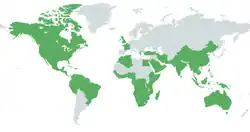
As of 2026, five families, 18 genera, and around 280 species had been discovered and described.[3] They are found in tropical and subtropical regions worldwide, mainly in warm and humid environments. They like to stay protected and hidden within leaf litter, caves, or underneath bark. Some species are subterranean; all are nocturnal. Fossilized amblypygids have been found dating back to the Carboniferous period, such as Weygoldtina.[1]
Description


Body-plan
Being arachnids, Amblypygi possess two body-segments; the prosoma and the opisthosoma (often referred to as the cephalothorax and abdomen), four pairs of legs, pedipalps, and chelicerae. The first pair of legs act as sensory organs and are not used for walking. The sensory legs are very thin and elongated, have numerous sensory receptors, and can extend several times the length of the body.[5] Their bodies are broad and highly flattened, with a solid prosoma and a segmented opisthosoma.[6]Most species have eight eyes; a pair of median eyes at the front of the carapace above the chelicerae and 2 smaller clusters of three eyes each further back on each side.
Size
Amblypygids range from 5 to 29 cm (2.0 to 11.4 in) in walking legspan.[5][7][6] The elongated first pair of legs, however, can reach extreme lengths of up to 61 cm (24 in) in total. If sensory legs are counted, the largest amblypygid species are the largest arachnids in the world by legspan.[6] Some of the larger species of the genus Heterophrynus may be the largest of the amblypygi in walking and sensory legspan (or whipspan).[6] Previously autotomized whip legs that have regrown fully upon being regenerated grow even longer than their non-autotomized counterparts.[7]
The largest whipspider by body size is Acanthophrynus, another species with very large overall dimensions, with a total body length of up to 45 mm (1.8 in). Some species, especially those in the family Phrynichidae, also have extremely elongated pedipalps, with Euphrynichus reaching nearly 40 cm (16 in) across the extended pedipalps.[7]
Pedipalps
Amblypygids have raptorial pedipalps modified for grabbing and retaining prey, much like the forelegs of mantises.[8] The pedipalps are generally covered in spines, used for impaling and capturing prey. They are kept folded in front of the prosoma when not in use.[6] Whipspider pedipalps often display sexual dimorphism in their size and shape.[9]
Pedipalp anatomy varies strongly across the amblypygi, with configurations often conforming to a particular style of prey capture. The pedipalps of some genera, such as Euphrynicus and others in the family Phrynichidae, are extremely long, and free of large spines until near the extreme distal end of the appendage[6], where a jointed "hand" is formed from spines and the tarsus of the appendage[7]. Others have shorter pedipalps with an increased number of large dorsal and ventral spines, forming a "catching basket" for prey capture.
Exoskeleton
Whip-spiders are covered with a layer of a solidified secretion that forms a super-hydrophobic coating.[10] Studies on the spotted tailless whip-scorpion also show their exoskeleton is enriched with several trace-elements, including calcium, magnesium, manganese, potassium, sodium, and zinc, which tends to accumulate as the individual gets older. The same trace-elements are also present in the exoskeleton of the other members of Tetrapulmonata.[11] Like other arachnids, an amblypygid will molt several times during its life.[5] Molting is done while hanging from the underside of a horizontal surface in order to use gravity to assist in separating the old exoskeleton from the animal.
Behavior

Amblypygids have eight legs, but use only six for walking, often in a crab-like, sideways fashion. The front pair of legs are modified for use as antennae-like feelers, with many fine segments giving the appearance of a "whip". When suitable prey is located with the antenniform legs, the amblypygid seizes its victim with large spines on the grasping pedipalps, impaling and immobilizing the prey. This is typically done while climbing the side of a vertical surface and facing downward toward their prey.[12]
Reproduction
Courtship involves the male depositing a stalked spermatophore, which has one or more sperm masses at the tip, onto the ground, and using his pedipalps to guide the female over them.[13] She gathers the sperm and lays fertilized eggs into a sac carried under the abdomen, or opisthosoma. When the young hatch, they climb up onto the mother's back; any which fall off before their first molt will not survive.
Socialization
In common with most other arachnids,[14] adult whipspiders are not particularly social.[7] However, some species may be among the few examples of arachnids that exhibit social behavior. Research conducted at Cornell University with Phrynus marginemaculatus and Damon diadema suggests that mother amblypygids communicate with their young with their antenniform front-legs, and the offspring reciprocate both with their mother and siblings. The ultimate function of this social behavior remains unknown.[14] The amount of aggression between individuals can vary considerably even within a given genus, with Peter Weygoldt observing that Heterophrynus alces is extremely aggressive to conspecifics, while H. longicornis is often found in male-female pairs and tolerate the presence of other individuals far more. Amblypygids hold territories that they defend from other individuals.[15]
Diet
Whipspiders mostly prey upon invertebrates, particularly insects, but they are opportunistic and have also been observed feeding on vertebrates.[5][7] Amblypygids are generally sit-and-wait predators, especially larger species such as Heterophrynus. Young individuals and small species tend to forage more actively[7]. They generally do not feed for a period of time before, during, and after molting. Female whipspiders will also often refrain from eating while carrying an egg sac and during the early development of the young, often a period of over 3 months.[7]
Pincer-like chelicerae work to grind and chew the prey prior to ingestion. The tailless whip scorpion may go for over a month in which no food is eaten. Often this is due to pre-molt. Due to the lack of venom the tailless whip scorpion is very nervous in temperament, retreating away if any dangerous threat is sensed by the animal.
As pets
Several genera of Amblypygi are sold and kept as pets, including Acanthophrynus, Charinus, Charon, Damon, Euphrynichus, Heterophrynus, Phrynus, Paraphrynus, and Phrynichus.[16][6] Tailless whip-scorpions live anywhere between 5 and 10 years.[17][18]
Genera


The following genera are recognised:[19][20]
- Palaeoamblypygi Weygoldt, 1996
- Paracharontidae Weygoldt, 1996
- Paracharon Hansen, 1921 (1 species, West Africa)
- Jorottui Moreno-González, Gutierrez-Estrada, & Prendini, 2023 (1 species, northern South America)
- Weygoldtinidae Dunlop, 2018[21]
- †Weygoldtina Dunlop, 2018 (2 species, Upper Carboniferous Europe, North America)[21]
- Paracharontidae Weygoldt, 1996
- Euamblypygi Weygoldt, 1996
- †Paracharonopsis Engel & Grimaldi, 2014 (1 species, Cambay amber, India, Eocene)[22]
- Charinidae Weygoldt, 1996
- Charinus Simon, 1892 (33 species)
- Sarax Simon, 1892 (10 species)
- Weygoldtia Miranda, Giupponi, Prendini & Scharff, 2018 (3 species)
- Neoamblypygi Weygoldt, 1996
- Charontidae Simon, 1892
- Unidistitarsata Engel & Grimaldi, 2014
- †Kronocharon Engel & Grimaldi, 2014 (1 species, Burmese amber, Myanmar, Cretaceous)
- †Burmacharon? Hu et al. 2020 (1 species, Burmese amber, Myanmar, Cretaceous)
- Phrynoidea Blanchard, 1852
- Phrynichidae Simon, 1900
- Damon C. L. Koch, 1850 (10 species)
- Euphrynichus Weygoldt, 1995 (2 species)
- Musicodamon Fage, 1939 (1 species)
- Phrynichodamon Weygoldt, 1996 (1 species)
- Phrynichus Karsch, 1879 (16 species)
- Trichodamon Mello-Leitão, 1935 (2 species)
- Xerophrynus Weygoldt, 1996 (1 species)
- Phrynidae Blanchard, 1852
- Acanthophrynus Kraepelin, 1899 (1 species)
- †Britopygus Dunlop & Martill, 2002 (1 species; Crato Formation, Brazil, Cretaceous)
- Heterophrynus Pocock, 1894 (14 species)
- Paraphrynus Moreno, 1940 (18 species)
- Phrynus Lamarck, 1801 (28 species, Oligocene - Recent)
- Phrynichidae Simon, 1900
- Incertae sedis:
- † Sorellophrynus Harvey, 2002 (1 species, Upper Carboniferous, North America)
- † Thelyphrynus Petrunkevich, 1913 (1 species, Upper Carboniferous, North America)
References
- 1 2 Garwood, Russell J.; Dunlop, Jason A.; Knecht, Brian J.; Hegna, Thomas A. (2017). "The phylogeny of fossil whip spiders". BMC Evolutionary Biology. 17 (1): 105. Bibcode:2017BMCEE..17..105G. doi:10.1186/s12862-017-0931-1. PMC 5399839. PMID 28431496.
- ↑ Harvey, M.S. (2013). "Amblypygi Thorell 1883". Whip spiders of the World. version 1.0. Western Australian Museum. Archived from the original on 23 September 2024. Retrieved 23 September 2024.
- ↑ "World Amblypygi Catalog". World Amblypygi Catalog. Natural History Museum Bern. 2023. Retrieved 17 April 2026.
- ↑ R. I. Pocok (1900). Fauna of British India. Arachnida.
- 1 2 3 4 Chapin, KJ; Hebets, EA (2016). "Behavioral ecology of amblypygids". Journal of Arachnology. 44 (1): 1–14. doi:10.1636/V15-62.1. S2CID 29923727.
- 1 2 3 4 5 6 7 McMonigle, Orin (2013). Breeding the world's largest living arachnid: amblypygid biology, natural history, and captive husbandry. Greenville, Ohio: Coachwhip Publications. ISBN 978-1-61646-183-6.
- 1 2 3 4 5 6 7 8 Weygoldt, Peter (2000). Whip Spiders (Chelicerata: Amblypygi): Their Biology, Morphology and Systematics. Apollo Books. ISBN 8788757463.
- ↑ Robert D. Barnes (1982). Invertebrate Zoology. Philadelphia, PA: Holt-Saunders International. pp. 617–619. ISBN 0-03-056747-5.
- ↑ McLean, C.J.; Garwood, R.J.; Brassey, C.A. (2019). "Sexual dimorphism in the size and shape of the raptorial pedipalps of Giant Whip Spiders (Arachnida: Amblypygi)". Journal of Zoology. 310 (1): 45–54. doi:10.1111/jzo.12726. ISSN 0952-8369.
- ↑ Wolff, Jonas O.; Schwaha, Thomas; Seiter, Michael; Gorb, Stanislav N. (November 28, 2016). "Whip spiders (Amblypygi) become water-repellent by a colloidal secretion that self-assembles into hierarchical microstructures". Zoological Letters. 2 (1): 23. doi:10.1186/s40851-016-0059-y. PMC 5126833. PMID 27942390 – via Springer Link.
- ↑ Radosavljevic, Dragoslav; Ada, Earl; Hochberg, Rick (2021). "Elemental enrichment of the exoskeleton of the whip spider Phrynus marginemaculatus (Arachnida: Amblypygi)". The Journal of Arachnology. 49 (2): 235–249. doi:10.1636/JoA-S-20-048.
- ↑ Ladle, Richard J.; Velander, Kathryn (2003). "Fishing behavior in a giant whip spider". The Journal of Arachnology. 31: 154–156. doi:10.1636/0161-8202(2003)031[0154:FBIAGW]2.0.CO;2. S2CID 86012520 – via ResearchGate.
- ↑ Peter Weygoldt (1999). "Spermatophores and the evolution of female genitalia in whip spiders (Chelicerata, Amblypygi)" (PDF). Journal of Arachnology. 27 (1): 103–116. Archived from the original (PDF) on 2008-05-17.
- 1 2 Rayor, Linda; Taylor, Lisa (2006). "Social Behavior in Amblypygids, and a Reassessment of Arachnid Social Patterns". Journal of Arachnology. 34 (2): 399–421. doi:10.1636/S04-23.1. S2CID 34165769 – via Biodiversity Heritage Library.
- ↑ Chapin KJ; Hill-Lindsay S (2015). "Territoriality evidenced by asymmetric intruder-holder motivation in an amblypygid". Behavioural Processes. 122: 110–115. doi:10.1016/j.beproc.2015.11.014. PMID 26616673. S2CID 37584495.
- ↑ "Tail-less Whip Scorpion - Damon medius". exotic-pets.co.uk. Retrieved 2019-07-13.
- ↑ "Tailless Whip Scorpion Care Sheet". Reptile Centre. Retrieved December 27, 2019.
- ↑ "Tailless Whip Scorpion: Facts, Lifespan, Care, Feeding, & Breeding". AllPetsDirectory. Retrieved 27 December 2019.
- ↑ Mark S. Harvey (2003). "Order Amblypygi". Catalogue of the smaller arachnid orders of the world: Amblypygi, Uropygi, Schizomida, Palpigradi, Ricinulei and Solifugae. CSIRO Publishing. pp. 3–58. ISBN 978-0-643-06805-6.
- ↑ Engel, M.S.; Grimaldi, D.A. (2014). "Whipspiders (Arachnida: Amblypygi) in amber from the Early Eocene and mid-Cretaceous, including maternal care". Novitates Paleoentomologicae. 9: 1–17.
- 1 2 Dunlop, Jason A. (2018-03-01). "Systematics of the Coal Measures whip spiders (Arachnida: Amblypygi)". Zoologischer Anzeiger. In honor of Peter Weygoldt. 273: 14–22. doi:10.1016/j.jcz.2017.11.004. ISSN 0044-5231.
- ↑ Moreno-González, Jairo A.; Gutierrez-Estrada, Miguel; Prendini, Lorenzo (2023-06-28). "Systematic Revision of the Whip Spider Family Paracharontidae (Arachnida: Amblypygi) with Description of a New Troglobitic Genus and Species from Colombia". American Museum Novitates (4000): 1–36. doi:10.1206/4000.1. ISSN 0003-0082. S2CID 259275494.
External links

 Data related to Amblypygi at Wikispecies
- Amblypigid video summarizing research from University of Nebraska's Eben Gering
- Amblypygi. The Antillean (West Indian) fauna.