West Coast Main Line route modernisation
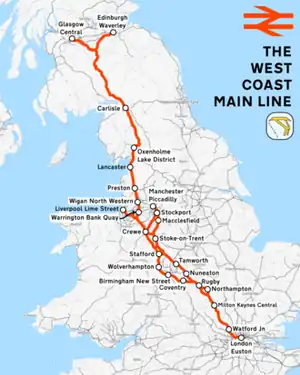
The West Coast Main Line (WCML) is a key strategic railway line in Great Britain. It links the cities of London, Birmingham, Liverpool, Manchester, Preston, Lancaster, Carlisle, Edinburgh and Glasgow. Virgin Trains took on the franchise to operate services on the routes in 1997 and, as part of the agreement, wanted an upgrade to the railway line to allow for faster more frequent trains to grow the business.[1] On 23 December 1994, the feasibility study was published.[2] The upgrade started in 1998 and was completed in 2009.[3] It came under parliamentary and media scrutiny because of cost and schedule overruns.[4] Further improvements such as the Norton Bridge railway flyover were completed after these dates.[5] The project is sometimes given the acronym WCRM (West Coast Route Modernisation).[6]
Previous modernisations
In the middle of the 20th century, the line was upgraded substantially as part of the 1955 Modernisation Plan.[7][8] Further electrification was discussed in 1968.[9]
The line north of Crewe was modernised by further electrification from Weaver Junction to Glasgow Central in the early 1970s.[10][11][12] Some innovative electrical engineering technology was used on the project, including lighter catenary and extensive use of headspans.[13] Substantial new signalling also took place in this timeframe.[14]
The Advanced Passenger Train concept was, in effect, a part of that upgrade. It relied on tilting trains to increase speed on the route, rather than making major civil engineering interventions.[15][16]
Post-privatisation modernisation
The late 20th and early 21st century modernisation was commenced by Railtrack and without public sector involvement; however, the Strategic Rail Authority was concerned about cost overruns. Railtrack asked the government for more money to complete the project, but the Labour Party's Secretary of State for Transport, Stephen Byers, put the company into liquidation instead. These problems with its cost and time overruns, along with other issues, are usually considered to be the causes of the liquidation of Railtrack.[17][18]
In 2002, Bechtel was invited to join the project.[19] The upgrade went substantially over budget;[4] regular updates were then conducted by several government departments.[20][21][22] The Strategic Rail Authority published a document in June 2003, which re-examined and clarified many of the assumptions to specify the direction and scope of the whole project.[23]
Technical aspects


The upgrade involved:[24]
- Major remodelling of Rugby railway station[25]
- Proof House Junction in Birmingham was remodelled
- 77 level crossings were either removed or modernised
- Over 800 points, switches and crossings were renewed, improved or removed
- Overhead line renewals
- Power supply upgrade to the autotransformer system
- 430 miles of track renewals[26]
- Over 2,000 signals were modified or renewed, with better lines of sight[27]
- Quadrupling the two track section in the Trent Valley, including the Tame viaduct.[28][29][30]


Benefits
The benefits of the project were claimed to be capacity improvements, journey time reductions of up to 28% in some cases, and improved safety.[25] Although Virgin Trains was a key driver for the project, the client was actually listed as the Department for Transport. The length of the project was just short of 11 years (110 months) and the final contract cost of approximately £9 billion.[31] The Campaign for Better Transport stated that the benefits are:[3]
- Road congestion reduction
- Carbon emissions reduction
- Economic
- Passenger benefits.
It is claimed that the upgrade was part of the reason that the BBC decided to move many of its operations from London to Salford.[3]: 4
Capacity enhancements
The Campaign for Better Transport stated that there are now 40% more long-distance services overall; there are 25% more between London and Scotland, 50% more between London and Birmingham, and 150% more between London and Manchester.[3]: 7
Safety
The removal and reduction of level crossings during the modernisation was one factor in improving the safety. A spokesperson for HM Railway Inspectorate said that "level crossings create the greatest potential for catastrophic risk on the railways."[32] Other crossings were also removed with subsequent reduction and modernisation of the overhead line; this also reduced maintenance costs.
Road congestion
Road congestion reduction has been harder to quantify, but modelling suggests 26,000 fewer car journeys on the M1 and M40 motorways as a direct result, with as many as seven million fewer car journeys between the cities of London and Manchester.[3]: 4
Carbon emissions
Between 2009 and 2017, on the London Euston to Manchester Piccadilly route alone, the modernisation resulted in a 77% increase in rail passengers, 23,000 tonnes of carbon saving and a 27% reduction in air passengers.[a] The number of flights between cities served by the WCML declined by 67% since 2004, at pre-COVID-19 pandemic levels.[3]: 12
Passenger benefits
In addition to journey time reductions, there was an increase in capacity so that a three trains per hour frequency of trains resulted between London Euston and Manchester Piccadilly, and London and Birmingham New Street.[24]
Future improvements
During modernisation, much of the signalling was renewed and concentrated in Rugby. However, money ran out and so the south end of the line still uses the Wembley Main Line Signalling Centre, which controls assets that fail frequently;[33] this point of failure will need to be addressed in the future. Other upgrades are continuing.[34]
Ongoing improvements
Carstairs has long being considered a bottleneck on the WCML and improvements including signalling, track renewal and other work finished in October 2022. Further work continued in 2023, including on the drains and embankments;[35] it also included substantial realignment of tracks and platforms to facilitate line speed increases[14] for which a 12-week closure was needed.[36][37][38]
More power-hungry trains and further electric freight means that, at many times, there is an overload of the power supply on the WCML. Parts of the route, including Preston to Carlisle, is sometimes called "congested infrastructure" due to power supply constraints; further upgrades will be planned to enhance these.[39]
Timeline
| Date | Event |
|---|---|
| 23 December 1994 | Feasibility study published. |
| 1998 | Agreement between Railtrack and Virgin Trains to upgrade the line. |
| October 2001 | Railtrack goes into liquidation.[40][41] |
| January 2002 | Secretary of State for Transport, Stephen Byers, asked the Strategic Rail Authority to intervene to get the project back on track. |
| May 2002 | Estimate of programme cost increases from £2.5 to £14.5 billion. |
| December 2005 | High-speed tilting trains introduced.[42] |
| October 2007 | First section of Trent Valley four-tracking scheme opened.[28] |
| December 2008 | Work mainly completed.[43] |
| 2014 | Works start on the Norton Bridge project. |
| April 2015 | Work to replace bridge at Watford, completed to enable line speed increase from 90 to 125 mph.[44] |
| March 2016 | First trains use the Norton Bridge rail flyover completed on budget and 18-months ahead of schedule.[45][46] |
| October 2022 | Major track renewal, signalling and simplification of track layout at Carstairs completed. |
| March 2023 | Further simplification of Carstairs and passing loop installed.[47] |
| 30 May 2023 | Carstairs station reopens, after a 12-week closure and blockade.[48] |
| July 2023 | Nine-day closure of the route in the Trent Valley-Colwich Junction area for upgrades, resignalling and new track.[49] |
See also
Notes
- ↑ The air passenger reduction was between Manchester and Heathrow, Gatwick, Stansted and London City Airports.
References
- ↑ "UK West Coast Route Modernisation Project". Sebokwiki.org. Archived from the original on 21 July 2021. Retrieved 21 July 2021.
- ↑ "West Coast Main Line Modernisation feasibility study" (PDF). Railwaysarchive.co.uk. 23 December 1994.
- 1 2 3 4 5 6 "Transformation of the West Coast Main Line" (PDF). Campaign for Better Transport. Archived (PDF) from the original on 4 July 2021. Retrieved 4 July 2021.
- 1 2 "The Modernisation of the West Coast Main Line". National Audit Office. 22 November 2006. Archived from the original on 21 July 2021. Retrieved 21 July 2021.
- ↑ "First trains use Norton Bridge rail flyover". A Little Bit of Stone. 29 March 2016. Archived from the original on 9 September 2019. Retrieved 30 July 2021.
- ↑ "West Coast Main Line". Railway Technology. Archived from the original on 27 August 2011. Retrieved 21 July 2021.
- ↑ Evans, Andrew W. (1969). "Inter-city Travel and the London Midland Electrification". Journal of Transport Economics and Policy. 3 (1): 69–95. ISSN 0022-5258. JSTOR 20052126.
- ↑ Nock, O.S. (1965). Britain's new railway: Electrification of the London-Midland main lines from Euston to Birmingham, Stoke-on-Trent, Crewe, Liverpool and Manchester. London: Ian Allan. OCLC 59003738.
- ↑ "Route Improvements Weaver Junction to Glasgow" (PDF). Railway Archives. April 1968.
- ↑ Sonagra, Radhika (18 July 2024). "50 years of electrifying the West Coast Main Line". Network Rail. Retrieved 7 August 2024.
- ↑ Nock, O.S. (1974). Electric Euston to Glasgow. Ian Allan. ISBN 978-0711005303.
- ↑ "Electric all the way" (PDF). Railways Archive. May 1974.
- ↑ "BR electrifies West Coast extension". Electronics and Power. 20 (11): 469. 1974. doi:10.1049/ep.1974.0354.
- 1 2 Shirres, David (2 May 2023). "Remodelling Carstairs Junction". Rail Engineer. Retrieved 11 August 2023.
- ↑ Jones, S. (1975). "The Advanced Passenger Train: An economic alternative to the construction of new track for High Speed". Rail International (7). Archived from the original on 29 July 2021. Retrieved 29 July 2021.
- ↑ "APT tilting train: The laughing stock that changed the world". BBC News. 18 December 2015. Archived from the original on 25 April 2017. Retrieved 28 July 2021.
- ↑ "Blood on the tracks". The Economist. 11 October 2001. ISSN 0013-0613. Archived from the original on 5 May 2021. Retrieved 28 July 2021.
- ↑ "Railtrack makes final departure from stock market". The Independent. 14 November 2013. Archived from the original on 29 July 2021. Retrieved 28 July 2021.
- ↑ "West Coast Main Line". Bechtel. Archived from the original on 21 July 2021. Retrieved 21 July 2021.
- ↑ "The Modernisation of the West Coast Main Line" (PDF). UK Parliament. 4 June 2007. Archived (PDF) from the original on 17 June 2021. Retrieved 21 July 2021.
- ↑ "West Coast Main Line progress report" (PDF). Strategic Rail Authority. April 2004.
- ↑ "West Coast Main Line progress report" (PDF). Department for Transport. May 2006.
- ↑ "West Coast Main Line Strategy" (PDF). Railways Archive. Archived (PDF) from the original on 2 December 2007. Retrieved 21 July 2021.
- 1 2 "West Coast Route Modernisation". Networkrailconsulting.com. Archived from the original on 16 January 2021. Retrieved 28 July 2021.
- 1 2 "Major improvements for Rugby station given approval". Network Rail Media Centre. Archived from the original on 21 July 2021. Retrieved 21 July 2021.
- ↑ Spoors, Richard; Martin, James (2005). "Modernising the UK's West Coast Main Line railway". Proceedings of the Institution of Civil Engineers. 158 (3): 112–119. doi:10.1680/cien.2005.158.3.112. ISSN 0965-089X.
- ↑ "Gantry Pole". Crown International. 25 August 2010. Archived from the original on 4 August 2021. Retrieved 4 August 2021.
- 1 2 "Making tracks in Trent Valley". Network Rail Media Centre. Archived from the original on 21 July 2021. Retrieved 21 July 2021.
- ↑ "Lichfield Trent Valley Four Tracking Project". Abacus. Archived from the original on 21 July 2021. Retrieved 21 July 2021.
- ↑ Baker, A.H.W.; Webb, D.; Fearnhead, R. (2007). "West Coast route modernisation: River Tame viaduct". Proceedings of the Institution of Civil Engineers - Bridge Engineering. 160 (4): 163–172. doi:10.1680/bren.2007.160.4.163. ISSN 1478-4637.
- ↑ "West Coast Route Modernisation" (PDF). Network Rail. Archived (PDF) from the original on 19 September 2020. Retrieved 29 July 2021.
- ↑ "Rail level crossings discouraged". BBC News. 7 November 2004. Archived from the original on 13 February 2009. Retrieved 11 November 2021.
- ↑ Abbott, James (March 2022). "Keeping the premier line up to scratch". Modern Railways. Vol. 79. Key Publishing. pp. 56–59.
- ↑ "West Coast Main Line upgrades to continue during August Bank Holiday". Rail Technology. Retrieved 11 August 2023.
- ↑ "Carstairs junction upgrade is key to modernising network". Network Rail Media Centre. Retrieved 31 October 2022.
- ↑ "Take a look at the new Carstairs Junction after 12-week remodelling project". Rail Technology. Retrieved 11 August 2023.
- ↑ "Carstairs Junction remodelling". Scotland's Railway. Retrieved 11 August 2023.
- ↑ "Carstairs Junction fully reopened". Network Rail Media Centre. Retrieved 11 August 2023.
- ↑ Shirres, David (10 July 2023). "The future of electrification". Rail Engineer. Retrieved 12 July 2023.
- ↑ "Blood on the tracks". The Economist. 11 October 2001. ISSN 0013-0613. Archived from the original on 5 May 2021. Retrieved 28 July 2021.
- ↑ "Railtrack investors annoyed but better off". CNN.com. Retrieved 28 July 2021.
- ↑ "High-speed tilting train on track". BBC News. 12 December 2005. Archived from the original on 30 July 2021. Retrieved 9 December 2021.
- ↑ "West Coast rail works completed". BBC News. 14 December 2008. Archived from the original on 16 August 2021. Retrieved 9 December 2021.
- ↑ "Orphanage Road bridge to be replaced as work to upgrade railway at Watford continues". Network Rail Media Centre. Archived from the original on 22 November 2021. Retrieved 22 November 2021.
- ↑ "Passengers benefiting from £250m railway upgrade between Stafford and Crewe". Network Rail Media Centre. Archived from the original on 30 July 2021. Retrieved 30 July 2021.
- ↑ "First trains use Norton Bridge rail flyover". A Little Bit of Stone. 29 March 2016. Archived from the original on 9 September 2019. Retrieved 9 December 2021.
- ↑ "£164m overhaul for key cross-border rail line". Network Rail Media Centre. Retrieved 21 February 2023.
- ↑ Johnson, Thomas (30 May 2023). "Carstairs station reopens ending three-month blockade of West Coast Main Line junction". New Civil Engineer. Retrieved 11 August 2023.
- ↑ "Railway upgrades to close Trent Valley line for nine days from Saturday". Network Rail Media Centre. Retrieved 12 July 2023.
Further reading
- Brentnall, E.G. (1966). "Paper 2: Signalling and Telecommunications Works on the Euston Main Line Electrification". Proceedings of the Institution of Mechanical Engineers, Conference Proceedings. 181 (36): 65–86. doi:10.1243/PIME_CONF_1966_181_108_02.
- Buck, Martin; Rawlinson, Mark (2000). Line By Line: The West Coast Main Line, London Euston to Glasgow Central. Swindon: Freightmaster Publishing. ISBN 0-9537540-0-6.
{{cite book}}: CS1 maint: publisher location (link) - Butland, A.N. (1966). "Paper 3: Civil Engineering Works of the Euston Main Line Electrification Scheme". Proceedings of the Institution of Mechanical Engineers, Conference Proceedings. 181 (36): 51–64. doi:10.1243/PIME_CONF_1966_181_107_02.
- Buxton, John; Heath, Donald (2025). Lines of power: the electrification of British Railways, trials, tribulations and successes. Lewes: Unicorn. ISBN 978-1-917458-10-8.
- Emerson, A.H. (1966). "Paper 4: Electrification of the London Midland Main Line from Euston". Proceedings of the Institution of Mechanical Engineers, Conference Proceedings. 181 (36): 17–50. doi:10.1243/PIME_CONF_1966_181_105_02.
- Duffy, Michael Ciaran (2003). Electric Railways, 1880-1990. History of Technology. Stevenage: IET. ISBN 978-0-85296-805-5.
- Keenor, Garry. Overhead Line Electrification for Railways - 6th edition.
- Nock, O.S. (1965). Britain's new railway: Electrification of the London-Midland main lines from Euston to Birmingham, Stoke-on-Trent, Crewe, Liverpool and Manchester. London: Ian Allan. OCLC 59003738.
- Nock, O.S. (1974). Electric Euston to Glasgow. Ian Allan. ISBN 978-0711005303.
- Wickens, Alan (Summer 1988). "APT - With Hindsight". Newsletter of the Friends of the National Railway Museum.
- Wolmar, Christian (2022). British Rail: A new history. [S.l.]: Michael Joseph. ISBN 978-0-241-45620-0. OCLC 1246353492.
- Wolmar, Christian (2005). On the Wrong Line: How Ideology and Incompetence Wrecked Britain's Railways (rev. ed.). London: Aurum Press. ISBN 1-85410-998-7.
- "Euston Main Line Electrification: A Technical Conference sponsored jointly by the British Railways Board and the Institutions of Civil, Mechanical, Electrical, Locomotive and Railway Signal Engineers". Conference Proceedings. 181 (6 (part 3F)). Institution of Mechanical Engineers (IMECH). 26 October 1966.
- "Network Rail: A Guide to Overhead Electrification Revision 10" (PDF). Network Rail. February 2015.
- "On board with electrification". Permanent Way Institution Journal. 139 (1). January 2021. ISSN 2057-2425 – via PWI.
External links

- Electric All The Way – A British Rail information booklet (1974) about the completion of electrification to Glasgow
- Rail Industry website, monitoring progress of the project.