Wellington Cenotaph
 Wellington Cenotaph | |
Interactive map of Wellington Cenotaph | |
| Location | Lambton Quay and Bowen Street, Wellington, New Zealand |
|---|---|
| Coordinates | 41°16′45″S 174°46′38″E / 41.279176°S 174.777103°E |
| Designer | Richard Gross |
| Completion date | 1931 |
| Opening date | Anzac Day (25 April) 1931 |
Official name | Wellington Cenotaph |
| Designated | 3 March 1982 |
| Reference no. | 215 |
The Wellington Cenotaph, also known as the Wellington Citizens' War Memorial, is a war memorial located on the intersection of Lambton Quay and Bowen Street in Wellington, New Zealand. It commemorates the war dead of the two world wars. The cenotaph is listed as a Category 1 Historic Place by Heritage New Zealand and it is the city's focus for the annual Anzac Day commemorations.
History
The Wellington Cenotaph was unveiled on Anzac Day (25 April) 1931 to commemorate the New Zealand dead of World War I. Before that a temporary cenotaph was used to commemorate Anzac Day until funds were raised for a permanent memorial and a decision made on the site.[1]
The cenotaph was designed by sculptor Richard Gross and Auckland architects Grierson, Aimer and Draffin.[1][2][3] Built of Carrara marble and Coromandel granite it features two wings decorated with relief sculptures and the central cenotaph is topped with a bronze figure on horseback.[1][3] Two bronze lions and a series of bronze friezes were later added in commemoration of World War II.[3]
The official dedication took place on 17 April 1932 by Bishop Sprott, the Anglican Bishop of Wellington.[1] The souvenir programme for the official dedication says the mounted figure was entitled 'The Will to Peace', and is described thus:
Pegasus spurning underfoot the victor's spoils of war and rising into the heavens, enabl[ing] his rider to emerge from the deluge of blood and tears, and to receive the great spiritual assurance of peace.[3]
On 18 March 1982, it was registered as a Category 1 Historic Place with registration number 215.[4]
On 2 September 2013, new plans for the cenotaph were presented including a new staircase and water feature up to the Parliament Buildings. The works also include repairs to the cenotaph surface materials and creation of a square to create a ceremonial space.[5][6]
As part of the redevelopment the Wellington Sculpture Trust commissioned Joe Sheehan to install Walk the Line, a line of 231 nephrite discs tracing the line of the Waipiro Stream.[7] The stream which is now in a culvert originally flowed down Bowen St across the cenotaph precinct to the foreshore.[7] Accompanying the installation is a recording of the sound of flowing water from speakers below the ground.[7] The water sounds were recorded on Te Ahumairangi Hill whose streams feed into Waipiro Stream.[7]
In 2015 the Wellington Anzac Day citizen's wreath-laying ceremony was held at the upgraded cenotaph.[8]
In 2025 the City Council began a three year programme of restoration work of the cenotaph.[1]
Image gallery
 Detail of the mounted figure, described above
 The cenotaph just before dawn on Anzac Day 2007
 Michael Joseph Savage's funeral procession next to the cenotaph in 1940
 Crowd surrounding the Cenotaph, Wellington, at the dedication ceremony in 1932
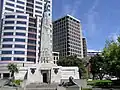 Full view of the Wellington Cenotaph (with Bowen House in the background)
 Walk the Line by Joe Sheehan
References
- 1 2 3 4 5 "Wellington cenotaph set for conservation work". Wellington City Council. 22 November 2024. Retrieved 29 August 2026.
- ↑ Gross, Richard Oliver. "Wellington Cenotaph". Dictionary of New Zealand Biography. Ministry for Culture and Heritage. Retrieved 8 March 2022.
- 1 2 3 4 "Wellington cenotaph". nzhistory.govt.nz. Ministry for Culture and Heritage. 17 April 2020. Retrieved 8 March 2022.
- ↑ "Cenotaph". New Zealand Heritage List/Rārangi Kōrero. Heritage New Zealand. Retrieved 18 March 2016.
- ↑ "Parliamentary precinct's big makeover". stuff.co.nz. Retrieved 11 September 2013.
- ↑ "Revamp for Cenotaph area on target". Stuff/Fairfax. 16 September 2014.
- 1 2 3 4 Elliott, Sue (29 January 2023). "Joe Sheehan walks the line with elegant simplicity". Stuff. Retrieved 30 January 2023.
- ↑ "Citizens ceremony at Wellington Cenotaph". Stuff/Fairfax. 25 April 2015.
External links
- Cenotaph (Wellington, N.Z.) – Te Puna Mātauranga o Aotearoa / The National Library of New Zealand
 Media related to Cenotaph, Wellington at Wikimedia Commons
Media related to Walk the Line at Wikimedia Commons
- World War I memorials in New Zealand
- Buildings and structures in Wellington City
- Heritage New Zealand Category 1 historic places in the Wellington Region
- Cenotaphs in New Zealand
- Tourist attractions in Wellington City
- 1930s architecture in New Zealand
- Outdoor sculptures in Wellington City
- Wellington Central, Wellington