Waverly Hills Sanatorium
| Waverly Hills Sanatorium | |
|---|---|
 Main entrance | |
| Geography | |
| Location | Kentucky, United States |
| Organization | |
| Type | Specialist |
| Services | |
| Specialty | Tuberculosis sanatorium |
| History | |
| Opened | 1910 |
| Closed | 1961 |
| Links | |
| Lists | Hospitals in Kentucky |
Waverly Hills Tuberculosis Sanatorium Historic Buildings | |
| Location | 4400 Paralee Dr., Louisville, Kentucky |
| Architect | James J. Gaffney, Dennis Xavier Murphy |
| MPS | Jefferson County MRA |
| NRHP reference No. | 83002746[1] |
| Added to NRHP | July 12, 1983 |
The Waverly Hills Sanatorium is a former sanatorium located in the Waverly Hills neighborhood of Louisville, Kentucky.
In the early 1900s, Jefferson County was ravaged by an outbreak of tuberculosis – known as the "White Plague" – which prompted the construction of a new hospital. The Sanatorium opened in 1910 as a two-story facility able to accommodate between 40 and 50 tuberculosis patients. The hospital closed in 1961, due to the success of antibiotic drug streptomycin in lowering the needs for such a facility. At some point, plans were made to turn the abandoned hospital into a hotel, but this is no longer the case.[2][3][4]
Currently, tours of the ex-hospital are conducted within the building. It is marketed as a haunted hospital.[5]
History
The land that is known today as "Waverly Hill" was purchased by Major Thomas H. Hays in 1883 as the Hays family home. Since the new home was far away from any existing schools, Mr. Hays decided to open a local school for his daughters to attend.[6] He started a one-room schoolhouse on Pages Lane and hired Lizzie Lee Harris as the teacher.[6] Due to Miss Harris' fondness for Walter Scott's Waverley novels, she named the schoolhouse Waverley School.[6] Major Hays liked the peaceful-sounding name, so he named his property Waverley Hill. The Board of Tuberculosis Hospital kept the name when they bought the land and opened the sanatorium.[6] It is not known exactly when the spelling changed to exclude the second "e" and became Waverly Hills. However, the spelling fluctuated between both spellings many times over the years.[7][8][9]
Original sanatorium
In the early 20th century, Louisville had one of the highest tuberculosis death rates in the United States, with the city's location in the Ohio Valley and limited airflow considering attributing factors. In an effort to contain the disease, a two-story wooden sanatorium was constructed with and administrative building and two open-air pavilions, each housing 20 patients.[10]
Artificial Pneumothorax, a procedure in which the lung is deliberately collapsed, allowing it to rest, was among one of the many treatments among patients at Waverly Hills.[11]
On August 31, 1912, all tuberculosis patients from the City Hospital were relocated to temporary quarters in tents on the grounds of Waverly Hills pending the completion of a hospital for advanced cases.[12][13] In December 1912, a hospital for advanced cases opened for the treatment of another 40 patients. In 1914, a children's pavilion added another 50 beds[14] making the known "capacity" around 130 patients.[15] The children's pavilion was not only for sick children but also for the children of tuberculosis patients who could not be cared for properly otherwise. This report also mentions that the goal was to add a new building each year to continually grow so there may have even been more beds available than specifically listed.[15]
Building of a durable facility and later closing of the sanatorium
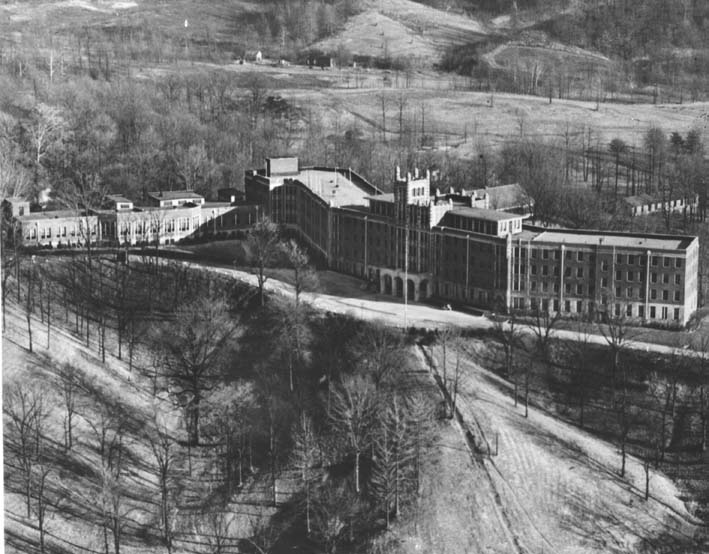
The Sanatorium's design reflected contemporary tuberculosis treatment practices that emphasized fresh air and a rural environment. Its extensive porches allowed patients to spend time outdoors during their treatments.[16]
Due to constant need for repairs on the wooden structures, need for a more durable structure, as well as need for more beds so that people would not be turned away due to lack of space,[17] construction of a five-story building that could hold more than 400 patients began in March 1924. The new building opened on October 17, 1926.[18]
In the summer of 1926, Esther Maxwell Barrens became the first Black nurse hired at Waverly Hills.[19]
Waverly Hills operated segregated facilities for black and white patients. Black patients were housed separately from patients in the main sanitorium.[20]
After effective treatments for tuberculosis became available the number of tuberculosis cases gradually declined.[21] The remaining patients were sent to Hazelwood Sanatorium in Louisville.[5] Waverly Hills closed in June 1961.
The new facility functioned as a largely self-contained community. Its grounds included laundry and water-treatment facilities, a slaughterhouse, vegetable gardens and a post office.[16]
A dormitory was constructed on the grounds to house nurses employed at the sanatorium.[22]
Woodhaven Medical Services
The building was reopened in 1962 as Woodhaven Geriatric Center, a nursing home primarily treating aging patients with various stages of dementia and mobility limits, as well as the severely mentally handicapped. However, Woodhaven failed greatly because it was severely understaffed and overcrowded. Woodhaven also had reports over patient neglect and was closed by the state of Kentucky in 1980.[23]
Prison
Simpsonville developer J. Clifford Todd bought the hospital in 1983 for $3,005,000. He and architect Milton Thompson wanted to convert it into a minimum-security prison for the state, but the developers dropped the plan after neighbors protested. Todd and Thompson then proposed converting the hospital into apartments, but they counted on Jefferson Fiscal Court to buy around 140 acres (57 ha) from them for $400,000, giving them the money to start the project.[24]
Statue
In March 1996, Robert Alberhasky bought Waverly Hills and the surrounding area. Alberhasky's Christ the Redeemer Foundation Inc. made plans to construct the world's tallest statue of Jesus on the site, along with an arts and worship center. The statue, which was inspired by the famed Christ the Redeemer statue on Corcovado Mountain in Rio de Janeiro, would have been designed by local sculptor Ed Hamilton and architect Jasper Ward.[25] The first phase of the development, coming in at a cost of $4 million, would have been a statue of 150 feet (46 m) tall and 150 feet (46 m) wide, situated on the roof of the sanatorium. The second phase would convert the old sanatorium into a chapel, theater, and a gift shop at a cost of $8 million or more.[26]
The plan to construct this religious icon fell through because donations to the project fell well short of expectations. In a period of a year, only $3,000 was raised towards the project despite efforts to pool money from across the nation. The project was canceled in December 1997.[26]
Restoration
After Alberhasky's efforts failed, Waverly Hills was sold to Tina and Charlie Mattingly in 2001. The Mattinglys hold tours of Waverly Hills and host a haunted house attraction each Halloween, with proceeds going toward restoration of the property. They are also currently restoring all the windows in the decrepit building while restoring the interior of the old sanatorium.[27][28]
Sounds of the Underground Music Festival
Waverly Hills Sanatorium hosted the last show of the touring music festival Sounds of the Underground on August 11, 2007.
The show featured prominent acts in the extreme metal and metalcore scene, including Job for a Cowboy, The Acacia Strain Hatebreed, Shadows Fall, Chimaira, Gwar, Cameo, Lamb of God, and The Number Twelve Looks Like You.[29]
Similar festivals or concerts will likely not happen again at the Waverly Hills Sanatorium, due to complaints made by local residents.[30]
Tunnel
The sanatorium featured a 500-foot tunnel built to carry steam and supplies between the heating plant located at the bottom of the hill and the main sanatorium building. [31]The tunnel was equipped with a cable car used to transport items up and down the passageway. According to a number of stories and anecdotes, during a limited time between the 1920s and 1940s the tunnel also served to transport corpses to a waiting ambulance at the bottom of the hill, sparing patients the knowledge that someone had died.[32]
In popular culture
- Waverly Hills has been popularized on the television show Ghost Hunters as being one of the "most haunted" hospitals in the eastern United States.[33]
- Ryan Bergara and Shane Madej from the web-series Buzzfeed Unsolved visited the location in season 2 for one of their supernatural episodes.[34]
- They later revisited it for the series premiere of Ghost Files, a similar series hosted on their independent Watcher channel.[35]
- The video game Project Zomboid, set in Kentucky, features a fictionalized version of the Waverly Hills Sanatorium, called the "Sunderland Hills Sanatorium".[36]
- The 2006 American horror film Death Tunnel was filmed at Waverly Hills.[37] The film was also dedicated, "to all the Lost Souls of Waverly Hills Sanatorium. May You Find Your Way Home!"[38]
See also
References
- ↑ "National Register Information System". National Register of Historic Places. National Park Service. January 23, 2007.
- ↑ Davis, Alex. "Spooky Waverly Hills may return as hotel", The Courier-Journal, August 7, 2008.
- ↑ Renovations hopeful for haunted hotel Archived January 13, 2009, at the Wayback Machine, Fox41.com
- ↑ "Waverly Hills is preparing to open for Halloween tours, but its owners still have bigger plans". Louisville Business First. Archived from the original on December 13, 2019. Retrieved December 1, 2015.
- 1 2 "About Us". Waverly Hills Sanatorium. Archived from the original on October 28, 2025. Retrieved November 30, 2025.
- 1 2 3 4 Detert, Fred. "How Waverly Hills Got Its Name" Archived April 27, 2024, at the Wayback Machine, Waverly Herald, circa 1953.
- ↑ Postcard (with 2nd E), located in display case in the laundry building at Waverly
- ↑ Postcard Archived June 19, 2008, at the Wayback Machine (without 2nd E)
- ↑ Endowment booklet (with 2nd E)
- ↑ "Waverly Hills Sanatorium". Kentucky Historic Institutions. June 14, 2017. Archived from the original on July 18, 2025. Retrieved August 21, 2026.
- ↑ Adams, Annmarie; Schwartzman, Kevin (November 1, 2005). "Pneumothorax Then and Now". Space and Culture. 8 (4): 435–448. doi:10.1177/1206331205280158. ISSN 1206-3312.
- ↑ Report of Board of Tuberculosis Hospitals (1915) Archived April 27, 2024, at the Wayback Machine. Freepages.history.rootsweb.com. Retrieved on November 27, 2011.
- ↑ "History of Waverly Hills", The Waverly Herald, pp. 3–4
- ↑ "History of Waverly Hills" Archived April 27, 2024, at the Wayback Machine, The Waverly Herald
- 1 2 Wilson, Dunning S.; Dittmar, L. J. Report of the Board of Tuberculosis Hospital Archived January 30, 2024, at the Wayback Machine, Dr. Dunning S Wilson was Medical Director of Waverly Hills. L. J. Dittmar was President of the Board of Tuberculosis Hospital.
- 1 2 "Independent Spirits, a Brief History of Waverly Hills Sanatorium, Composer Rachel Grimes's Film "Along the Way Forth," and More". Frazier Kentucky History Museum. Archived from the original on August 19, 2026. Retrieved August 25, 2026.
- ↑ "Sanatorium Has Waiting List for Treatment, Effective In Early Stages", The Louisville Times, December 5, 1928.
- ↑ "Independent Spirits, a Brief History of Waverly Hills Sanatorium, Composer Rachel Grimes's Film "Along the Way Forth," and More". Frazier Kentucky History Museum. Retrieved August 30, 2026.
- ↑ Pohl, Lynn (2022). Waverly Hills Sanatorium: A History. Arcadia Publishing. ISBN 978-1-4671-4999-0.
- ↑ Rhoden, Giselle (March 2, 2026). "Meet one of the few living patients from Waverly Hills Sanatorium's segregated ward". Louisville Public Media. Archived from the original on August 19, 2026. Retrieved August 25, 2026.
- ↑ "Achievements in Public Health, 1900–1999: Control of Infectious Diseases". Centers for Disease Control and Prevention. July 30, 1999. Archived from the original on July 25, 2026. Retrieved August 25, 2026.
- ↑ Bartlett, Beverly. "Waverly: Tuberculosis Hospital Was Heart of an Isolated Community, Inspiring Loyalty in Patients, Staff" (PDF).
{{cite web}}: CS1 maint: url-status (link) - ↑ Bartlett, Beverly (November 23, 1989). "Waverly Hills (Part 2)". The Courier-Journal. p. 60. Archived from the original on June 2, 2024. Retrieved June 1, 2024 – via newspapers.com.
- ↑ "Famed hospital now a white elephant", The Courier-Journal, August 13–14, 1986, p.1.
- ↑ "World tallest Christ statue planned for Waverly Hills", The Courier-Journal [Louisville], March 1996: 1.
- 1 2 "Jesus statue 'would take a miracle'." Kentucky Post December 12, 1997: 1.
- ↑ Seewer, John. "Haunted houses mix big-budget scenes and settings for ghoulish getaways", The Canadian Press, October 2, 2009.
- ↑ "Waverly Hills Sanatorium Haunted House", The Courier-Journal, October 3, 2009.
- ↑ "Aug 11, 2007: Sounds Of The Underground at Waverly Hills Louisville, Kentucky, United States | Concert Archives". www.concertarchives.org. Retrieved August 30, 2026.
- ↑ "PLEASURE RIDGE PARK: Waverly Hills rock concert was its last: Neighbors outraged by noise, vulgarities", The Courier-Journal, August 22, 2007.
- ↑ Pohl, Lynn (2022). Waverly Hills Sanatorium: A History. Arcadia Publishing. ISBN 978-1-4671-4999-0.
- ↑ Pohl, Lynn (2022). Waverly Hills Sanatorium: A History. Arcadia Publishing. p. 135. ISBN 9781467149990. Archived from the original on June 2, 2024. Retrieved June 2, 2024.
- ↑ Hussain, Tania (May 27, 2020). "'Ghost Hunters': Kristen Luman Previews Team's 'Return to Waverly Hills' Sanatorium With Haunting Season Finale (Exclusive)". Popculture.com. Archived from the original on October 21, 2022. Retrieved October 21, 2022.
- ↑ Taylor, Ryan Bergara, Kari Koeppel, Shane Madej, Micki (April 28, 2017). "We Investigated An Abandoned Hospital And It Was Horrifying". BuzzFeed. Retrieved August 30, 2026.
{{cite web}}: CS1 maint: multiple names: authors list (link) - ↑ Lovitt, Maggie (September 21, 2022). "'Ghost Files': Ryan Bergara & Shane Madej Unpack Their Return to Paranormal Investigation". Collider. Archived from the original on October 21, 2022. Retrieved October 21, 2022.
- ↑ "Hallodoid" Archived April 8, 2025, at the Wayback Machine. Project Zomboid. October 31, 2024. Retrieved April 9, 2025.
- ↑ IMDb. Death Tunnel – Trivia. IMDb. Retrieved December 11, 2025, from https://www.imdb.com/title/tt0418627/trivia/?ref_=tt_dyk_trv Archived January 6, 2026, at the Wayback Machine
- ↑ IMDb. Death Tunnel – Crazy credits. IMDb. Retrieved December 11, 2025, from https://www.imdb.com/title/tt0418627/crazycredits/?tab=cz&ref_=tt_dyk_cc Archived January 6, 2026, at the Wayback Machine


External links

- Waverly Hills Sanatorium
- Waverly Hills Sanatorium at Abandoned
- Waverly Hills Sanatorium/Woodhaven Geriatric Center Memorial & Historical Resource
- Vintage aerial photo
- Waverly Hills Sanatorium on Kentucky Life, Kentucky Educational Television
- Inside The Haunted Halls Of Waverly Hills Sanatorium – Travel Channel
- 1910 establishments in Kentucky
- 1961 disestablishments in Kentucky
- 1962 establishments in Kentucky
- 1982 disestablishments in Kentucky
- Defunct hospitals in Louisville, Kentucky
- Hospital buildings completed in 1910
- Hospital buildings on the National Register of Historic Places in Kentucky
- Hospitals disestablished in 1961
- Hospitals established in 1910
- National Register of Historic Places in Louisville, Kentucky
- Reportedly haunted locations in Kentucky
- Tuberculosis sanatoria in the United States
- Unused buildings in Kentucky