Wall of Tears (Galápagos Islands)
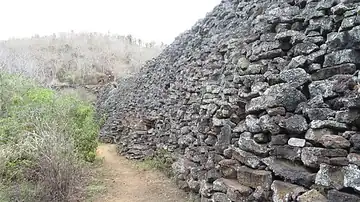
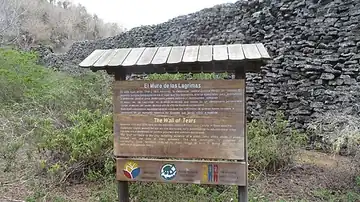
The Wall of Tears (Spanish: El Muro de las Lágrimas) is a historical site 5 km west of Puerto Villamil on Isabela Island in the Galapagos Islands, Ecuador. It is one of the few remaining vestiges of the penal colony that existed on Isabela Island between 1946 and 1959. Since then, it has become a local landmark and sightseeing destination for tourists.
History
In 1893, prior to the establishment of the modern penal colony, the entrepreneur Antonio Gil founded the settlement of Puerto Villamil, named for José de Villamil, where prisoners were often employed mining coral and burning it to produce lime.[1]
After World War II, during which time parts of the Galápagos Islands served as an American military base, President José María Velasco Ibarra ordered the founding of what was to be the largest penal colony in the archipelago.[2] Among their labors, prisoners in the penal colony were forced to carry large chunks of basalt to build the wall, "to subdue the criminal instincts of the prisoners as well as their depraved passions."[3] The colony was active from 1946 until a revolt by prisoners followed by a mass escape attempt involving the hijacking of an American yacht led to the colony's closure in 1959.[2]
Despite popular legends, the penal colony was home to prisoners convicted of relatively minor crimes; the total population of Isabela and Floreana Islands in the year 1950 was approximately 250, of which about 100 were convicts.[2] The penal colony was razed and abandoned after its closure; as of 1997, the only visible ruins were a heavily rusted iron cylinder and the Wall of Tears itself.[4]
Features
In its dimensions, the wall measures approximately 50 meters long, 5 meters wide, and 8 meters tall.[4][a]
The wall is located approximately 5 kilometers from Puerto Villamil via foot trail.[6] Approximately halfway along the trail is the island's Tortoise Breeding Center.[5] The penal colony was built in the foot of a hill and the trail runs up the hill to afford tourists a scenic view beyond the wall to the Bay of Villamil beyond.[4][5]
In popular culture
The Wall of Tears is mentioned in Jodi Picoult's 2021 novel Wish You Were Here, as it is visited by the protagonist during a trip to the Galápagos Islands.[7]
References
Notes
Citations
- 1 2 Bassett, Carol Ann (2009). Galapagos at the Crossroads: Pirates, Biologists, Tourists, and Creationists Battle for Darwin's Cradle of Evolution. Washington, DC: National Geographic Society. p. 40. ISBN 978-1-4262-0402-9.
- 1 2 3 Erazo, Paúl Mena (18 November 2013). "La isla de Galápagos que alguna vez fue cárcel". BBC Mundo (in Spanish). Retrieved 15 February 2014.
- 1 2 D'Orso, Michael (2002). Plundering Paradise: The Hand of Man on the Galápagos Islands. New York: HarperCollins. p. 146. ISBN 0-06-019390-5.
- 1 2 3 Constant, Pierre (1997). The Galapagos Islands. Hong Kong: The Guidebook Company Ltd. p. 249. ISBN 0-8442-4755-3.
- 1 2 3 Westwood, Ben (2012). Galápagos Islands. Berkeley, CA: Moon Handbooks. p. 77. ISBN 978-1-59880-975-6. ISSN 2169-8201.
- ↑ "Wall of Tears". Galapagos a la Carte. 2026. Retrieved 26 May 2026.
- ↑ Picoult, Jodi (2021). Wish You Were Here. New York: Ballantine Books. p. 173. ISBN 978-1-984818-42-3.