Vanishing spray

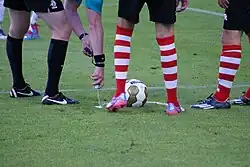


Vanishing spray, also known as vanishing foam, is a substance applied to an association football pitch in order to provide a temporary visual marker. It is most often used by the referee to indicate the minimum distance that the defending team may position themselves from the ball during a direct free kick, as well as to indicate the spot from where the kick is taken. The spray appears similar to white paint or watered-down shaving foam when initially applied, and completely disappears within about a minute, leaving no visible residue behind.
Used mainly at the highest levels of competition, vanishing spray is said to help prevent unnecessary delays by preventing the defensive team from encroaching closer than the mandated 10 yards (9.15 meters) from the ball during a free kick, and also by preventing the attacking team from illegally moving the ball from the spot where the referee awarded the kick. Its use in football is not regulated by the Laws of the Game, with authorisation being in the hands of the governing body of a match, league, or tournament.
The spray was developed in Brazil in 2000 by inventor Heine Allemagne under the commercial name "Spuni," and was independently commercialized in Argentina as "9-15." After being approved by FIFA and the International Football Association Board in 2012, it made its first appearance at a senior FIFA World Cup in 2014 and has since been adopted by top domestic leagues and international competitions worldwide. Its invention and commercial rights became the subject of a long-running dispute between Allemagne and FIFA, culminating in a 2021 Brazilian court ruling that found FIFA had negotiated in bad faith over the patent.
Overview
Vanishing spray is applied from an aerosol can carried by the referee in a holster secured to their shorts. The referee has full discretion on whether or not to use vanishing spray, and opponents are required to retreat 10 yards from the spot of a free kick regardless of whether vanishing spray is used (unless the team awarded the kick elects to take a "quick" free kick with opponents still within 10 yards). It is generally only used when a free kick is awarded where a goal-scoring attempt is highly likely to develop (e.g. it is usually not used when a team is awarded a free kick in its own half of the pitch). When the referee chooses to use vanishing spray, they will usually mark the spot of the ball, then pace 10 yards in the direction of the attack, then spray a line marking that distance. Finally, the referee will indicate for the free kick to be taken, usually by blowing the whistle. The marks disappear after about one minute, though some accounts suggest full disappearance can take up to two minutes depending on field and weather conditions.[1]
Technical details
The can contains water (~80%), butane gas (~17%), surfactant (~1%), and other ingredients including vegetable oil (~2%).[2] The liquefied butane expands when the product is ejected from the can. The butane evaporates instantly, forming bubbles of gas in the water/surfactant mixture. The surfactant(s) cause the bubbles to have stability and hence a gas-in-liquid colloid (foam) forms. The bubbles eventually collapse and the foam disappears, leaving only water and surfactant residue on the ground. The foam has also been described as a biodegradable, volatile substance that is harmless to both players and turf.[3] More technical details can be found in the US patent applications for two of the commercial products available: Spuni (2001) and 9-15 (2010).
History

Origins
In 2000, Brazilian inventor Heine Allemagne developed the spray under the name "Spuni" (from espuma, the Portuguese word for foam). According to Allemagne, the idea came to him while watching a broadcast in which a commentator raised the recurring problem of defensive walls encroaching on free kicks, which reminded him of shaving foam and prompted him to test the substance as a temporary field marking.[4] The spray was first tested on an experimental basis by the Federação Mineira de Futebol during the 2000 Taça BH de Juniores, a lower-division youth tournament, before the Brazilian Football Confederation (CBF) authorized its use, initially requiring referees to file reports on its performance, in the 2001 Brazilian Championship, Copa João Havelange.[3][5] In 2002, a circular signed by Armando Marques, then president of the CBF's referees' committee, made the spray's use mandatory in all matches organized by the confederation.[3] Referees unanimously approved its use and the spray was since adopted in Brazilian competitions. An international patent application for "Spuni" was filed by its inventor on March 31, 2000, and the patent was granted on October 29, 2002, eventually being recognized in 44 countries.[6][7]
International adoption
The spray was independently commercialized in Argentina under the name "9-15" by entrepreneur Pablo Silva, who first claimed authorship of the concept in 2009; commercial production of the Argentine version began in 2008.[8] Allemagne and Silva subsequently agreed to jointly promote the product, on the reasoning that a project backed by both the CBF and the Argentine Football Association (AFA) would carry more weight with FIFA.[3] The Argentine Football Association tested the spray for the first time in a Primera B Nacional match between Los Andes and Chacarita during the 2008–09 season, before it was adopted in Argentina's top flight roughly six months later and, shortly after, in Mexico's top division.[1] It was then used in continental club competitions, the Copa Sudamericana and Copa Libertadores, before the 2011 Copa América became the first tournament for national teams to use the spray.[9] Its success caused it to be adopted by several national leagues in 2011 in America, including Major League Soccer.[9] It has also been used in the 2013 FIFA U-20 World Cup in Turkey, the 2014 UEFA European Under-17 Championship in Malta and Gozo, and the 2014 FIFA World Cup in Brazil.
FIFA formally approved the equipment in 2012, following a report submitted by the South American Football Confederation (CONMEBOL) that led the International Football Association Board (IFAB) to unanimously approve its use on football pitches worldwide at a general meeting in Surrey, England.[4][10]
Patent dispute
In 2018, Allemagne publicly alleged that FIFA had not paid him for the spray, instead continuing to produce and use the spray without paying royalties. In December 2017, a Brazilian court acknowledged Allemagne's patent and ordered FIFA to stop using the spray in its competitions; FIFA refused to comply, arguing that Brazilian courts had no jurisdiction over the organization.[11] In October 2021, the Court of Justice of the State of Rio de Janeiro ruled against FIFA, ordering the organization to compensate Allemagne after finding that it had negotiated in bad faith over the purchase of the patent, having repeatedly used the product free of charge while its inventor had made himself available to transfer the underlying technology.[12]
Modern use

The first World Cup match to feature the vanishing spray was the opening game of the 2014 FIFA World Cup between Brazil and Croatia on 12 June, used by referee Yuichi Nishimura.[13][14] The spray is now authorised for use in top flight football for the Bundesliga in Germany[15] (though Germany's consumer protection agency, TÜV, initially banned it due to environmental concerns),[16] Serie A in Italy, Ligue 1 in France, La Liga in Spain, the Premier League in England,[17] Major League Soccer in the United States of America and Canada, the Iran Pro League, the Czech First League, the Hong Kong Premier League, the A-League in Australia,[18] the Thai Premier League, the Primeira Liga in Portugal,[19] the Ekstraklasa in Poland,[20] the Danish Superliga,[21] the Indian Super League,[22] the J-League in Japan,[23] and the V.League 1 in Vietnam.[24]
References
- 1 2 "El spray marcará distancias". Marca (in Spanish). 2 July 2011.
- ↑ "The story behind football's magic foam". Outlook. BBC World Service. 28 July 2014.
- 1 2 3 4 "Spuni x Fifa: conheça a história do brasileiro que briga para ser reconhecido como inventor do spray do futebol". ge (in Brazilian Portuguese). 7 July 2020. Retrieved 24 October 2023.
- 1 2 "Após 12 anos, spray inventado por mineiro é aprovado pela FIFA". globoesporte.com (in Portuguese). 28 March 2012. Retrieved 24 October 2023.
- ↑ Rossi, André (9 May 2003). "Brasileiro quer levar spray revolucionário para o mundo" [A Brazilian wants to bring the revolutionary spray to the world]. Terra (in Brazilian Portuguese). São Paulo. Archived from the original on 15 July 2014.
- ↑ Brazil Published 0002743-A, Dias Heine Allemagne Vilarinho, "BR-0002743-A: Foaming aqueous composition, use thereof and process for temporary demarcation of regulation distances in sports.", published 29 October 2002
- ↑ "Patente del aerosol evanescente - CHEMIKER DO BRASIL PRODUTOS AU (BR); DIAS HEINE ALLEMAGNE VILARINHO (BR)". Latipat - Espacenet (in Spanish).
- ↑ ""El aerosol me cambió la vida"" [The spray changed my life]. La Nueva España (in Spanish). 3 December 2013.
- 1 2 Torres, Cesar R. (7 August 2011). "Vanishing Spray and the Future of Technology". The New York Times. Retrieved 18 August 2014.
- ↑ "El aerosol, un invento argentino que finalmente se usará en todo el mundo". Clarín (in Spanish). 20 April 2012. Retrieved 21 April 2012.
- ↑ Utton, Dominic (28 June 2018). "World Cup bosses kicked me in the teeth". The Daily Express. Retrieved 22 July 2018.
- ↑ "TJ-RJ condena Fifa a indenizar inventor do spray de barreira". Consultor Jurídico (in Brazilian Portuguese). 28 October 2021. Retrieved 24 October 2023.
- ↑ Smith, Ben (12 June 2014). "World Cup: Brazil 3 Croatia 1". BBC Sport. Sao Paulo. Retrieved 13 June 2014.
- ↑ "Vanishing spray used for first time at tournament". BBC Sport. 12 June 2014. Retrieved 13 June 2014.
- ↑ "DFL approves vanishing spray". Bundesliga. Düsseldorf. 11 August 2014. Archived from the original on 11 August 2014.
- ↑ "Football League Decides To Jump On Board The Vanishing Spray Bandwagon". World Soccer Talk. 5 November 2014. Retrieved 14 November 2014.
- ↑ Meagher, Gerard (30 July 2014). "Premier League referees will use vanishing spray in new season". The Guardian. Retrieved 18 August 2014.
- ↑ Migliaccio, Val. "The A-League set to use vanishing spray after popularity during World Cup and Barclays Premier League". Fox Sports (Australia). The Advertiser. Archived from the original on 19 August 2014. Retrieved 18 August 2014.
- ↑ "Garrafas de Spray nas competições profissionais" [Spray cans in professional competitions] (in Portuguese). Liga Portugal. Archived from the original on 4 December 2014. Retrieved 27 November 2014.
- ↑ "Premier League jak Ekstraklasa" [Premier League like Ekstraklasa] (in Polish). Ekstraklasa. Archived from the original on 26 February 2017. Retrieved 25 February 2017.
- ↑ Davidsen, Martin (20 February 2015). "Superligaen indfører nyt redskab" [The Superliga introduces a new tool]. Ekstra Bladet (in Danish). Tipsbladet.
- ↑ Chakrabarty, Shamik (11 August 2014). "At CFL, vanishing spray appears in Indian football for very first time". The Indian Express.
- ↑ Orlowitz, Dan (24 February 2015). "J-League introduces vanishing spray for 2015 Season". FootballChannel.Asia. Archived from the original on 20 May 2015.
- ↑ Tùng, Lê (2 March 2016). "Trọng tài V.League được trang bị bình xịt tự hủy" [The V.League referee is equipped with a self-destructing spray]. Zing News (in Vietnamese).