Definition
If X is a random variable, the moments sn and cumulants (same as the Ursell functions) un are functions of X related by the exponential formula:

(where
is the expectation).
The Ursell functions for multivariate random variables are defined analogously to the above, and in the same way as multivariate cumulants.[1]

The Ursell functions of a single random variable X are obtained from these by setting X = X1 = ⋯ = Xn.
The first few are given by
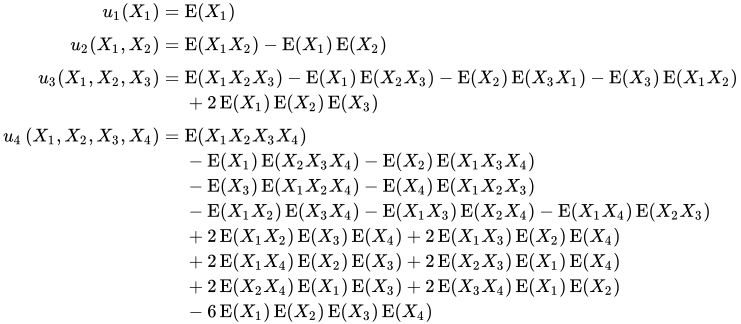
![{\displaystyle {\begin{aligned}u_{1}(X_{1})={}&\operatorname {E} (X_{1})\\[1ex]u_{2}(X_{1},X_{2})={}&\operatorname {E} (X_{1}X_{2})-\operatorname {E} (X_{1})\operatorname {E} (X_{2})\\[1ex]u_{3}(X_{1},X_{2},X_{3})={}&\operatorname {E} (X_{1}X_{2}X_{3})-\operatorname {E} (X_{1})\operatorname {E} (X_{2}X_{3})-\operatorname {E} (X_{2})\operatorname {E} (X_{3}X_{1})-\operatorname {E} (X_{3})\operatorname {E} (X_{1}X_{2})\\&+2\operatorname {E} (X_{1})\operatorname {E} (X_{2})\operatorname {E} (X_{3})\\[1ex]u_{4}\left(X_{1},X_{2},X_{3},X_{4}\right)={}&\operatorname {E} (X_{1}X_{2}X_{3}X_{4})\\&-\operatorname {E} (X_{1})\operatorname {E} (X_{2}X_{3}X_{4})-\operatorname {E} (X_{2})\operatorname {E} (X_{1}X_{3}X_{4})\\&-\operatorname {E} (X_{3})\operatorname {E} (X_{1}X_{2}X_{4})-\operatorname {E} (X_{4})\operatorname {E} (X_{1}X_{2}X_{3})\\&-\operatorname {E} (X_{1}X_{2})\operatorname {E} (X_{3}X_{4})-\operatorname {E} (X_{1}X_{3})\operatorname {E} (X_{2}X_{4})-\operatorname {E} (X_{1}X_{4})\operatorname {E} (X_{2}X_{3})\\&+2\operatorname {E} (X_{1}X_{2})\operatorname {E} (X_{3})\operatorname {E} (X_{4})+2\operatorname {E} (X_{1}X_{3})\operatorname {E} (X_{2})\operatorname {E} (X_{4})\\&+2\operatorname {E} (X_{1}X_{4})\operatorname {E} (X_{2})\operatorname {E} (X_{3})+2\operatorname {E} (X_{2}X_{3})\operatorname {E} (X_{1})\operatorname {E} (X_{4})\\&+2\operatorname {E} (X_{2}X_{4})\operatorname {E} (X_{1})\operatorname {E} (X_{3})+2\operatorname {E} (X_{3}X_{4})\operatorname {E} (X_{1})\operatorname {E} (X_{2})\\&-6\operatorname {E} (X_{1})\operatorname {E} (X_{2})\operatorname {E} (X_{3})\operatorname {E} (X_{4})\end{aligned}}}](./_assets_/eb734a37dd21ce173a46342d1cc64c92/8cebe4a3c250c2bd2d80bffd061ea3fc74b821c9.svg)
Characterization
Percus (1975) showed that the Ursell functions, considered as multilinear functions of several random variables, are uniquely determined up to a constant by the fact that they vanish whenever the variables Xi can be divided into two nonempty independent sets.
References
- Glimm, James; Jaffe, Arthur (1987), Quantum physics (2nd ed.), Berlin, New York: Springer-Verlag, ISBN 978-0-387-96476-8, MR 0887102
- Percus, J. K. (1975), "Correlation inequalities for Ising spin lattices" (PDF), Comm. Math. Phys., 40 (3): 283–308, Bibcode:1975CMaPh..40..283P, doi:10.1007/bf01610004, MR 0378683, S2CID 120940116
- Ursell, H. D. (1927), "The evaluation of Gibbs phase-integral for imperfect gases", Proc. Cambridge Philos. Soc., 23 (6): 685–697, Bibcode:1927PCPS...23..685U, doi:10.1017/S0305004100011191, S2CID 123023251