Unity Theatre, London
 Aerial view of Unity Theatre in 1974, with alley entrance at bottom right | |
Interactive map of Unity Theatre | |
| Address | 1 Goldington Street London UK |
|---|---|
Current use | Redeveloped for housing |
| Construction | |
| Closed | 1975 |
Years active | 1936–1975 |
Unity Theatre was a theatre club in London from 1936 to 1994.
Initially based in St. Judes Hall, Britannia Street, in Somers Town, in 1937 it moved to a former chapel in Goldington Street in the same area. After the theatre was destroyed by fire in 1975, productions continued sporadically in other venues till 1994. The original site was sold for social housing, becoming Unity Mews: a plaque commemorates the theatre.[1]
Unity Theatre had links to the Left Book Club Theatre Guild and the Communist Party.[2]: 32 During its lifetime, the theatre hosted over 250 productions, most of which were new plays.[3]: 17
History
Origin

The theatre grew from the Workers' Theatre Movement, formed in the East End of London.[4] This was an attempt to bring contemporary social and political issues to a working class audience; it introduced plays by, about and for workers. The company used agitprop theatre techniques to highlight the suffering of unemployment and hunger marches in the Great Depression and to challenge the rise of Nazism in Germany and Oswald Mosley's British Union of Fascists. They sought to show the republican struggle in Spain.[5]
First decade
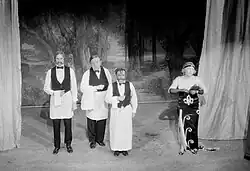
The company pioneered new dramatic forms, such as documentary pieces known as "Living Newspapers"[3]: 141 and satirical pantomimes. The latter included a political version of the traditional Babes in the Wood lampooning Neville Chamberlain's appeasement policy during the 1938 Munich Crisis. Its cast featured Bill Owen, Mark Cheney, Vida Hope, Alfie Bass, and Una Brandon-Jones.[3]: 165–176 Ann Davies portrayed the Popular Front in the guise of Robin Hood (the principal boy), appearing at the end in Soviet dress to declare:[6]: 130
When strife disturbs and wars corrupt our age
Keen satire is the business of the stage.
When the curtain falls upon our pantomime tonight
Join with the workers in the social fight.
The programme included lyrics for some of the production's songs.[7]: 9 Babes in the Wood ran for seven months, and Montagu Slater credited the play with making real political change.[8] The theatre's production of Ben Bengal's Plant In The Sun (1938), with Paul Robeson and Alfie Bass in leading roles, won accolades from theatre critics and several drama awards.[3]: 156–158
When Britain declared war on Germany in September 1939 at the outbreak of World War II, all theatres immediately closed. Unity Theatre re-opened two weeks later (the first to do so), remaining active throughout the conflict. Unity's Mobile Group presented productions – in whole or part – in factories, hospitals, parks, and air-raid shelters in adapted underground Tube stations.[6]: 131 During the war, Ann Davies became the theatre's first woman president.[8]
According to the chief theatre critic of The Sunday Times, writing in 1990,[9]
The best work of the Unity Theater was done in the 1930s and during World War II. At a time of great poverty and ideological confusion, it provided a political and artistic outlet for people who were getting tired of being patronized and who were increasingly suspicious of their politicians.
In addition, there was an associated Unity Theatre School. Unity was a volunteer theatre, neither fully amateur, nor professional (apart from a short-lived professional company founded in 1946 by Ted Willis) and loosely linked to a national network. By the outbreak of World War II, there were more than 250 branches throughout the country.
Postwar
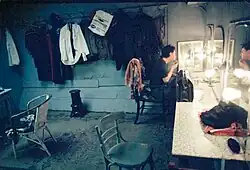
After the war, the satirical and documentary approaches taken in Unity Theatre productions became mainstream both in professional theatres in London and popular television programmes. According to Chambers (1989), "Unity turned inwards and failed either to find a new role or to renew with sufficient vigour its traditional one."[3]: 349–350 The London theatre closed after a fire in 1975.[3]: 395–397 In the view of Peter (1990), "[Unity Theatre] finally expired ... because it represented a spirit of old-fashioned opposition and could not find its place in a more strident and increasingly prosperous age."[9]
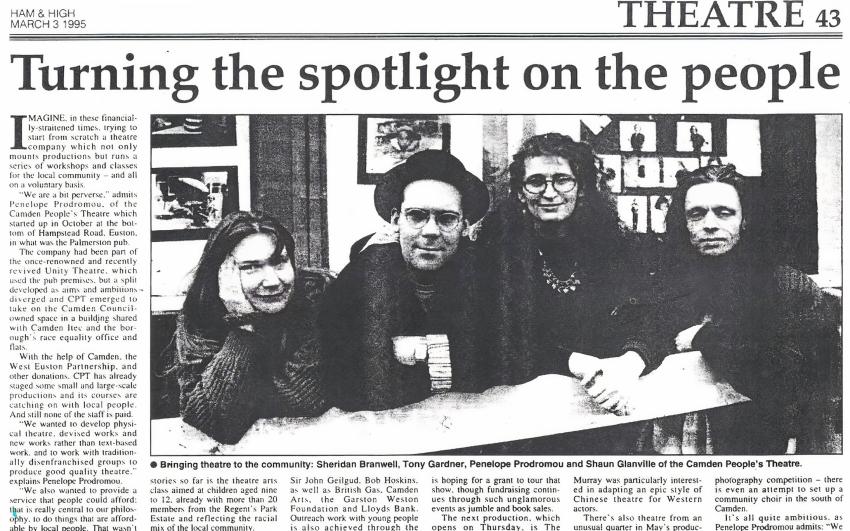
Attempts were made to revive the theatre in the late 1980s and early 1990s with a studio theatre in the space now occupied by Camden People's Theatre.[10] The Merseyside Left Theatre, which became an affiliate of Unity Theatre in 1939, has, since 1944, operated first as Merseyside Unity Theatre and then as Unity Theatre Liverpool.[11] Unity Theatre Cardiff, formed in 1942, left the Unity Theatre movement in 1948 and was renamed Everyman Theatre Cardiff.[12]
The Unity Theatre Trust was established in 1962 as a registered charity with the aim of "[advancing] the education of the public by fostering, promoting and increasing the interest of the public in the art of drama and the co-related arts."[13] It maintains an archive and awards grants.[14]
Notable people
Dramatists
Unity introduced new dramatists to the British stage, presenting premieres of Bertholt Brecht's Señora Carrar's Rifles (1938), Clifford Odets's Waiting for Lefty, Seán O'Casey's The Star Turns Red (1940), Strike and The Misadventures of Mr. Pickwick by Arnold Hinchliffe, and Jean-Paul Sartre's Nekrassov (1956).[5] The theatre also helped popularise the plays of Maxim Gorky.
Actors
Notable actors associated with Unity Theatre included Alfie Bass, Una Brandon-Jones, Michael Gambon, Julian Glover, Vida Hope, Bob Hoskins, David Kossoff, Harry Landis, Herbert Lom, Warren Mitchell, Bill Owen, Eric Paice, Michael Redgrave, actor-manager Hazel Vincent Wallace, Ted Willis, and Roger Woddis.[3]: 22–23, 240, 189, 300–301, 331–332
Musicians
Notable musicians associated with the theatre included composers Alan Bush and Christian Darnton, conductor David Ellenberg, pianist James Gibb,[16] baritone John Goss, piano duo Mary and Geraldine Peppin, composer John Sykes, and composer and songwriter Lionel Bart. Bart's earliest contributions were lyrics for Turn It Up, a revue. He also wrote the lyrics for an agitprop version of Cinderella and the revue Peacemeal, and composed the musical Wally Pone, based on Ben Jonson's Volpone.[3]: 331, 335, 350
Designers
The designers of Unity Theatre's sets, costumes, and programmes included James Friell and Lawrence Gowing (sets for Babes in the Wood); James Boswell, who designed the programme for Giant Ripper (1940); and John Heartfield, who contributed to the translation and design of the Soviet thriller Comrade Detective (1944).[17]: 104 Rivka Black and Ern Brooks created sets and costumes for various productions.[17]: 39 During the 1950s and 1960s, Ken Sprague designed several sets for productions of Shaw's The Apple Cart, Chekov's The Cherry Orchard, and Miller's The Crucible.[18]: 45 Sean Kenny designed the sets and lighting for Bloomsday (1960), an adaptation of Joyce's novel Ulysses.[3]: 352
Managers
Managers of the theatre or its various operations included Heinz Bernard (director),[19] Alec Bernstein (chair),[3]: 265 Raymond Cross (business manager),[15] Jack Firestein (who ran Unity's folk club and bookstall),[3]: 357 and Oscar Lewenstein (general manager, and secretary of the national society).[3]: 265
See also
- Documentary theatre – Theatrical genre
- English drama – 1901–1945 and 1945–2000
- Interwar Britain – British history, 1918–1939
- Music hall – Type of British theatrical entertainment popular between 1850 and 1960
- Social history of post-war Britain (1945–1979)
Notes
- ↑ The person on the roof is the actor Declan Mulholland.
References
- ↑ Unity Theatre, a theatre run by the people for the people 1936–1975. London Remembers (metal plaque recessed into brickwork). Chalton Street, Somers Town, London: St. Pancras Housing Association. 1992. Retrieved 29 August 2026.
- ↑ Leach, Robert (2006). Theatre Workshop: Joan Littlewood and the Making of Modern British Theatre. University of Exeter Press. ISBN 978-0-859-89759-4. OCLC 76937072.
- 1 2 3 4 5 6 7 8 9 10 11 12 13 Chambers, Colin (1989). The Story of Unity Theatre. New York: St. Martin's Press. ISBN 978-0-312-03580-8. OCLC 19975636. Retrieved 24 August 2026 – via Internet Archive.
- ↑ "A brief history and traditions of Unity Theatre". Retrieved 26 June 2007.
- 1 2 Theatre Museum on Unity Theatre accessed 11 May 2007
- 1 2 Leach, Robert (2023). British Socialist and Workers Theatre: Red Stages. Palgrave Macmillan. doi:10.1007/978-3-031-25682-0. ISBN 978-3-031-25681-3. OCLC 1360301150. Full access available to users of The Wikipedia Library.
- ↑ Unity Theatre (c. 1938). "Innocence Outraged" (programme for Babes in the Wood). Retrieved 28 August 2026 – via Internet Archive.
- 1 2 Borg, James M. (2010) [2004]. "Davies, Ann Lorraine". Oxford Dictionary of National Biography (online ed.). Oxford University Press. doi:10.1093/ref:odnb/68985. ISBN 978-0-19-861412-8. Retrieved 28 August 2026. (Subscription, Wikipedia Library access or UK public library membership required.)
- 1 2 Peter, John (28 January 1990). "The View From Stage Left". New York Times (review of The Story of Unity Theatre by Colin Chambers). Section 7, p. 28. Retrieved 25 August 2026.
- ↑
"Turning the spotlight on the people". Ham & High. Camden People's Theatre. 3 March 1995. p. 43. Retrieved 29 August 2026.
[The company] started up [in] Hampstead Road, Euston, in what was the Palmerston pub ... [it] had been part of ... [the] recently revived Unity Theatre, which used the pub premises.
- ↑ Ashworth, Megan; Merkin, Ros (May 2026). "A Radical Re-imagining: the history of Merseyside Unity Theatre 1937–1987" (PDF) (exhibition guide). Liverpool John Moores University. pp. 4–5, 10. Retrieved 29 August 2026.
- ↑ "About Everyman Theatre". 2026. Retrieved 29 August 2026.
- ↑ "Unity Theatre Trust". Charity Commission. 2025. See tab "Governing document". Retrieved 29 August 2026.
- ↑ "Unity Theatre Trust". 2026. Retrieved 29 August 2026.
- 1 2 Newley, Patrick [in Dutch] (20 January 2000). "Raymond Cross". The Stage. London. p. 30, col 4.
- ↑ Letter from Andy Croft. 'Why James Gibb held auditions for the Communist party', in The Guardian, 7 August, 2013
- 1 2 Lindey, Christine (2018). Art for All: British Socially Committed Art from the 1930s to the Cold War. London: Artery Publications. ISBN 978-0-95582-288-9. OCLC 1010955299.
- ↑ Green, John (2002). Ken Sprague: People's Artist. Stroud: Hawthorn Press with Artery Publications. ISBN 978-1-903-45834-1. OCLC 52632515.
- ↑ Kaut-Howson, Helena (21 January 1995). "Heinz Bernard". The Independent.
Further reading
- Chambers, Colin (1989). The Story of Unity Theatre. New York: St. Martin's Press. ISBN 978-0-312-03580-8. OCLC 19975636. A comprehensive social and political history.
External links
- 'London Unity Theatre' records at Working Class Movement Library
- Unity Theatre records at Southern Illinois University Carbondale
- Unity Theatre Company records at V&A Theatre and Performance Department
- The People's Museum, Somers Town holds a collection of programmes, posters and memorabilia.