United Planters' Association of Southern India
 | |
| Abbreviation | UPASI |
|---|---|
| Formation | August 28, 1893 |
| Founded at | Mayo Hall, Bangalore |
| Type | Trade association |
| Legal status | Association |
| Purpose | Represents planters of tea, coffee, rubber, pepper, and cardamom in South India |
| Headquarters | Glenview |
| Location |
|
Region served | Tamil Nadu, Kerala, Karnataka |
| Members | 3 state planters' associations; 13 district planters' associations |
| Affiliations | UPASI Tea Research Foundation |
| Website | www |
The United Planters' Association of Southern India (UPASI) is a trade association representing planters of tea, coffee, rubber, pepper, and cardamom in the south Indian states of Tamil Nadu, Kerala, and Karnataka.[1][2] Founded in 1893 during British colonial rule, UPASI describes itself as an "apex body," made up of state and district-level planters' associations.[1][3][4][5] Its headquarters, known as Glenview, is in Coonoor in the Nilgiris district of Tamil Nadu.[6]
UPASI's stated activities span economic research, market intelligence, industrial relations, scientific research, and public policy advocacy for the plantation crop sector.[2][7] It oversees the UPASI Tea Research Foundation, a dedicated scientific research body for the South Indian tea industry, and jointly organises "The Golden Leaf India Awards (TGLIA)" tea competition with the Tea Board of India.[8]
History
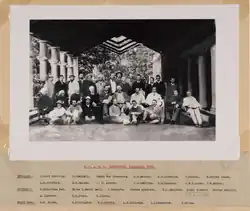
UPASI was formed on 28 August 1893, when representatives of thirteen district planting associations met at Mayo Hall in Bangalore to form a single, united organisation representing planting interests across the region.[9][3][10] According to historian K. Ravi Raman, UPASI was established at the height of British colonial rule as an organisation dedicated to the interests of British planters, principally tea planters, in South India.[1]
UPASI's scientific work dates to the early twentieth century. In collaboration with regional governments, it helped establish experimental and research stations for coffee, tea, and rubber in the 1900s-1920s, including a Coffee Experimental Station at Sidapur and a Tea Experimental Station at Peermade, and formally established its own Scientific Department during this period.[11][12] A dedicated Tea Experimental Station was set up at Gudalur, Nilgiris in 1926, which evolved over subsequent decades into the present-day UPASI Tea Research Foundation, constituted in 1999.[11]
A detailed institutional history, A Planting Century: The First Hundred Years of the United Planters' Association of Southern India, 1893-1993, was written by journalist and historian S. Muthiah and published to mark the organisation's centenary in 1993.[13]
Structure and activities
UPASI functions as a federation of three state planters' associations and thirteen district planters' associations across Tamil Nadu, Kerala, and Karnataka.[6] Its stated objectives include undertaking scientific research relating to plantation crops, disseminating technical knowledge on cultivation and processing, representing planting-sector interests before government and policymakers, and collecting and publishing statistics on the plantation industries of South India.[3][6][14]
UPASI publishes The Planters' Chronicle, a trade journal (successor to the earlier Planting Opinion, launched in 1895), and produces an annual UPASI Yearbook.[6][15] Through its affiliated UPASI Tea Research Foundation, it conducts research and provides advisory services on tea cultivation, plant protection, and processing, and jointly organises the annual Golden Leaf India Awards tea competition with the Tea Board of India.[8]
UPASI established a Krishi Vigyan Kendra (KVK) in the Nilgiris district in September 1982, with a mandate to support rural development among small tea growers alongside UPASI's estate-sector research activities.[16] In 2000, the Tea Board of India designated UPASI-KVK as the nodal agency for small tea growers in the Nilgiris and launched, through it, a Quality Upgradation Programme (QUP) aimed at improving the standard of tea produced by smallholders in the district.[17][18][19] A follow-on Factory Upgradation Programme (FUP), also administered by UPASI-KVK from 2001, provided bought-leaf factories support towards equipment upgradation along with training to help factories attain ISO and HACCP certification.[20][21][22] Later, the UPASI KVK was closed following the discontinuation of its collaborative framework with the Indian Council of Agricultural Research.[23]
A study by the V.V. Giri National Labour Institute on family labour in the small-holding plantation sector situates UPASI among the institutional actors supporting the roughly 60,000 smallholders who, as of the mid-2000s, contributed around 40 percent of total South Indian tea production in the Nilgiris.[24]
Tea

Tea has historically been one of the principal plantation crops represented by the United Planters' Association of Southern India (UPASI). Since its formation in 1893, the association has represented tea plantation interests across southern India, functioning as a federation of regional planting associations and serving as an industry body on matters relating to cultivation, labour, research and public policy.[25][26][27]
Organised tea research in South India starts with the establishment of UPASI's Tea Experimental Station in 1926 at Devarshola near Gudalur, Nilgiris with Dr. W.S. Shaw as the first Chief Scientific Officer.[10] In 1999, UPASI reconstituted the department as a separate, formally administered body named UPASI Tea Research Foundation, with representation from the Ministry of Commerce and Industry and the Tea Board of India on its governing board.[28][29] The UPASI Tea Research Foundation is one of three principal tea research bodies recognised by the Tea Board of India.[30]
UPASI has also commissioned and supported studies on labour availability and mechanisation in the tea sector. Research undertaken by the association and its Tea Research Foundation has been cited in analyses of labour shortages in South Indian plantations and the changing economics of tea production.[31][32]
Coffee
Since its establishment, the UPASI has been closely associated with the development of coffee cultivation and research in southern India. During the late nineteenth and early twentieth centuries, the association represented the interests of coffee plantation owners and advocated scientific methods to improve cultivation and disease management.[25][26][33][34] UPASI played an important role in promoting organized coffee research. According to the Coffee Board of India, the association initiated one of the earliest coordinated efforts towards scientific coffee research in the 1900s, which eventually led to the establishment of the Mysore Coffee Experimental Station at Balehonnur in 1925.[35] The association worked with scientists including Dr. Leslie Coleman, Rudolph Anstead and Gustav Hermann Krumbiegel in developing research programmes for coffee cultivation.[36][37][38]
During the colonial period, UPASI also represented coffee planters before government committees dealing with production, marketing and export policy. It participated alongside the Coffee Cess Act Committee and the Coffee Market Expansion Board during efforts to address the crisis of surplus coffee production, institutions that later evolved into the Coffee Board of India.[39]
Rubber
UPASI was also closely involved in the early development of India's natural rubber industry. During the early twentieth century, the association encouraged the establishment and expansion of rubber plantations in southern India, particularly in Travancore, and Malabar, and supported the spread of plantation-based agriculture through infrastructure development and technical assistance.[25] UPASI's "Planting Directory", published periodically during the twentieth century, has been used extensively by historians as a primary source documenting the growth of plantations.[40]
The association also promoted scientific research on rubber cultivation. Under the leadership of John Joseph Murphy (rubber planter), UPASI established a Rubber Scientific Department and founded one of India's earliest dedicated rubber research facilities at Mundakayam in 1924. Research undertaken there contributed to controlling fungal diseases such as ''Phytophthora meadii'', which had affected rubber plantations in southern India.[41][25]
See also
References
- 1 2 3 Raman, K. Ravi (2014). "Business, Ethnicity, Politics, and Imperial Interests: The United Planters' Association of Southern India, 1893–1950". Business History Review. 88 (1): 73–95. doi:10.1017/S0007680513001438. Retrieved 2026-07-02.
- 1 2 "About UPASI". UPASI. Retrieved 2026-07-02.
- 1 2 3 "History & Mission". UPASI. Retrieved 2026-07-02.
- ↑ India, United Planters' Association of Southern (1953). UPASI, 1893-1953. United Planters' Association of Southern India.
- ↑ Planting Directory of Southern India. United Planters' Association of Southern India. 1960.
- 1 2 3 4 "The United Planters' Association of Southern India (UPASI)". Association of Natural Rubber Producing Countries. Retrieved 2026-07-02.
- ↑ Wright, Arnold (2004). Southern India: Its History, People, Commerce, and Industrial Resources. Asian Educational Services. ISBN 978-81-206-1344-7.
- 1 2 "Home". UPASI. Retrieved 2026-07-02.
- ↑ India, United Planters' Association of Southern (1953). UPASI, 1893-1953.
- 1 2 Griffiths, Sir Percival Joseph; Griffiths, Sir Percival (1967). The History of the Indian Tea Industry. Weidenfeld & Nicolson.
- 1 2 "History". UPASI Tea Research Foundation. Retrieved 2026-07-02.
- ↑ "Coffee Board of India". coffeeboard.gov.in. Archived from the original on 2026-04-12. Retrieved 2026-07-09.
- ↑ Muthiah, S. (1993). A Planting Century: The First Hundred Years of the United Planters' Association of Southern India, 1893–1993. New Delhi: Affiliated East-West Press.
- ↑ Neilson, Jeff; Pritchard, Bill (2009-03-20). Value Chain Struggles. Wiley. doi:10.1002/9781444308723. ISBN 978-1-4051-7393-3.
- ↑ "The Hindu : Book Review : From the pages of history". www.hindu.com. Archived from the original on 2010-01-21. Retrieved 2026-07-14.
- ↑ "Schemes & Services :: Krishi Vigyan Kendra (KVK)". www.agritech.tnau.ac.in. Retrieved 2026-07-15.
- ↑ 59TH ANNUAL REPORT 2012-2013 (PDF). Kolkata: TEA BOARD INDIA. 2013. p. 24.
- ↑ Neilson, Jeffrey; Pritchard, Bill; Spriggs, John (2006-01-01). "Implementing Quality and Traceability Initiatives Among Smallholder Tea Producers in Southern India". Acta Horticulturae (699): 327–334. doi:10.17660/ActaHortic.2006.699.38.
- ↑ Ma, Vijayabaskar; P. Karthiayani, Viswanathan (2019-05-15), Emerging Vulnerabilities in India’s Plantation Economy, pp. 167–186, ISBN 978-981-13-7110-3, retrieved 2026-07-31
- ↑ Mansingh, Pallavi; T. Johnson, Liby (2012). "COMPARATIVE ANALYSIS OF EXISTING MODELS OF SMALL TEA GROWERS IN TEA VALUE CHAIN IN THE NILGIRIS" (PDF). NRPPD Discussion Paper. 20. Centre for Development Studies, Trivandrum. Retrieved 2026-07-15.
- ↑ Larsen, Marianne (2016). "Sustaining Upgrading in Agricultural Value Chains? State-Led Value Chain Interventions and Emerging Bifurcation of the South Indian Smallholder Tea Sector". Sustainability. 8 (11): 1102. Bibcode:2016Sust....8.1102L. doi:10.3390/su8111102.
- ↑ Neilson, Jeff; Pritchard, Bill (2009-03-20). Value Chain Struggles. Wiley. doi:10.1002/9781444308723. ISBN 978-1-4051-7393-3.
- ↑ "Sustainable Agricultural Developments in the Nilgiris". Badagas of the Blue Mountains. 2019-05-24. Retrieved 2026-07-15.
- ↑ Sarkar, Kingshuk; Rasaily, Rinju (2019). Family labour in small holding plantation sector: A study with special focus on women and children in selected areas of South India. VV Giri National Labour Institute, Ministry of Labour & Employment ….
- 1 2 3 4 Muthiah, S. (1993). A Planting Century: The First Hundred Years of the United Planters' Association of Southern India, 1893-1993. Affiliated East-West Press. ISBN 978-81-85938-04-2.
- 1 2 Raman, K. Ravi (April 2014). "Business, Ethnicity, Politics, and Imperial Interests: The United Planters' Association of Southern India, 1893–1950". Business History Review. 88 (1): 73–95. doi:10.1017/S0007680513001438. ISSN 0007-6805.
- ↑ "Planting History | Poabs Estates". 2014-07-31. Retrieved 2026-07-14.
- ↑ Foundation, UPASI Tea Research (2000). Annual Report for the Period 1st January to 31st December (74th Annual Report). UPASI Tea Research Foundation.
- ↑ Chakravarty, B. (2022). A Critical Review of the Tea Board’s Tea Research Management in India. International Journal of Advances in Engineering and Management (IJAEM), 4(2), 1487–1498. https://doi.org/10.35629/5252-040214871498
- ↑ "Priority Areas". www.teaboard.gov.in. Retrieved 2026-07-20.
- ↑ Kulkarni, Mahesh. "Acute labour shortage grips south Indian plantations". Archived from the original on 2020-11-12. Retrieved 2026-07-09.
- ↑ "Tea plantation labour in India - EconBiz". www.econbiz.de. Archived from the original on 2014-10-11. Retrieved 2026-07-31.
- ↑ Hull, Edmund C. P.; Hull, Edmund C. P.; Mair, Robert Slater (1877). Coffee planting in southern India and Ceylon. University of California Libraries. London, New York, E. & F. N. Spon.
- ↑ Arnold, Edwin Lester Linden (1893). On the Indian hills : or, Coffee-planting in southern India. University of California Libraries. London : S. Low, Marston.
- ↑ The Connoisseur's Book of Indian Coffee. Macmillan India Limited. 2002. ISBN 978-0-333-93806-5.
- ↑ "Coffee Research in India". Coffee Board of India. Retrieved 2026-07-09.
- ↑ "CCRI 100". ccri100.org. Retrieved 2026-07-09.
- ↑ Shortt (M.D.), John (1864). A Hand-Book to Coffee Planting in Southern India, etc. Pharoah and Company.
- ↑ Plys, Kristin (April 2026). "The Indian Coffee House Workers Movement, 1936–1977: From Colonial Firm to Workers Cooperative". International Labor and Working-Class History. 109: 200–218. doi:10.1017/S0147547926100222. ISSN 0147-5479.
- ↑ Baak, Paul E. (July 1993). "Out of the Shadow, into the Spotlights. The 'Indigenous' Aspects of Plantation Development; the Case of the Emergence of Syrian Christian Planters in Princely Travancore in the First Half of the Twentieth Century". Itinerario. 17 (2): 74–96. doi:10.1017/S0165115300024414. ISSN 2041-2827.
- ↑ Shah, Aditi (2020-06-04). "J J Murphy: Kerala's Rubber Man". PeepulTree Live History India. Retrieved 2026-07-09.