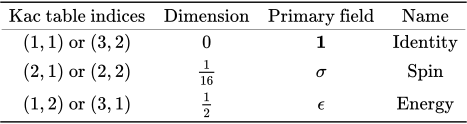
The Kac table of the  minimal model is:

This means that the space of states is generated by three primary states, which correspond to three primary fields or operators:[1]
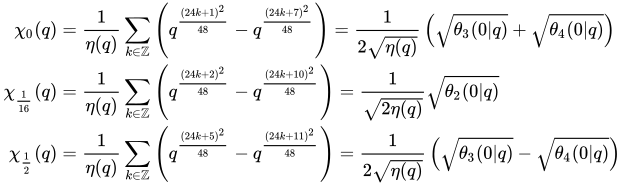
The decomposition of the space of states into irreducible representations of the product of the left- and right-moving Virasoro algebras is

where  is the irreducible highest-weight representation of the Virasoro algebra with the conformal dimension
 .
In particular, the Ising model is diagonal and unitary.
Fusion rules and operator product expansions
The fusion rules of the model are

The fusion rules are invariant under the  symmetry
 .
The three-point structure constants are

Knowing the fusion rules and three-point structure constants, it is possible to write operator product expansions, for example

where  are the conformal dimensions of the primary fields, and the omitted terms
 are contributions of descendant fields.
Correlation functions on the sphere
Any one-, two- and three-point function of primary fields is determined by conformal symmetry up to a multiplicative constant. This constant is set to be one for one- and two-point functions by a choice of field normalizations. The only non-trivial dynamical quantities are the three-point structure constants, which were given above in the context of operator product expansions.


with  .


The three non-trivial four-point functions are of the type  . For a four-point function
 , let
 and
 be the s- and t-channel Virasoro conformal blocks, which respectively correspond to the contributions of
 (and its descendants) in the operator product expansion
 , and of
 (and its descendants) in the operator product expansion
 . Let
 be the cross-ratio.
In the case of  , fusion rules allow only one primary field in all channels, namely the identity field.[2]

In the case of  , fusion rules allow only the identity field in the s-channel, and the spin field in the t-channel.[2]

In the case of  , fusion rules allow two primary fields in all channels: the identity field and the energy field.[2] In this case we write the conformal blocks in the case
 only: the general case is obtained by inserting the prefactor
 , and identifying
 with the cross-ratio.

In the case of , the conformal blocks are:

From the representation of the model in terms of Dirac fermions, it is possible to compute correlation functions of any number of spin or energy operators:[1]


These formulas have generalizations to correlation functions on the torus, which involve theta functions.[1]