Tropical Storm Polly (1992)
 Polly on August 29 | |
| Meteorological history | |
|---|---|
| Formed | August 27, 1992 |
| Dissipated | September 1, 1992 |
| Severe tropical storm | |
| 10-minute sustained (JMA) | |
| Highest winds | 100 km/h (65 mph) |
| Lowest pressure | 975 hPa (mbar); 28.79 inHg |
| Tropical storm | |
| 1-minute sustained (SSHWS/JTWC) | |
| Highest winds | 95 km/h (60 mph) |
| Lowest pressure | 987 hPa (mbar); 29.15 inHg |
| Overall effects | |
| Fatalities | 228 |
| Damage | $1.3 billion (1992 USD) |
| Areas affected | China, Taiwan, Japan, Philippines |
Part of the 1992 Pacific typhoon season | |
Tropical Storm Polly, known as Isang in the Philippines, was a strong and deadly tropical cyclone that affected China, Taiwan and Okinawa Prefecture. Polly originated as a tropical disturbance west of Rota on August 23. The JTWC issued the first warning on Tropical Depression 16W on August 24. Polly upgraded to a tropical storm on August 27. On August 29, the JMA reported that Polly attained a minimum pressure of 975 hPa (28.8 inHg).
In Philippines, the storm caused mudflows from the slopes of Mount Pinatubo. In China, Polly caused a severe storm surge. 157 people were killed in Zhejiang. 31 deaths were reported in Shandong. Damage was estimated at $1.3 billion. In Japan, no injuries and deaths were reported. The storm caused six landslides in Yonaguni Island. In Taiwan, eight people were killed.
Meteorological history
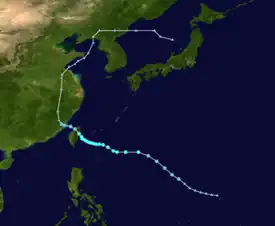
Tropical storm (39–73 mph, 63–118 km/h)
Category 1 (74–95 mph, 119–153 km/h)
Category 2 (96–110 mph, 154–177 km/h)
Category 3 (111–129 mph, 178–208 km/h)
Category 4 (130–156 mph, 209–251 km/h)
Category 5 (≥157 mph, ≥252 km/h)
Unknown


 Extratropical cyclone, remnant low, tropical disturbance, or monsoon depression
At 12:00 UTC on August 23, the Joint Typhoon Warning Center (JTWC) first monitored a tropical disturbance west of Rota. The JTWC issued its Tropical Cyclone Formation Alert (TCFA) at 19:00 UTC on August 24. At 12:00 UTC on August 25, the JTWC issued the warning on Tropical Depression 16W.[1] Once the storm crossed the Philippine Area of Responsibility (PAR) on August 26, the Philippine Atmospheric, Geophysical and Astronomical Services Administration (PAGASA) assigned it the local name Isang.[2] At 12:00 UTC on August 26, the JTWC upgraded Polly to a tropical storm.[3]
At 00:00 UTC on August 27, the Japan Meteorological Agency (JMA) began monitoring the system as a tropical depression. At 18:00 UTC on August 27, the JMA upgraded Polly to a tropical storm. At 03:00 UTC on August 29, the JMA upgraded Polly to a severe tropical storm. At 06:00 UTC, the storm unofficially reached its peak intensity with 1-minute sustained winds of 60 mph (95 km/h).[1] At 21:00 UTC on the same day, the JMA estimated a minimum pressure of 975 hPa (28.8 inHg).[4] At 06:00 UTC on August 30, Polly made its first landfall in Hualien, Taiwan as a tropical storm. At 12:00 UTC on the same day, the JTWC downgraded Polly to a tropical depression and issued the final warning for the system. [3] At 06:00 UTC on August 31, the JMA downgraded Polly to a tropical storm. At 12:00 UTC on September 4, the JMA ceased tracking the system.[4]
Preparations and Impact
China
Nationwide, damage was estimated at $1.3 billion across Fujian, Zhejiang, Jiangsu, Shandong, Hebei, Tianjin, and Liaoning. In Yueqing, rainfall at the Yandun station reached 741 mm (29.2 in), with a 24-hour rainfall of 406 mm (16.0 in) and a 12-hour rainfall of 271 mm (10.7 in). In Fujian, a storm surge of 10.96 m (36.0 ft) was recorded at Fushan Pier, surpassing the historically recorded high-tide level. 12 people were reported dead, A total of 28,800 dwellings, 5,335 ha (13,180 acres) of aquaculture, 200 sluices and bridges were destroyed, 90,000 homes were damaged by the storm, Monetary damage was estimated at to ¥950 million. 157 people were killed and 535 were injured, A total of 142,000 homes, 42 pumping stations, 605 km (376 mi) of embankments, 51 small-sized hydropower stations, 333 km (207 mi) of river banks, 763 km (474 mi) of roads, 480 bridges, 1,184 dams, 5,775 km (3,588 mi) of power lines, 95 sluices, 735 km (457 mi) of communication lines were damaged, 1,860 boats were either damaged or destroyed. Damage was estimated at $636 million (¥3.5 billion) in Zhejiang.[5]
14 people were killed and 25 were injured; 657,000 hectares of crops were inundated by floodwaters; 21,000 dwellings collapsed and 52,000 dwellings were damaged in Jiangsu. In Shandong, 31 deaths were reported due to remnants of Polly. A total of 20 piers, 16,000 homes, 200 km (120 mi) of power lines, 405 utility poles were destroyed. Two scenic spots were damaged. 13,900 ha (34,000 acres) of shrimp ponds and 52,200 ha (129,000 acres) of fruit trees were affected. 97,550 trees were toppled. Damage was estimated at ¥2.5 billion. In Hebei, storm tide was recorded at 5.6 m (18 ft), 80,000 ha (200,000 acres) of agriculture and aquaculture land were flooded, including 30,000 ha (74,000 acres) hectares of shrimp ponds and 50,000 ha (120,000 acres) of rice fields, Monetary damage was estimated at to ¥115 million. In Tianjin, a total of 100 culvert gates, three pumping stations, three docks, 30 boats were damaged, 200 ha (490 acres) of oil fields in Dagang were inundated by floodwaters, damage was estimated at ¥450 million. In Liaoning, six people were killed. A total of 104 boats, 480 km (300 mi) of roads were damaged. 6.18 million trees were destroyed. 71,600 hectares of agriculture land were either flooded or destroyed. Damage was estimated at ¥30 million.[5][6]
Elsewhere
In Philippines, a total of nine people were killed. Two dikes were damaged. Thousands of homes were buried. In Mount Pinatubo, rainfall received of 137.6 mm (5.42 in).[7][8] In Taiwan, eight people were killed, including 66-year-old woman and 78-year-old woman. three people were injured. Damage was estimated at $72.6 million.[9][6] In Okinawa Prefecture, One port was collapsed. Six landslides were reported, Two roads were damaged. Damage to sugarcane was estimated at ¥2.7 million in Yonaguni Island.[10][11]
References
- 1 2 1992 Annual Tropical Cyclone Report (PDF) (Report). Joint Typhoon Warning Center. pp. 88–91.
- ↑ Destructive Typhoons 1970-2003 (Report). National Disaster Coordinating Council. November 9, 2004. Archived from the original on October 21, 2013.
- 1 2 ""GARY 1992" Entry". NOAA Historical Hurricane Tracks.
- 1 2 "RSMC Best Track Data (text) 1990-1999". Japan Meteorological Agency. Archived from the original on January 22, 2013. Retrieved May 30, 2026.
- 1 2 毛耀順, 江彥文 (2009). 中國氣象災害大典 [The Great Compendium of Meteorological Disasters in China] (in Chinese). 氣象出版社. pp. 267–270. ISBN 9787502945886.
- 1 2 Tropical cyclones in 1992 (PDF) (Report). Royal Observatory. September 1994. Archived from the original (PDF) on August 11, 2003.
- ↑ "5 die in boiling mud from Pinatubo". Manila Standard. August 30, 1992. p. 4 – via Google News Archive.
- ↑ "Lahar rampage: Death toll now 9; 40,000 evacuated". Manila Standard. August 31, 1992. p. 2 – via Google News Archive.
- ↑ "Tropical storm Polly kills three on Taiwan". Pacific Stars And Stripes. Tokyo. September 1, 1992. p. 6 – via NewspaperArchive.
- ↑ "Weather Disaster Report (1992-918-04)". Digital Typhoon (in Japanese). Retrieved August 20, 2026.
- ↑ "Weather Disaster Report (1992-936-10)". Digital Typhoon (in Japanese). Retrieved August 20, 2026.
Tropical cyclones of the 1992 Pacific typhoon season | ||
|---|---|---|
 | ||
