Tropical Storm Gary (1992)
 Severe Tropical Storm Gary on July 22 | |
| Meteorological history | |
|---|---|
| Formed | July 17, 1992 |
| Dissipated | July 24, 1992 |
| Severe tropical storm | |
| 10-minute sustained (JMA) | |
| Highest winds | 100 km/h (65 mph) |
| Lowest pressure | 980 hPa (mbar); 28.94 inHg |
| Category 1-equivalent typhoon | |
| 1-minute sustained (SSHWS/JTWC) | |
| Highest winds | 120 km/h (75 mph) |
| Lowest pressure | 976 hPa (mbar); 28.82 inHg |
| Overall effects | |
| Fatalities | 62 |
| Damage | $1.11 billion (1992 USD) |
| Areas affected | Hong Kong, China, Philippines |
Part of the 1992 Pacific typhoon season | |
Severe Tropical Storm Gary, known as Ditang in the Philippines, was a strong and destructive tropical cyclone that affected China and the Philippines. Gary upgraded to a tropical storm on July 21. On July 22, the JMA reported that Gary attained a minimum pressure of 980 hPa (29 inHg). In Philippines, 36 people were killed, In China, 26 deaths were reported. 486 bridges were damaged. In Hong Kong, at least 18 people were injure. In Macau, no injuries and deaths were reported.
Meteorological history
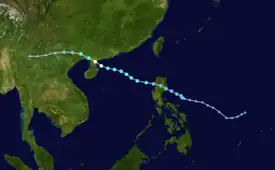
Tropical storm (39–73 mph, 63–118 km/h)
Category 1 (74–95 mph, 119–153 km/h)
Category 2 (96–110 mph, 154–177 km/h)
Category 3 (111–129 mph, 178–208 km/h)
Category 4 (130–156 mph, 209–251 km/h)
Category 5 (≥157 mph, ≥252 km/h)
Unknown


 Extratropical cyclone, remnant low, tropical disturbance, or monsoon depression
On July 16, the Joint Typhoon Warning Center (JTWC) first monitored a tropical disturbance northwest of the Yap.[1] On July 17, the JTWC issued its Tropical Cyclone Formation Alert (TCFA).[2] At 06:00 UTC on July 17, the Japan Meteorological Agency (JMA) began monitoring the system as a tropical depression. Once the storm crossed the Philippine Area of Responsibility (PAR) on July 17, the Philippine Atmospheric, Geophysical and Astronomical Services Administration (PAGASA) assigned it the local name Ditang.[3] At 0:00 UTC on July 19, the JTWC issued its first warning on Tropical Depression 07W. At08:00 UTC on July 20, Gary made its first landfall in Dinapigue as a tropical depression. At 18:00 UTC on the same day, the JTWC upgraded Gary to a tropical storm.[1] At 00:00 UTC on July 21, the JMA upgraded Gary to a tropical storm. At 00:00 UTC on July 22, the JMA upgraded Gary to a severe tropical storm. At 06:00 UTC on the same day, the JMA estimated a minimum pressure of 980 hPa (29 inHg).[3]
At 12:00 UTC on the same day, the storm developed a large ragged eye and the JTWC upgraded Gary to a Category 1 typhoon.[2] At 18:00 UTC on the same day, Gary made landfall near Zhanjiang.[1] At 00:00 UTC on July 23, both the JMA and JTWC downgraded Gary to a tropical storm.[1][3] At 12:00 UTC on July 23, the JTWC issued the final warning for the system.[2] The storm dissipated between Yunnan and Myanmar at 18:00 UTC on July 24.[1]
Preparations and Impact
In Philippines, 36 people were killed, 77 were injured, 6 were reported missing, 134,417 people were affected. total damage was estimated at $18.4 million (₱471 million), including $9.7 million (₱249 million) in damage to infrastructure and $8.3 million (₱213 million) in damage to agriculture.,[note 1] A total of 478 homes were damaged. 1,305 homes were partially damaged.[4] 15 passengers were killed in Palayan City. Five people were reported drowned in Caloocan City. A 30-year woman was drowned. One person drowned in Quezon City. Central Luzon declared as hardest hit area.[5] Four feet mudflows from rains were reported in Mount Pinatubo. 53 families were evacuated in Zambales and 183 families were evacuated in Caloocan.[6] President Fidel V. Ramos declared a state of calamity in 2 cities and Nueva Ecija.[7]
In Hong Kong on July 20 at 10:30 pm HKT, the Royal Observatory issued a Signal No. 1. The following day, at 03:45 pm HKT, the Royal Observatory raised it to a Strong Wind Signal No. 3. At 05:45 am HKT on July 22, the Royal Observatory raised it to Northeast Gale or Signal No. 8. At 04:15 pm HKT the same day, the Royal Observatory downgraded it Strong Wind Signal No. 3. At 06:50 pm HKT, all signals were lowered. A total of 18 injuries were reported. Failing trees were occurred in two places.[8]
In China, one fatality occurred, nine people were injured, A total of 100,000 homes, 362 km (225 mi) of roads, 86 bridges, 19 reservoirs, and 63 rural water conservancy projects were damaged, A total of 20,000 homes were destroyed, 290 km (180 mi) of high and low voltage power lines, 374 km (232 mi) of communication lines, 434 culverts and sluices were destroyed. A total of 146,000 ha (360,000 acres) of agricultural land were flooded, Damage was estimated at 5 billion RMB in Guangdong. In Xuwen County, rainfall peaked at 267 mm (10.5 in) in one day. 2.98 million people in Guangdong Province were affected by the disaster, 226,100 ha (559,000 acres) of crops were damaged, 29,000 thatched houses collapsed, Two power stations were damaged. The water levels in the Zuojiang and Yujiang Rivers increased considerably. 700 boats were damaged, including 540 sailing boats and 147 motorized boats.[9][8] In Guangxi, 25 people were reported dead and 54 people were injured. Approximately 23,000 homes were either destroyed or sustained damage. 400 bridges were damaged. A total of 680 km (420 mi) of roads, 304 km (189 mi) of drainage pipes were damaged.[8] 102,400 ha (253,000 acres) of farmland were flooded.[9] Damage was estimated at 1 billion RMB. Nationwide, 1,042 km (647 mi) of roads and 486 bridges were damaged. Damage was estimated $1.09 billion (6 billion RMB).[8]
Notes
- ↑ Money values converted via Pacific Exchange Rate Service with an exchange rate for 1992
References
- 1 2 3 4 5 ""GARY 1992" Entry". NOAA Historical Hurricane Tracks.
- 1 2 3 1992 Annual Tropical Cyclone Report (PDF) (Report). Joint Typhoon Warning Center. pp. 58–60.
- 1 2 3 "RSMC Best Track Data (text) 1990-1999". Japan Meteorological Agency. Archived from the original on January 22, 2013. Retrieved May 30, 2026.
- ↑ Destructive Typhoons 1970-2003 (Report). National Disaster Coordinating Council. November 9, 2004. Archived from the original on October 21, 2013.
- ↑ "29 typhoon Ditang deaths listed". Manila Standard. July 22, 1992. p. 6 – via Google News Archive.
{{cite news}}: CS1 maint: url-status (link) - ↑ "20 die in Ditang's wake". Manila Standard. July 21, 1992. p. 2 – via Google News Archive.
{{cite news}}: CS1 maint: url-status (link) - ↑ "NE declared calamity area". Manila Standard. July 22, 1992. p. 4 – via Google News Archive.
{{cite news}}: CS1 maint: url-status (link) - 1 2 3 4 Tropical cyclones in 1992 (PDF) (Report). Royal Observatory. September 1994. Archived from the original (PDF) on August 11, 2003.
- 1 2 毛耀順, 江彥文 (2009). 中國氣象災害大典 [The Great Compendium of Meteorological Disasters in China] (in Chinese). 氣象出版社. pp. 267–270. ISBN 9787502945886.