Trolleybuses in Chișinău
| Chișinău trolleybus system | |||
|---|---|---|---|
 | |||
 BKM-321 trolleybus in front of the airport, Chișinău, Moldova | |||
| Operation | |||
| Locale | Chișinău, Moldova | ||
| Open | 1949 | ||
| Status | Open | ||
| Routes | 32 | ||
| Owner | Government of Chișinău | ||
| Operator | Regia Transport Electric Chișinău (RTEC) | ||
| Infrastructure | |||
| Electrification | 600 V DC | ||
| Depot | 3 | ||
| Stock | 453 | ||
| Statistics | |||
| Route length | 246 km (153 mi) | ||
| |||
| Website | http://www.chisinau.md/pageview.php?l=ro&idc=478 RTEC (in Romanian) | ||

The Chișinău trolleybus system forms an important part of the public transport network in Chișinău, the capital of Moldova. The system was created shortly after the end of the World War II to replace the old electric tram system that suffered extensive damage during the war.[1] Along with the network of minibuses known as rutiere, it forms the backbone of the Chișinău transport system, with the average daily ridership reaching 250,000 passengers per day.[2][3]
History
The history of the trolleybus network in Chișinău goes back to 1949 when the city council took the decision to introduce it as a substitute for the tram network that was heavily damaged during World War II and could only be rebuilt to a limited extent. The first line connecting the Chişinău Railway Station with the University of Medicine ran along the Stephen the Great boulevard, where the former tram tracks were removed, and was served by six MTB-82D units. In 1959 the tram depot was transferred to serve the trolleybus system that comprised over 50 units at that time, and by 1961 trolleybuses had completely replaced the trams. The second and the third depots were introduced into service in 1966 and 1986, respectively.[1]
Lines
As of March 2026 the Chișinău trolleybus network consists of 32 lines covering all the city districts and the suburban areas such like Durlești, Stăuceni, Trușeni and Bubueci.[4]
| Line | Route | Notes |
| 1 | or. Durlești – str. Sarmizegetusa |  connection with Chisinau railway station |
| 2 | bd. Traian – str. Pușkin | circular route |
| 3 | șos. Balcani – str. Miorița | |
| 4 | Grădina Botanică – str. Constituţiei | connection with Chisinau railway station |
| 5 | Trolleybus depot 2 – str. Bariera Sculeni | connection with Chisinau railway station |
| 7 | str. Uzinelor - str. Alexei Mateevici | |
| 8 | bd. Traian – parcul "La izvor" | connection with Chisinau railway station |
| 9 | Autogara Sud Vest – Autogara Nord |  connection with Autogara Nord (North bus station)
|
| 10 | str. Studenților – str. Miorița | |
| 12 | str. Ion Dumeniuc – str. Alexei Mateevici | |
| 13 | str. Ion Dumeniuc – str. Dokuceaev | connection with Autogara Nord (North bus station) |
| 16 | Beton Armat Association – str. Alexei Mateevici | |
| 17 | Autogara Sud Vest – Gara | connection with Chisinau railway station
|
| 20 | Trolleybus depot 2 – str. Vasilii Dokuceaev | connection with Chisinau railway station |
| 21 | str. Mesterul Manole– șos. Balcani | |
| 22 | șos. Balcani – Grădina Botanică | |
| 23 | str. Ion Dumeniuc – parcul "La izvor" | |
| 24 | str. Ion Dumeniuc – str. Mioriţa | |
| 25 | str. Ceucari – str. Alexei Mateevici | |
| 26 | str. Ceucari – str. Ion Dumeniuc | |
| 27 | str. Ceucari – str. Ion Creangă | |
| 28 | str. Ceucari – Trolleybus depot 2 | |
| 29 | Universitatea Agrară – parcul "Ștefan cel Mare" | |
| 30 | Aeroportul Internațional Chișinău – Piata Marii Adunari Nationale |  connection with Chișinău International Airport |
| 32 | str. Alexei Mateevici– or. Stăuceni | Suburban route to Stăuceni town |
| 33 | Universitatea de Medicina – or. Durlești | |
| 34 | str. Tighina – Trușeni | Suburban route to Trușeni village |
| 35 | str.Vasile Alecsandri – or. Durlești | |
| 36 | Teatrul National Mihai Eminescu – or. Ialoveni | Suburban route to Ialoveni town |
| 37 | str. Constantin Negruzzi – Bubueci | Suburban route to Bubueci village |
| 38 | str. Alba Iulia – str. Burebista |
Fleet

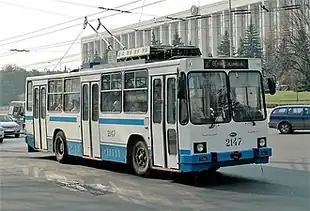

Current fleet
The fleet consists mainly of the various modification of popular low-floor trolleybus BKM-321 manufactured by Belkommunmash in Belarus and it's Moldovan analogue RTEC 62321 equipped by Moldovan electronics. Chișinău is the second-largest current user of this model, after Minsk (and Moscow in past). In addition, the network also operates by 5 articulated vehicles RTEC 62433 (BKM-433), some Škoda 24Tr, articulated Van Hool AG300T and Polish Solaris Trollino 18.[5] All trolleybuses Škoda, Van Hool and Solaris were purchased used as dismissed in Swiss, Latvia and Estonia.
| Model[6] | Total / Active |
| BKM-321 | 101 / 98 |
| RTEC 62321M2 | 65 / 59 |
| RTEC 62321M1 | 64 / 62 |
| RTEC 6232100DM3 | 40 / 40 |
| Škoda 14TrM | 39 / 32 |
| ZiU-682V variants | 23 / 20 |
| Škoda 24Tr Irisbus Citelis | 20 / 20 |
| YuMZ T2 | 20 / 19 |
| ZiU-682G variants | 17 / 13 |
| ZiU-683V01 | 5 / 3 |
| BKM-433 Vitovt Max II | 5 / 5 |
| Solaris Trollino II 18 AC | 10 / 10 |
| Solaris Trollino II 18 Ganz | 5 / 5 |
| BKM-213 | 2 / 2 |
| RTEC 624201M1 | 1 / 1 |
| VMZ-5298.00 (VMZ-375) | 1 / 1 |
| YuMZ T1 | 1 / 1 |
In 2021, two trolleybuses built by the now-defunct Dutch manufacturer APTS (Advanced Public Transport Systems), to its Phileas design, were acquired secondhand: A 2011 prototype for a planned new busway system in Pescara, Italy, and a 2014 prototype (with doors on both sides) for the Metromare busway then under construction in Rimini, Italy.[7] Neither ever entered service on the systems for which they had been purchased, and eventually they were sold to a dealer in secondhand vehicles.[8] They were given fleet numbers 1001 and 1002 in Chișinău, and No. 1001 entered service in June 2022.[9]
Past fleet
In past in Chișinău operated the Soviet-built ZiU-5 and ZiU-9, Czech Škoda 14Tr and Ukrainian-built trolleybuses YuMZ-T2. There were also 2 articulated BKM-213 in service (operated since 2005 until 2025) and several articulated ZiU-683.
Now all these vehicles are dismissed. Some of them are used like company service vehicles or museum vehicles. [5]
Managing company and Depots
All trolleybuses in Chișinău are managed by Municipal Company RTEC (Regia Transport Electric Chișinău/Chișinău Electric Transport Managing Company).
There 3 trolleybus depots in the city and one special car service brach for repairing of vehicles.
- Trolleybus depot 1 - located in Buiucani Administrative District. The Headquarter of RTEC is situated here.;
- Trolleybus depot 2 - was built in Botanica Administrative District - a great resident and industrial area;
- Trolleybus depot 3, built in 1985 - the newest one. Located in Ciocana Administrative District.
- Repair Service - located very closed to the Depot 1. Occupies territory of ex tram depot.
Tickets, prices and payment terms
Every vehicle has a fare collector who sells single-ride tickets valid for this particular ride only. Alternatively, one can purchase a monthly ticket, valid for a calendar month. A single-ride ticket costs (since September '22) 6 MDL, and the price of the monthly pass is 234 MDL. There are also: monthly ticket for scholars and students – 70 MDL, ticket for 15 days – 100 MDL, monthly ticket for students with social privileges – 70 MDL, monthly ticket for economic agents – 320 MDL. Since may 2026, the ticket prices are 7 MDL.
References
- 1 2 "Chisinau trolleybus history". Retrieved 6 May 2013.
{{cite web}}: CS1 maint: deprecated archival service (link) - ↑ "Report of the Department of Public Transport". 6 March 2013. Archived from the original on 6 June 2015. Retrieved 10 June 2013.
- ↑ "The role of trolleybus in the Chisinau transport network".
- ↑ "Chisinau trolleybus timetable".
- 1 2 "ГОРОДСКОЙ ЭЛЕКТРОТРАНСПОРТ совмещённый трамвайно-троллейбусный сайт".
- ↑ "Chișinău, Trolleybus – Vehicle Statistics".
- ↑ "Trolleynews [regular news section]". Trolleybus Magazine. No. 358. UK: National Trolleybus Association. July–August 2021. p. 155. ISSN 0266-7452.
- ↑ "Italian Tragedies". Trolleybus Magazine. No. 339. UK: National Trolleybus Association. May–June 2018. p. 91. ISSN 0266-7452.
- ↑ "Trolleynews [regular news section]". Trolleybus Magazine. No. 365. UK: National Trolleybus Association. September–October 2022. p. 211.
External links

- "Trolleybus city: Chisinau (Moldavien)". Trolleymotion.
- Kishinev (Chişinău) database / photo gallery and Kishinev (Chişinău) trolleybus list at Urban Electric Transit – in various languages, including English.
- Regia Transport Electric Chisinau Facebook Page