Trimethyltin hydroxide
 | |
| Names | |
|---|---|
| IUPAC name
Trimethyltin hydroxide | |
Other names
| |
| Identifiers | |
3D model (JSmol) |
|
| ChemSpider | |
| ECHA InfoCard | 100.202.818 |
| EC Number |
|
PubChem CID |
|
| UNII | |
CompTox Dashboard (EPA) |
|
| |
| |
| Properties | |
| (CH3)3SnOH | |
| Molar mass | 180.822 g·mol−1 |
| Appearance | White crystalline solid[1][2] |
| Melting point | 118 °C (244 °F; 391 K)[3] (sublimes) |
| Soluble[2] | |
| Solubility | Soluble in organic solvents[2] |
| Hazards | |
| Occupational safety and health (OHS/OSH): | |
Main hazards |
Highly toxic |
| GHS labelling:[4] | |
  | |
| Danger | |
| H300, H310, H330, H410 | |
| P260, P262, P264, P270, P271, P273, P280, P284, P301+P316, P302+P352, P304+P340, P316, P320, P321, P330, P361+P364, P391, P403+P233, P405, P501 | |
| Related compounds | |
Related compounds |
|
Except where otherwise noted, data are given for materials in their standard state (at 25 °C [77 °F], 100 kPa).
Infobox references | |

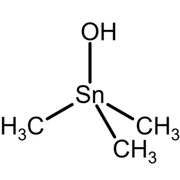
Trimethyltin hydroxide is an organotin compound with the chemical formula (CH3)3SnOH. It is a white crystalline solid.
Synthesis
Trimethyltin hydroxide can be synthesized by reaction of trimethyltin chloride with a strong base in methanol.
It can also be synthesized by hydrolysis of trimethyltin chloride and purification by sublimation.[2]
Structure
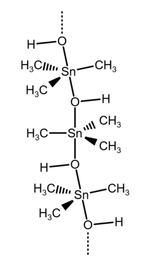
Solid trimethyltin hydroxide is a coordination polymer. It forms orthorhombic crystals.[5] The room temperature crystal structure of trimethyltin hydroxide comprises a total of 32 crystallographically independent (CH3)3SnOH units arranged in four independent coordination polymer strands.[6] Each strand is an infinite linear chain of (CH3)3SnOH units, where in each unit Sn is approximately trigonal bipyramidal, surrounded by three methyl groups at the equator and two hydroxyl groups at the poles, where oxygens are shared between the units. The hydroxide groups play role as bridges between the units.[5] Below 160 K (−113 °C; −172 °F) the crystal structure undergoes phase transition.[6]
Uses
Trimethyltin hydroxide is a reagent used for the cleavage of nonhindered alkyl esters. It is a method that is used for mild, efficient and selective hydrolysis of esters to produce corresponding carboxylic acids.[2][7] Trimethyltin hydroxide is used in the synthesis of modified thymines, which is useful as inhibitors of RNase A. It reacts with 2,2-disubstituted benzothiazolines to produce trialkyltin derivatives of sulfur containing Schiff base complexes.[1]
References
- 1 2 https://www.thermofisher.com/order/catalog/product/071167.06
- 1 2 3 4 5 Furlán, Ricardo L. E.; Mata, Ernesto G. (2011). "Trimethyltin Hydroxide". Encyclopedia of Reagents for Organic Synthesis. doi:10.1002/047084289X.rn01292. ISBN 978-0-471-93623-7.
- ↑ https://www.sigmaaldrich.com/GB/en/sds/aldrich/cds025240
- ↑ PubChem. "Stannane, hydroxytrimethyl-". pubchem.ncbi.nlm.nih.gov. Retrieved 2026-02-20.
- 1 2 https://journals.iucr.org/a/issues/2005/a1/00/a33185/a33185.pdf
- 1 2 Anderson, Kirsty M.; Tallentire, Sarah E.; Probert, Michael R.; Goeta, Andrés E.; Mendis, Budhika G.; Steed, Jonathan W. (2011). "Trimethyltin Hydroxide: A Crystallographic and High Z ′ Curiosity". Crystal Growth & Design. 11 (3): 820–826. doi:10.1021/cg101464j.
- ↑ Nicolaou, K. C.; Estrada, Anthony A.; Zak, Mark; Lee, Sang Hyup; Safina, Brian S. (2005). "A Mild and Selective Method for the Hydrolysis of Esters with Trimethyltin Hydroxide". Angewandte Chemie International Edition. 44 (9): 1378–1382. doi:10.1002/anie.200462207. PMID 15674985.