Tribonacci ratio
 A tribonacci rectangle contains two scaled copies of itself, τ = ((τ − 1)2 + 2(τ − 1) + 1) / τ | |
| Rationality | irrational algebraic |
|---|---|
| Symbol | τ |
| Representations | |
| Decimal | 1.83928675521416113255... |
| Algebraic form | real root of x3 = x2 + x + 1 |
| Continued fraction (linear) | [1;1,5,4,2,305,1,8,2,1,4,6,14,...] [1] not periodic infinite |
In mathematics, the tribonacci ratio is a geometrical proportion, given by the unique real solution of the equation x3 = x2 + x + 1. Its decimal expansion begins with 1.839286755214161... (sequence A058265 in the OEIS).
The moniker tribonacci was introduced by high-school student Mark Feinberg in an article published in the Fibonacci Quarterly of october 1963.[2]
Definition

Three quantities a > b > c > 0 are in the tribonacci ratio if This ratio is commonly denoted


Substituting and in the first fraction gives It follows that the tribonacci ratio is the unique real solution of the cubic equation .


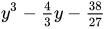
Closed-form expressions for are found by solving the depressed cubic , which has real zero .[3]



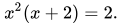
The point of intersection with of unit circle and the hyperbola is Substituting for , the equation of the abscissa is or


Dividing both sides by results in the fixed point iteration and the continued reciprocal square root An image of the Julia set of the backward iteration in the complex plane is found below.


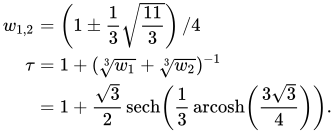
Alternative expressions for the tribonacci ratio can be derived from the reciprocal equation, that is, the depressed cubic with real zero .[4]


Additionally, leads to the infinite radical


is the superstable fixed point of the Newton iteration .

Properties

The tribonacci ratio can be written in terms of itself as fractions
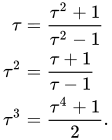
Similarly as the infinite geometric series

For every integer one has from this an infinite number of further relations can be found. A notable example is .


Continued fraction pattern of a few low powers [5]

The tribonacci ratio is the fourth smallest cubic Pisot number.[6] By definition of these numbers, the absolute value of the algebraic conjugates is smaller than 1, thus powers of generate almost integers. For example: . After 18 rotation steps the phases of the inward spiraling conjugate pair – initially close to – nearly align with the imaginary axis.


The first implied mention of the tribonacci constant was in the eleventh century, when the Persian poet and polymath Omar Khayyam found the solution of the cubic by considering the intersection of a circle and a rectangular hyperbola.[7]


with real zero is the Weber class polynomial associated with discriminant . Properties of the related Klein j-invariant result in near-identity



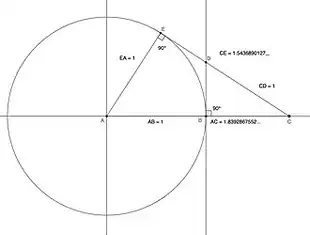
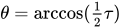
Argument satisfies , a result which is related through distance parameter to the 'miraculous' neusis construction of the hendecagon, found by Benjamin and Snyder.[8][9]


The reciprocal of the tribonacci ratio solves the equation .[10] The angle is close to 1 radian. Its complement figures in the geometric construction of the tribonacci constant found by biologist Xerardo Neira.[11]



The tribonacci ratio is particularly important in the study of the snub cube: all its metrics can be expressed in terms of .
Tribonacci sequence
The first muddled mention of the tribonacci sequence is in Charles Darwin's On the Origin of Species (1859), illustrating the population growth of elephants on the supposition that during their lifetime each pair of parents produces three pair of young.[12]
The number of compositions of n − 2 into parts 1, 2 and 3 is counted by the nth tribonacci number (n > 1).
The tribonacci sequence is defined by the third-order recurrence relation with initial values


The first few terms are 0, 0, 1, 1, 2, 4, 7, 13, 24, 44, 81, 149, 274, 504, 927,... (sequence A000073 in the OEIS).
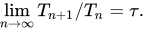
The limit ratio between consecutive terms is the tribonacci constant:
An alternative relation for is given by


The sequence is extended to negative indices using obtaining (0), 1,−1, 0, 2,−3, 1, 4,−8, 5, 7,−20, 18, 9,−47,... (sequence A057597 in the OEIS).

The relationship between the negative and positive indexed segments of the sequence is given by This reflection formula holds for all integers and can be derived from Agronomof's identity [13][14]


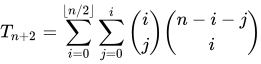
The sequence is related to sums of binomial coefficients by

Powers of the tribonacci ratio can be written with tribonacci numbers as quadratic coefficients which is proved by mathematical induction on This relation also holds for The order of the coefficients corresponds to the bottom row of matrix below.



The generating function of the tribonacci sequence for non-negative n is given by

Let and complex conjugate pair and be the zeros of polynomial with discriminant , the tribonacci numbers are then given by the Binet formula with real and conjugates and the roots of





Since , the number is the nearest integer to , with and coefficient 0.3362281169949410942253629... [a]


The tribonacci numbers are obtained as integral powers of a matrix with real eigenvalue [15]


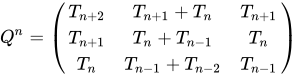
The trace of gives the tribonacci-Lucas numbers 3, 1, 3, 7, 11, 21, 39, 71, 131, 241, 443, 815, 1499, 2757,... satisfying the same recurrence relation. Variously, (sequence A001644 in the OEIS)


These Lucas numbers have the Fermat property: if p is prime, The converse does not hold, but the small number of tribonacci pseudoprimes makes the sequence special. The only composite numbers below 107 to pass the test are n = 182, 25201, 2332, 63618, 194390, 750890, 804055, 1889041, 2487941, 3542533, 3761251, 6829689. (sequence A371805 in the OEIS)


The tribonacci word sequence on the alphabet is defined by the substitution rule With initiator , the first seven words are For , the series of words produced by iterating the substitution are similarly obtained by concatenating the previous three: The number of c, b and a's in each word is equal to successive tribonacci numbers and the word length .[16] The tribonacci word sequence is the basis of the construction of the classic Rauzy fractal.[17]


Tribonacci spiral

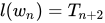
A tribonacci spiral is a logarithmic spiral that gets wider by a factor of for every quarter turn. It is described by the polar equation with initial radius and parameter


If drawn on a tribonacci rectangle, the spiral has its pole at the foot of altitude of a triangle on the diagonal and passes through vertices of rectangles with aspect ratio which are perpendicularly aligned and successively scaled by a factor . The pole of the spiral divides the main diagonal in ratio and bisects the diagonal of the lower right rectangle.


See also
Solutions of equations similar to :

- Golden ratio – the positive solution of the equation
- Plastic ratio – the real solution of the equation
- Supergolden ratio – the real solution of the equation


Notes
- ↑ Constant 𝑎 comes from Simon Plouffe's 1992 formula, its minimal polynomial can be found with an integer relation algorithm.
References
- ↑ Sloane, N. J. A. (ed.). "Sequence A019712". The On-Line Encyclopedia of Integer Sequences. OEIS Foundation.
- ↑ Feinberg, Mark (October 1963). "Fibonacci-Tribonacci" (PDF). Fibonacci Quarterly. 1 (3): 71–74. doi:10.1080/00150517.1963.12431573.
- ↑ Wolfdieter Lang, (sequence A058265 in the OEIS)
- ↑ (sequence A316711 in the OEIS) − 1
- ↑ For τ (sequence A019712 in the OEIS)
- ↑ Panju, Maysum (2011). "A systematic construction of almost integers" (PDF). The Waterloo Mathematics Review. 1 (2): 35–43. Retrieved August 15, 2026.
- ↑ Lang, Wolfdieter (2015). "A geometrical problem of Omar Khayyám and its cubic" (PDF). On-Line Encyclopedia of Integer Sequences. Retrieved 2026-06-30.
- ↑ Lanzi, Oscar (Jun 11, 2019). "Trig identities analogous to tan(pi/5) + 4sin(pi/5) = sqrt(5 + 2sqrt(5))". Mathematics stack exchange. Retrieved 2026-07-08.
- ↑ Benjamin, Elliot; Snyder, Chip (May 2014). "On the construction of the regular hendecagon by marked ruler and compass". Mathematical Proceedings of the Cambridge Philosophical Society. 156 (3): 409–424. doi:10.1017/S0305004113000753.
- ↑ Chema, Peter M. (2017). "Tribonacci constant as ratio of square to rhombus projection" (PDF). On-Line Encyclopedia of Integer Sequences. Retrieved 2026-06-30.
- ↑ Neira, Xerardo (Dec 12, 2020). "A geometric construction of the tribonacci constant with marked ruler and compass" (PDF). On-Line Encyclopedia of Integer Sequences. Retrieved 2026-06-30.
- ↑ Podani, János; Kun, Ádám; Szilágyi, András (2018). "How Fast Does Darwin's Elephant Population Grow?" (PDF). Journal of the History of Biology. 51 (2): 259–281. doi:10.1007/s10739-017-9488-5.
- ↑ Agronomof, Nicolai A. (1914). "Sur une suite récurrente". Mathesis (in French). 4: 125–126.
- ↑ Tuenter, Hans J. H. (October 2023). "In Search of Comrade Agronomof: Some Tribonacci History". The American Mathematical Monthly. 130 (8): 708–719. doi:10.1080/00029890.2023.2231796. MR 4645497. Zbl 1527.01024.
- ↑ Sloane, N. J. A. (ed.). "Sequence A000073". The On-Line Encyclopedia of Integer Sequences. OEIS Foundation.
- ↑ Sloane, N. J. A. (ed.). "Sequence A080843". The On-Line Encyclopedia of Integer Sequences. OEIS Foundation.
- ↑ Siegel, Anne; Thuswaldner, Jörg M. (2009). "Topological properties of Rauzy fractals". Mémoires de la Société Mathématique de France. 2. 118: 1–140. doi:10.24033/msmf.430.
| Individual numbers |
| ||||||
|---|---|---|---|---|---|---|---|
| Types | |||||||
| Related topics | |||||||
