Williamson's mouse-deer
| Williamson's chevrotain | |
|---|---|
Scientific classification  | |
| Kingdom: | Animalia |
| Phylum: | Chordata |
| Class: | Mammalia |
| Infraclass: | Placentalia |
| Order: | Artiodactyla |
| Family: | Tragulidae |
| Genus: | Tragulus |
| Species: | T. williamsoni |
| Binomial name | |
| Tragulus williamsoni | |
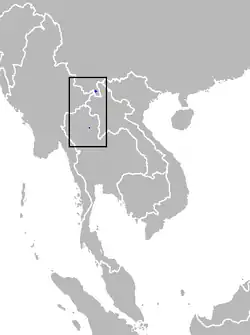 | |

Williamson's mouse-deer (Tragulus williamsoni), also called the northern mouse-deer and Williamson's chevrotain is a species of even-toed ungulate in the family Tragulidae. It is found in Thailand and southern China. The species is named after the collector Walter James Franklin Williamson.[3]
Morphology
Williamson's mouse-deer is a tawny colored ungulate with a darker head and a white underbelly. It has a white triangular patch on the throat with a tawny border.[4]
Williamson's mouse-deer measures around 0.47m long and weighs around 3.5kg making it significantly larger than most other mouse-deer.[4][5]
Habitat and ecology
Williamson's mouse-deer is found in Thailand and in the Yunnan province of southern China.[1] It favors low-altitude habitats with dense foliage along the banks of rivers or streams. Williamson's mouse-deer demonstrates a preference for areas populated by fig trees, Burmese grapes, Alpinia kwangsiensis, and Phrynium capitatum.[6]
Williamson's mouse-deer is crepuscular. This may enable it to avoid competition with larger herbivores such as boars, muntjacs, sambars, and serows, all of which are more active nocturnally than the mouse-deer.[5]
Description and taxonomy
Williamson's mouse-deer was described by the English zoologist C. Boden Kloss in 1916 as a subspecies of the lesser mouse-deer (Tragulus kanchil). The holotype specimen was collected by Walter James Franklin Williamson from the Me Song Forest in northern Thailand. It is held at Natural History Museum in London.[7][8]
Conservation status
The IUCN Red List lists Williamson's mouse-deer as data deficient. Based on its known range, it is presumed to be threatened by local hunting practices and by habitat loss due to logging,[1] farming, rubber plantations, and urbanization.[5]
Williamson's mouse-deer is listed as a first-class protected species in China.[5]
References
- 1 2 3 Timmins, R.; Duckworth, J.W.; Meijaard, E. (2015). "Tragulus williamsoni". IUCN Red List of Threatened Species. 2015 e.T136533A61978926. doi:10.2305/IUCN.UK.2015-2.RLTS.T136533A61978926.en. Retrieved 12 November 2021.
- ↑ Kloss, C. Boden (1916). "On a new mouse-deer from Upper Siam". Journal of the Natural History Society of Siam. 2: 88–89.
- ↑ Meijaard, E.; Chua, M. A. H.; Duckworth, J. W. (2017). "Is the northern chevrotain, Tragulus williamsoni Kloss, 1916, a synonym or one of the least-documented mammal species in Asia?" (PDF). Raffles Bulletin of Zoology. 65: 506–514.
- 1 2 Kloss, C. Boden (1916). "On a new mouse-deer from upper Siam". The Journal of the Natural History Society of Siam. v.2 (1916-1918). Natural History Society of Siam. Archived from the original on 2025-02-23.
- 1 2 3 4 He, Ru-Chuan; Wang, Lin; Goodale, Eben; Li, Kai; Quan, Rui-Chang (2023-10-05). "The extremely small body size of Williamson's mouse deer (Tragulus williamsoni) allows coexistence with sympatric larger ungulates through temporal avoidance". Frontiers in Ecology and Evolution. 11 1125840. doi:10.3389/fevo.2023.1125840. ISSN 2296-701X.
- ↑ Ming, Cao; Wei, Zhou; Bing, Bai; Qin, Zhang; Bin, Wang; Min-Yong, Chen (June 2010). "Habitat Use of Williamson's Mouse-deer (Tragulus williamsoni) in Mengla Area, Southern Yunnan". 动 物 学 研 究 Zoological Research. 31 (3): 303–309. doi:10.3724/SP.J.1141.2010.03303 (inactive 9 July 2026). ISSN 0254-5853. PMID 20672420.
{{cite journal}}: CS1 maint: DOI inactive as of July 2026 (link) - ↑ Meijaard, E.; Groves, C. P. (2004-01-01). "A taxonomic revision of the Tragulus mouse-deer (Artiodactyla)". Zoological Journal of the Linnean Society. 140 (1): 63–102. doi:10.1111/j.1096-3642.2004.00091.x. ISSN 0024-4082.
- ↑ "NHMUK ZD 1947.1510". Natural History Museum Data Portal. 27 May 2007. Retrieved 9 Jul 2026.