Tosyl azide
 | |
 | |
| Names | |
|---|---|
| Preferred IUPAC name
4-Methylbenzene-1-sulfonyl azide | |
| Other names
p-Toluenesulfonyl azide; p-Tosyl azide; p-Toluenesulfonazide; TsN3 | |
| Identifiers | |
3D model (JSmol) |
|
| ChemSpider | |
| ECHA InfoCard | 100.012.164 |
| EC Number |
|
PubChem CID |
|
| UNII | |
CompTox Dashboard (EPA) |
|
| |
| |
| Properties[1] | |
| C7H7N3O2S | |
| Molar mass | 197.22 g/mol |
| Appearance | Colorless to pale yellow oily liquid |
| Density | 1.286 g/cm3 |
| Melting point | 21 to 22 °C (70 to 72 °F; 294 to 295 K) |
| Boiling point | 110 to 115 °C (230 to 239 °F; 383 to 388 K) at 0.001 mmHg |
Except where otherwise noted, data are given for materials in their standard state (at 25 °C [77 °F], 100 kPa).
Infobox references | |

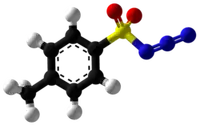
Tosyl azide (systematic name: 4-methylbenzenesulfonyl azide; abbreviation: TsN3) is an organic compound with the formula CH3C6H4SO2N3. It is a widely used reagent in organic synthesis, primarily valued for its ability to transfer diazo groups and generate reactive nitrene intermediates.[1] Although it is one of the more stable sulfonyl azides, it is highly energetic, heat- and shock-sensitive, and presents significant explosive hazards, particularly when isolated in pure bulk form.[2]
Uses
Tosyl azide serves as a versatile building block in modern synthetic chemistry, with three primary applications.
Diazo transfer
The most prominent application of tosyl azide is as a diazo-transfer reagent. In the Regitz diazo transfer, tosyl azide reacts with active methylene compounds (such as β-keto esters, malonates, and 1,3-diketones) in the presence of a base (typically triethylamine or DBU) to yield α-diazo carbonyl compounds.[3][4] These resulting α-diazo compounds are versatile intermediates used in cyclopropanation, X–H insertion reactions, and the synthesis of various heterocycles.[1]
Nitrene transfer and C–H amination
Tosyl azide serves as a convenient precursor to the tosyl nitrene (TsN:), a highly reactive electrophilic species.[5] Upon thermal or photochemical activation, or more commonly via transition metal catalysis (using complexes of rhodium, copper, ruthenium, cobalt, or iron), tosyl azide extrudes nitrogen gas to generate a metal-bound nitrene intermediate.[6] This intermediate can undergo:
Click chemistry
In the context of click chemistry, tosyl azide participates in the copper-catalyzed azide-alkyne cycloaddition (CuAAC). It undergoes a [3+2] cycloaddition with terminal alkynes to construct N-sulfonyl-1,2,3-triazoles.[9][10] These sulfonyl triazoles are valuable scaffolds in medicinal chemistry and materials science.[10]
Preparation
Tosyl azide is typically synthesized via the nucleophilic substitution reaction of tosyl chloride (p-toluenesulfonyl chloride) with sodium azide.[11] The reaction is commonly carried out in a biphasic mixture of acetone and water, sometimes utilizing phase-transfer catalysts or simple stirring at room temperature.[11]
Due to its explosive nature, commercial suppliers often provide tosyl azide as a dilute solution in toluene or other solvents rather than as a neat liquid.[12] In recent years, to mitigate the risks associated with batch processing, chemists have developed continuous flow chemistry protocols where tosyl azide is generated in situ and immediately consumed in subsequent reactions (such as diazo transfer or triazole synthesis) without ever being isolated or accumulated in large quantities.[13][2]
Safety and hazards
Despite being considered one of the more stable sulfonyl azides compared to its aliphatic counterparts, tosyl azide is highly energetic and is classified as a potential explosive.[2]
Differential scanning calorimetry (DSC) and thermal hazard assessments reveal that tosyl azide undergoes a highly exothermic decomposition, releasing nitrogen gas.[14] The onset of this explosive decomposition typically occurs around 120 °C, but localized heating, friction, or mechanical shock can trigger premature detonation.[2] Hazard assessments using Yoshida's predictive correlations have flagged tosyl azide as having severe impact sensitivity.[14]
Consequently, strict safety protocols are mandatory when handling tosyl azide.[14] It should never be heated above 100 °C, and it should be stored in small quantities at low temperatures, preferably kept in solution.[1] For scale-up and industrial applications, continuous flow reactors or in situ generation methods are strongly preferred over traditional batch chemistry to minimize the inventory of the explosive reagent at any given time.[2]
See also
References
- 1 2 3 4 Heydt, H.; Regitz, M.; Mapp, A. K.; Chen, B. (2008). "P-Toluenesulfonyl Azide". p-Toluenesulfonyl Azide. Encyclopedia of Reagents for Organic Synthesis. doi:10.1002/047084289X.rt141.pub2. ISBN 978-0-471-93623-7.
- 1 2 3 4 5 Deadman, B. J.; O'Mahony, R. M.; Maguire, A. R. (2016). "Taming tosyl azide: the development of a scalable continuous diazo transfer process". Chemical Science. 7 (3): 1990–1996. doi:10.3889/oamjms.2017.222. PMC 6062742. PMID 29362629.
- ↑ Presset, M.; Mailhol, D.; Coiffier, C.; Rodriguez, J.; Vidal, T. (2011). "Diazo-Transfer Reactions to 1,3-Dicarbonyl Compounds with Tosyl Azide". Synthesis (16): 2549–2552. doi:10.1055/s-0030-1260107.
- ↑ Dar'in, D.; Bakulina, O.; Krasavin, M. (2019). "A 'sulfonyl-azide-free' (SAFE) aqueous-phase diazo transfer protocol". Chemical Communications. 55 (36): 5239–5242. doi:10.1039/C9CC01855J (inactive 6 August 2026). PMID 30968083.
{{cite journal}}: CS1 maint: DOI inactive as of August 2026 (link) - ↑ Brandenberg, O. F.; Fasan, R.; Arnold, F. H. (2017). "Abiological Carbene and Nitrene Transfer Reactions". Current Opinion in Biotechnology. 47: 102–111. doi:10.1016/j.copbio.2017.06.005. PMID 28692874.
- ↑ Yuan, Y. C.; Huang, X.; Wang, B. (2022). "Transition-metal-catalyzed C–H bond amidations using cyclic sulfonyl azides". Organic Chemistry Frontiers. 10 (2): 314–330. doi:10.1039/D2QO01434F (inactive 6 August 2026).
{{cite journal}}: CS1 maint: DOI inactive as of August 2026 (link) - ↑ Lee, S.; Kim, H.; Park, J. (2019). "A Rh(III)-Catalyzed Formal [4+1] Approach to Pyrrolidines". Organic Letters. 21 (18): 7428–7432. doi:10.1021/acs.orglett.9b02531 (inactive 6 August 2026).
{{cite journal}}: CS1 maint: DOI inactive as of August 2026 (link) - ↑ van Klein, J. E. M. N.; de Bruin, B. (2012). Cobalt-Porphyrin Catalyzed Intramolecular C-H Amination. Wiley-VCH.
- ↑ Jankovič, D.; Hudobík, M.; Krutošík, A. (2022). "Copper-Catalyzed Azide–Alkyne Cycloaddition of Hydrazoic Acid". The Journal of Organic Chemistry. 87 (4): 2772–2783. doi:10.1021/acs.joc.1c02775. PMC 8938953. PMID 35148087.
- 1 2 Li, J.; Zhang, Y.; Wang, C. (2018). "Preparation of triazole compounds via click chemistry reaction". Colloids and Surfaces A: Physicochemical and Engineering Aspects. 555: 465–472. doi:10.1016/j.colsurfa.2018.07.030.
- 1 2 Curphey, T. J. (1981). "Preparation of p-Toluenesulfonyl Azide. A Cautionary Note". Organic Preparations and Procedures International. 13 (2): 112–115. doi:10.1080/00304948109356105.
- ↑ "p-Toluenesulfonyl azide solution". Sigma-Aldrich. Retrieved 11 August 2026.
- ↑ O'Mahony, R. M.; Deadman, B. J.; Maguire, A. R. (2021). "Generation of Tosyl Azide in Continuous Flow Using an Azide Resin and Telescoping with Diazo Transfer". Organic Process Research & Development. 25 (12): 2772–2780. doi:10.1021/acs.oprd.1c00301 (inactive 6 August 2026).
{{cite journal}}: CS1 maint: DOI inactive as of August 2026 (link) - 1 2 3 Green, S. P.; Wheelhouse, K. M.; Payne, A. D.; Hahn, S.; MacClellan, J. P. (2019). "Thermal Stability and Explosive Hazard Assessment of Diazo Compounds and Diazo Transfer Reagents". Organic Process Research & Development. 24 (1): 67–89. doi:10.1021/acs.oprd.9b00422. PMC 6972035. PMID 31983869.