Tinia (moon)
 Timelapse animation of Tinia (yellow arrow) orbiting back and forth around Uni, as seen by the Hubble Space Telescope from 2005 to 2006 | |
| Discovery | |
|---|---|
| Discovered by | Brown et al. |
| Discovery date | August 2005 |
| Designations | |
Designation | (55637) Uni I |
| Pronunciation | /ˈtɪniə/ |
Named after | Tinia |
| Orbital characteristics | |
| 4750±40 km[1] 4770±40 km[2] | |
| Eccentricity | 0.17±0.03[3][2] |
| 8.3095 d (prograde)[1] 8.3094±0.0002 d[2] | |
| Inclination | 63.1°[1] 275.5±0.3°[2] |
| Satellite of | 55637 Uni |
| Physical characteristics | |
| 180.8±0.6 km[4][a][b] 193.0±1.0 km[4][b] | |
| Albedo | 0.139±0.023[4] 0.122±0.02[4] |
| 6.476±0.183[4] | |
Tinia is the only known moon of the trans-Neptunian object 55637 Uni. Tinia was discovered in August 2005, by observations with the Hubble Space Telescope, and announced on 22 February 2007.[5]
In 2026, a 2 chord stellar occultation was done and estimated Tinia's diameter at approximately 180.8[4][a][b] to 193.0 km.[4][b] It orbits Uni every 8.3 days at an average distance of 4800 km.[2] Tinia was named together with Uni on 1 September 2025 after Tinia, the Etruscan sky god and husband of the Etruscan goddess of love and fertility Uni.[6]
History
Discovery
Uni has one known moon, which is named Tinia. Tinia was discovered in August 2005, by observations with the Hubble Space Telescope, and announced on 22 February 2007.[5]
Naming
Tinia was named together with Uni on 1 September 2025 after Tinia, the Etruscan sky god and husband of the Etruscan goddess of love and fertility Uni.[6] Tinia (also Tin, Tinh, Tins or Tina) was the sky god and the highest deity in Etruscan religion, equivalent to the Roman Jupiter and the Greek Zeus.[7]
Occultations
A 2 chord stellar occultation in 2026 was done.[4]
Orbital characteristics
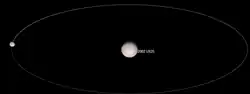
Tinia completes one complete orbit around Uni every 8.3094±0.0002[2] days, with an orbital eccentricity of 0.17±0.03,[2] indicating a total system mass of (1.25±0.03)×1020 kg.[2] Its orbital eccentricity is 0.17±0.03.[2] It orbits Uni at a distance of 4770 km.[2]
Physical characteristics
Tinia was discovered at 0.16 arcseconds from Uni with a difference in absolute magnitude of 2.5.[5][8] 2 chord stellar occultation in 2026 derived an absolute magnitude of 6.476±0.183 for Tinia,[4] Its diameter is estimated at 180.8±0.6 km,[4] or 193.0±1.0 km.[4]
See also
Notes
References
- 1 2 3 "2002 UX25 System parameters". Will Grundy. Retrieved 2023-08-29.
- 1 2 3 4 5 6 7 8 9 10 M.E. Brown (2013). "The density of mid-sized Kuiper belt object 2002 UX25 and the formation of the dwarf planets". The Astrophysical Journal Letters. 778 (2): L34. arXiv:1311.0553. Bibcode:2013ApJ...778L..34B. doi:10.1088/2041-8205/778/2/L34. S2CID 17839077.
- ↑ "(55637) Uni and Tinia". www.johnstonsarchive.net. Retrieved 2025-09-06.
- 1 2 3 4 5 6 7 8 9 10 11 12 Rommel, Flavia L.; Proudfoot, Benjamin; Ortiz, José L.; Morales, Nicolás; Gómez-Limón, José María; Holler, Bryan J.; Ragozzine, Darin; Santana-Ros, Toni; Santos-Sanz, Pablo; Fernández-Valenzuela, Estela; Aceituno, Francisco J. (2026-07-01). "Stellar Occultations by Trans-Neptunian Object Satellites: Predictions and Observations". The Planetary Science Journal. 7 (7): 184. doi:10.3847/PSJ/ae84c6. ISSN 2632-3338.
- 1 2 3 "IAUC 8812: Satellites of 2003 AZ_84, (50000), (55637), (90482); V1281 Sco; V1280 Sco". www.cbat.eps.harvard.edu. Retrieved 2025-09-06.
- 1 2 "WGSBN Bulletin (Vol. 5, No. 20)" (PDF). IAU. 2025-09-01. p. 6.
- ↑ de Grummond, Etruscan Myth, Sacred History and Legend, page 53
- ↑ "Αρχειοθετημένο αντίγραφο". Archived from the original on 2007-09-12. Retrieved 2018-10-06.