Timon princeps
| Timon princeps | |
|---|---|
 | |
Scientific classification  | |
| Kingdom: | Animalia |
| Phylum: | Chordata |
| Class: | Reptilia |
| Order: | Squamata |
| Family: | Lacertidae |
| Genus: | Timon |
| Species: | T. princeps |
| Binomial name | |
| Timon princeps (Blanford, 1874) | |
| Synonyms[2] | |
| |


Timon princeps, commonly called the Siirt lizard or the Zagrosian lizard, is a species of lizard in the family Lacertidae (wall lizards). The species is endemic to Western Asia.
Description
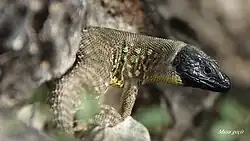
The dorsal scales of T. princeps are an olive-tinted grey color, and the underbelly is an off-white. They have blue spots edged with black on their sides.[3] Adult males have blue around their mouths, and adult females often have dark olive-green or black heads.
The outer row of ventral scales are smooth, and there are 13-17 femoral pores on each side.[4]
Juvenile T. princeps often have less spotting on their backs, in comparison to the spotting found on adults.
Geographic range
Timon princeps is native to southwestern Iran (central Zagros Mountains near Shiraz), northern Iraq, northeastern Syria, and southeastern Turkey.[2]
Ecology
The population of Timon princeps located in Iran is exclusively found in the forested areas of the Zagros Mountains.[5]
Reproduction
T. princeps is oviparous.[2] During breeding, males will bite onto the lower back of females.
Conservation
As of December of 2008, Timon princeps is listed as Least Concern on the IUCN Red List.[1]
References
- 1 2 Tok, Varol; Ugurtas, Ishmail; Sevinç, Murat; Crochet, Pierre-André; Kaska, Yakup; Kumlutaş, Yusuf; Avci, Aziz (2009). "Timon princeps". The IUCN Red List of Threatened Species. 2009 e.T164629A5913265. IUCN. doi:10.2305/IUCN.UK.2009.RLTS.T164629A5913265.en. Retrieved 17 August 2026.
- 1 2 3 Species Timon princeps at The Reptile Database . www.reptile-database.org.
- ↑ Blanford, W. T. (1874). "Descriptions of new Reptilia and Amphibia from Persia and Baluchistan" (PDF). The Annals and Magazine of Natural History. 4 (14): 31. Retrieved 22 August 2026.
- ↑ Anderson, Steven C. (13 June 1974). "Preliminary Key to the Turtles, Lizards, and Amphisbaenians of Iran". Fieldiana: Zoology. 65 (4). Chicago, U.S.A.: Field Museum of Natural History: 40. ISSN 0015-0754. Retrieved 19 August 2026.
- ↑ Anderson, S.C. (1968). Fisher, W. B. (ed.). "Zoogeographic analysis of the lizard fauna of Iran" (PDF). The Cambridge History of Iran: The Land of Iran. 1. Cambridge University Press: 351. doi:10.1017/CHOL9780521069359. Retrieved 19 August 2026.
External links
- Photos: multiple pictures
Further reading
- Blanford WT (1876). Eastern Persia: An Account of the Journeys of the Persian Boundary Commission 1870–71–72. Vol. II. Zoology and Geology. Published by the Authority of the Government of India. London: Macmillan and Co. viii + 516 pp. + Plates I-XXVIII. (Lacerta princeps, pp. 364–367 + Plate XXIV).
- Boulenger GA (1887). Catalogue of the Lizards in the British Museum (Natural History). Second Edition. Volume III. Lacertidæ ... London: Trustees of the British Museum (Natural History). (Taylor and Francis, printers). xii + 575 pp. + Plates I-XL. (Lacerta princeps, pp. 18–19).
- Mayer, Werner; Bischoff, Wolfgang (1996). "Beiträge zur taxonomischen Revision der Gattung Lacerta (Reptilia: Lacertidae). Tiel 1: Zootoca, Omanosaura, Timon und Teira als eigenständige Gattungen [Contributions to the taxonomic revision of the genus Lacerta (Reptilia: Lacertidae). Part 1: Zootoca, Omanosaura, Timon and Teira as full genera]". Salamandra 32 (3): 163–170. (Timon princeps, new combination, p. 169). (in German, with an abstract in English).