Thirunizhalmala
| Thirunizhalmala | |
|---|---|
 | |
| Written | c. 13th century |
| Country | Aranmula |
| Language | Malayalam |
| Genre | "Pattu" genre |
Thirunizhalmala ("Garland of the Sacred Shade" or "Grace"[1]) is a c. 13th century "pattu" genre poem in the Malayalam language.[2][3] Along with "Ramacharitham", it is one of the earliest extant poems in Malayalam.[2] It is generally considered to be a work associated with the Vaishnavite bhakti movement in south India.[4] It is sometimes referred to as "the first religious work in the Malayalam".[1] "Thirunizhalmala" was discovered by the scholar M. M. Purushothaman Nair in 1980.[5][1]
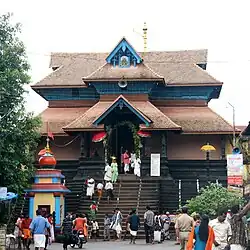
The poem was most probably composed by a high-caste poet (from a certain "Kurumur Palli"), using local meters and Dravidian orthography.[6][7] It is assumed that the work predates the famous "Ramacharitham" by around a century.[8] The manuscript of the poem was discovered in northern Kerala.[4] The central theme of the poem is the description of the ritual life of the Aranmula Temple in Pathanamthitta.[9] The main rites described are the ancient rituals of the Malayar or Malayan community, performed to remove the various impurities of the gods.[8][4] It also describes the temple and its surroundings, the families of the temple-villages' owners, and the protecting soldiery.[4]
"Thirunizhalmala" is linked to the north Kerala art form Theyyam and the community of its performers.[10] The poem contains the earliest instance in Malayalam of the legend of Parasurama "founding" Kerala and establishing the sixty-four Brahmin settlements.[6] It also mentions the medieval Tamil poet Kamban.[6]
Modern editions of "Thirunizhalmala" have been published by M. M. Purushothaman Nair (1981 and 2016) and R. C. Karippath (2006).[10]
References
- 1 2 3 Freeman, Rich (2003). "The Literature of Hinduism in Malayalam". In Flood, Gavin (ed.). The Blackwell Companion to Hinduism. Blackwell Publishing. p. 163. ISBN 0-631-21535-2.
- 1 2 Freeman, Rich (2003). "The Literary Culture of Premodern Kerala". In Sheldon, Pollock (ed.). Literary Cultures in History. University of California Press. pp. 444 and 449.
- ↑ Nair, Purushothaman, ed. (1981). Thirunizhal Mala: Prachina Bhashakavyam. Kottayam: Current Books. pp. 35–36.
- 1 2 3 4 Freeman, Rich (2003). "The Literary Culture of Premodern Kerala". In Sheldon, Pollock (ed.). Literary Cultures in History. University of California Press. pp. 460–62.
- ↑ Freeman, Rich (2003). "The Literary Culture of Premodern Kerala". In Sheldon, Pollock (ed.). Literary Cultures in History. University of California Press. p. 458.
- 1 2 3 Freeman, Rich (2003). "The Literary Culture of Premodern Kerala". In Sheldon, Pollock (ed.). Literary Cultures in History. University of California Press. pp. 458–59.
- ↑ Freeman, Rich (2003). "The Literary Culture of Premodern Kerala". In Sheldon, Pollock (ed.). Literary Cultures in History. University of California Press. p. 460.
- 1 2 Freeman, Rich (2003). "The Literary Culture of Premodern Kerala". In Sheldon, Pollock (ed.). Literary Cultures in History. University of California Press. pp. 458–60.
- ↑ Leelavathy, M. (1996). Malyalakavithasahithya Charithram. Trichur: Kerala Sahitya Akademi. pp. 26–30.
- 1 2 Galewicz, Cezary (2021). "Editorship and History Making: On Historicizing Modern Editions of Tiruniḻalmāla". Cracow Indological Studies. 23 (1): 9–10. doi:10.12797/cis.23.2021.01.01. ISSN 2449-8696.


