Thiele−Innes elements
The Thiele−Innes elements, named after Thorvald N. Thiele (1838–1910)[1] and Robert T.A. Innes (1861–1933)[2], are auxiliary quantities that can be used to calculate the relative apparent position of components of a binary star system.[3]
Orbital elements

The orbit of a binary star and the relative position at any moment of its components (specifically the position of the weaker component B relative to the brighter component A) are characterized by a set of seven orbital elements. These elements are (as an example numerical values are given for alpha Centauri[4]):
| symbol | orbital element | alpha Centauri |
|---|---|---|
| P | period of revolution | 79.910 ± 0.011 years |
| a | semi-major axis (in arcseconds) | 17″.570 ± 0″.022 |
| i | inclination between plane of true orbit and plane of its projection on the celestial sphere | 79°.205 ± 0°.041 |
| Ω | ascending node: position angle of intersection line between true and apparent orbits | 204°.850 ± 0°.084 |
| T | instant (Julian year) of the stars' passage through the periastron | 1875.660 ± 0.012 |
| e | numerical eccentricity of the orbit | 0.51790 ± 0.00076 |
| ω | angle between ascending node and periastron, counted in the direction of motion | 231°.650 ± 0°.076 |
Definition of the Thiele-Innes elements
The Thiele-Innes elements are constants that describe how the real orbit in space is projected onto the celestial sphere. They are functions of the orbital elements a, Ω, ω, and i (the so-called classical or Campbell elements[5]), and are defined as follows:[6]
- A = a · (cos ω cos Ω − sin ω sin Ω cos i)
- B = a · (cos ω sin Ω + sin ω cos Ω cos i)
- F = a · (−sin ω cos Ω − cos ω sin Ω cos i)
- G = a · (−sin ω sin Ω + cos ω cos Ω cos i)
For alpha Centauri one finds from the orbital elements above:
- A = 8″.8076
- B = 6″.9231
- F = −13″.3613
- G = −3″.9378
From elements to position
The time (t)-dependent part of the Kepler orbit of the binary star follows from the three remaining orbital elements, e, T and P. First one calculates the mean anomaly M(t) at a time t:
- M = (t − T) · 360°/P (modulo 360°)
Next, find the eccentric anomaly E, such that E = M + e sin(E) (Kepler's equation).
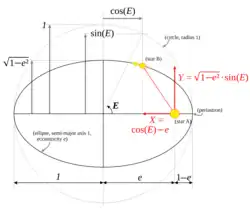
From E and the orbital eccentricity e follow the rectangular coordinates within the Kepler orbit:
- X = cos(E) − e
- Y = √(1−e²) · sin(E)
The apparent position (x,y) of the double star, in rectangular coordinates, as seen from Earth, can then be calculated by means of:
- x = A·X + F·Y
- y = B·X + G·Y
(positive x is North, positive y is East[7]).
This can be elegantly written as a simple matrix multiplication:

From x and y follow the phase angle ϑ (theta; measured counterclockwise in degrees from North) and the apparent distance ρ (rho; in arc seconds):
- ρ = √ [x² + y²]
- ϑ = arctan(y/x) (modulo 360°) (if x>0), or
- arctan(y/x) + 180° (if x<0);
- if x=0, then ϑ = 90° (if y>0) or ϑ = 270° (if y<0)
A calculation
Example: alpha Centauri. At the beginning of the year 2010 (t = 2010.0) one finds:
- M = 245°.211
- E = 224°.436
- X = cos(E) − e = −1.23193
- Y = √(1−e²) · sin(E) = −0.59891
- x = AX + FY = −2″.848
- y = BX + GY = −6″.170
- ρ = √ [x² + y²] = 6″.796
- ϑ = arctan(y/x) + 180° = 245°.222
Popularity
Historically, the Thiele-Innes elements simplified various calculations regarding the orbits of binary stars.[8] Using the Thiele-Innes method has also long been attractive because of the fact that the elements A, B, F, and G are constants that need to be evaluated only once; thereafter, in an age before the modern computer, a time series of E(t), and thus a full series of positions (ρ,ϑ), could be calculated efficiently.[9]
References
- ↑ Thiele, Thorvald N. (1883). "Neue Methode zur Berechnung von Doppelsternbahnen". Astronomische Nachrichten. 104: 245–254. Retrieved 2026-08-24.
- ↑ Bos, W.H. van den; Innes, R.T.A. (1926). "Orbital Elements of Binary Stars". Circular of the Union Observatory Johannesburg. 68: 352–359. Retrieved 2026-08-24.
- ↑ W.D. Heintz, 'Double stars', in: G.D. Roth, Arthur Beer, Astronomy: a Handbook (Cambridge Massachusetts: Sky Publishing Company, 1975) pp. 472-486: 484-485. ISBN 0-387-91125-1.
- ↑ Finsen, W.S.; Worley, C.E. (1970). Third Catalogue of Orbits of Visual Binary Stars (PDF). Johannesburg: Republic Observatory Johannesburg. p. 203. Retrieved 2026-08-24.
- ↑ Heintz, p. 485.
- ↑ Heintz, p. 474 (Fig. 20-1).
- ↑ Van den Bos & Innes (1926), pp. 356-359, repeatedly stress the many advantages of their use, for example: "Mr. Finsen had the opportunity of applying both methods to the same case, and was struck by the great simplification introduced by the new method" (p. 356 note)."
- ↑ Heintz, p. 485 (with note 5).