The Uncle from Brooklyn
| The Uncle from Brooklyn | |
|---|---|
 | |
| Directed by | Ciprì & Maresco |
| Screenplay by | Ciprì & Maresco |
| Produced by | Galliano Juso |
| Starring | Pippo Agusta |
| Cinematography | Luca Bigazzi |
| Edited by | Jacopo Quadri |
| Music by | Joseph Vitale |
| Distributed by | Filmauro |
Release date |
|
| Language | Italian |
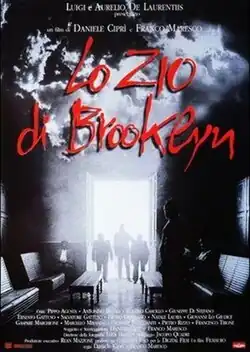
The Uncle from Brooklyn (Italian: Lo zio di Brooklyn) is a 1995 Italian black comedy film written and directed by Ciprì & Maresco, at their feature film debut.
Plot
Cast
- Pippo Agusta as Don Masino
- Francesco Arnao as Saint Polifemo
- Antonino Bruno as Zoras the Magician
- Rosario Carollo as Ciccio Gemelli
- Luigi Cinà as Paliddu
Production
The film marked the feature debut of Daniele Ciprì and Franco Maresco, a duo of Sicilian filmmakers who had attracted critical acclaim and a cult following thanks to the Rai 3 series Cinico TV.[1] It was shot in Palermo with a cast of non-professional actors and a budget of about 600 millions lire.[2]
Release
The film was selected for screening at the 52nd Venice International Film Festival, but the directors ultimately withdrew it, protesting against the choice of placing it into the secondary Window on Images sidebar.[2][3] It was later screened at the 46th Berlin International Film Festival, in the Forum section.[4]
Reception
For this film Ciprì & Maresco were nominated for the Nastro d'Argento for Best New Directors.[5] Luca Bigazzi won the Ciak d'Oro for Best Cinematography.[6]
Variety's critic David Rooney described the film as a "both praiseworthy and disappointing", noting that "on one hand, it reps an exercise of extreme audaciousness, thumbing its nose at commercial film conventions. On the other, the tenuousness of the story makes it seem too much like an extended, at times undisciplined version of material with which Cipri and Maresco aficionados are already familiar".[7] Time Out called it "deliriously weird" and "a gloriously bawdy black comedy".[8] Director Gianni Amelio referred to it as "a heart-wrenching film", claiming "I don’t know whether it marks the end of cinema or its rebirth".[3] In a retrospective analysis, Ernest Hampson similarly described it as "a film which bids farewell to the cinema", noting "it gradually unravels and self-destructs, in step with the imminent disintegration of the universe which it depicts", and its "perverse anti-narrative" apparently "take[s] pleasure in confusing and frustrating the expectations of the modern audience".[1]
References
- 1 2 Hampson, Ernest (2005). "Cipri and Maresco: Uncompromising Visions — Aesthetics of the Apocalypse". In Hope, William (ed.). Italian Cinema: New Directions. P. Lang. ISBN 978-0-8204-7209-6.
- 1 2 Manin, Giuseppina (29 July 1995). "Vi manca il coraggio, non avrete nostro Zio". Corriere della Sera. p. 28.
- 1 2 Ventavoli, Bruno (27 August 1995). "Dalla Sicilia con cinismo". La Stampa. No. 231. p. 14. Retrieved 5 July 2026.
- ↑ Manin, Giuseppina (19 February 1996). "Zio di Brooklyn: chi non abbandona, applaude". Corriere della Sera. p. 28.
- ↑ "Martone e Tornatore supersfida tra i candidati ai Nastri d'Argento". La Repubblica. 3 February 1996. p. 35.
- ↑ Lancia, Enrico (1998). I premi del cinema. Gremese Editore. p. 280. ISBN 978-88-7742-221-7.
- ↑ Rooney, David (29 October 1995). "The Uncle from Brooklyn". Variety. Retrieved 5 July 2026.
- ↑ "The Uncle from Brooklyn". Time Out. 10 September 2012. Retrieved 5 July 2026.