The Trumpeter (song)
| "The Trumpeter" | |
|---|---|
 | |
| Single by John McCormack | |
| Written | 1904 |
| Released | 1918 |
| Genre | pop |
| Length | 2:09 |
| Label | Victor |
| Composer | J. Airlie Dix |
| Lyricist | J. Francis Barron |
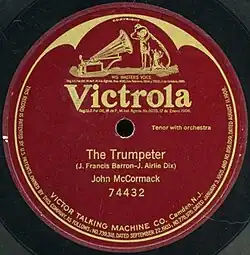
"The Trumpeter" is a 1904 song[1] with music by J. Airlie Dix (d.1911) and lyrics by J. Francis Barron (1870-1940) which became a widely popular before, during and after World War I.[2] Also known by the song's opening line and refrain "Trumpeter, what are you sounding now?", it was recorded with full orchestral arrangement by various artists including Peter Dawson and John McCormack.
Lyrics
Trumpeter, what are you sounding now?
(Is it the call I'm seeking?)
"You'll know the call," said the Trumpeter tall,
"When my trumpet goes a-speakin'.
I'm rousin' 'em up;
I'm waking' 'em up,
The tents are astir in the valley,
And there's no more sleep with the sun's first peep,
For I'm soundin' the old Reveille!"
Trumpeter what are you sounding now?
(Is it the call I'm seeking?)
"Can't mistake the call," said the Trumpeter tall,
"When my trumpet goes a-speakin'.
I'm urging' 'em on,
They're scamperin' on,
There's a drummin' of hoofs like thunder.
There's a madd'nin' shout as the sabres flash out,
For I'm sounding the "Charge" no wonder."
Trumpeter what are you sounding now?
(Is it the call I'm seeking?)
"Lucky for you if you hear it at all
For my trumpet's but faint in speakin',
I'm callin' 'em home! Come home! Come home!
Tread light o'er the dead in the valley,
Who are lyin' around face down to the ground,
And they can't hear me sound the 'Rally'.
But they'll hear it again in a grand refrain
When Gabriel sounds the 'Rally'."[3]
References
- ↑ "The Trumpeter (Dix, Joshua Airlie)". International Music Score Library Project (IMSLP) / Petrucci Music Library. Retrieved 3 June 2026.
- ↑ Brian Murdoch Fighting Songs and Warring Words: Popular Lyrics of Two World Wars 2002 1134969058 -"One example is 'The Trumpeter', written in 1904 by J.Francis Barron and J. Airlie Dix. It achieved perhaps its greatest popularity in performance and recordings during the war, though it remained known in a version by Peter Dawson after the war. It may be considered in the light of a wartime recording, in which it was given a quasi-natural context by Raymond Newell and Ion Swinley. On 12" Columbia 9776 (1929). 24 Their recording opens with a conversation before battle, behind which the bugle call motif of the music ....."
- ↑ "The LiederNet Archive".