Las Trece Rosas
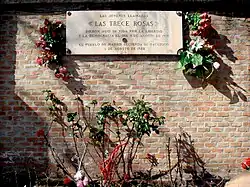
Las Trece Rosas (the "Thirteen Roses") were a group of thirteen young women who were executed by a Francoist firing squad on 5 August 1939, just after the conclusion of the Spanish Civil War. Their execution was part of a massive execution campaign known as the "saca de agosto", which also included 43 young men (among them a fourteen-year-old).[1]
Following the capitulation of Madrid to Franco's troops and the end of the Civil War, the Madrid Provincial Committee of the Unified Socialist Youth (JSU) (an organisation resulting from the merger of the Socialist Youth and the Communist Youth even though most pro–Spanish Socialist Workers' Party (PSOE) members had abandoned the organisation) tried to reorganise under the leadership of 21-year-old José Peña Brea. He was betrayed, arrested, and tortured; under torture he revealed the names of his collaborators, which led to a wave of arrests of JSU members in Madrid. The Thirteen Roses were among the many JSU members captured and imprisoned by the police. During their detention in the Ventas prison they were repeatedly tortured and humiliated, and conditions in the prison were considered inhumane and overcrowded. They were ultimately executed by firing squad against the wall of the East Cemetery (now la Almudena) on 5 August 1939. Many of their comrades at the prison recall that while they were being driven away by lorry to their deaths, they sang the "Youthful Guardsmen" (JSU's anthem) so as to be heard by their comrades who remained in jail. The victims were accused of aiding a military rebellion and of assassinating a high-ranking political police officer, his 16-year-old daughter, and driver;[2] however, they were already in prison when the assassination occurred.
In 2005, a foundation (Fundación Trece Rosas) was created in Spain to keep their memory alive.
Victims
The thirteen victims were:[3]
Seven of the women were under age – in Francoist Spain the age of majority was 21.[4]
| Photo | Name | Age | Job | Biography |
|---|---|---|---|---|
| Carmen Barrero Aguado | 24 | |||
| Martina Barroso García | 22 | |||
| Blanca Brissac Vázquez | 29 | |||
| Pilar Bueno Ibáñez | 27 | |||
 |
Julia Conesa Conesa | 19 | ||
| Adelina García Casillas | 19 | |||
| Elena Gil Olaya | 20 | |||
| Virtudes González García | 18 | |||
| Ana López Gallego | 21 | |||
| Joaquina López Laffite | 23 | |||
 |
Dionisia Manzanero Salas | 20 | ||
| Victoria Muñoz García | 19 | |||
| Luisa Rodríguez de la Fuente | 18 |
An additonal woman, Antonia Torre Yela, is considered the "fourteenth rose".[5]
See also
References
- ↑ Preston 2011, p. 633.
- ↑ Casanova et al. 2004, p. 329.
- ↑ Egido León 2009, p. 63.
- ↑ Huete Machado, Lola (5 August 2017). "La corta vida de trece rosas". El País (in Spanish). Retrieved 2 March 2025.
- ↑ Hernández Holgado, Fernando (24 October 2003). Mujeres encarceladas: la prisión de Ventas, de la República al franquismo, 1931-1941 (in Spanish). Marcial Pons Ediciones de Historia. ISBN 9788495379641.
Bibliography
- Casanova, Julián; Solé i Sabaté, Josep Maria; Villarroya, Joan; Moreno, Francisco (2004). Víctimas de la guerra civil (in Spanish). Madrid: Temas de Hoy. ISBN 978-8484603337.
- Egido León, Ángeles (26 October 2009). El perdón de Franco. La represión de las mujeres en el Madrid de la posguerra (in Spanish). Madrid: Catarata. ISBN 978-8483194621.
- Ferrero, Jesús (2003). Las Trece Rosas (in Spanish). Madrid: Ediciones Siruela. ISBN 8478446761.
- Fonseca, Carlos (2004). Trece Rosas Rojas: La Historia Mas Conmovedora de La Guerra Civil (in Spanish). Madrid: Temas de Hoy. ISBN 978-8484603610.
- Larson, Kajsa C. (May 2010). Remembering the Thirteen Roses: Thinking between History and Memory (PhD thesis). University of Minnesota. Retrieved 3 March 2025.
- Preston, Paul (2011). El holocausto español : odio y exterminio en la Guerra civil y después (in Spanish). Barcelona: Debate. ISBN 9788483068526.
External links
- Foundation Trece Rosas (archived)
- Tribute to Las Trece Rosas (archived)
- La corta vida de trece rosas
- with part of the original verdict.
- Spanish women of the Spanish Civil War (Republican faction)
- Spanish people of the Spanish Civil War (Republican faction)
- Spanish socialists
- Spanish communists
- Executed Spanish women
- Martyrs of the Spanish Civil War
- Executed activists
- Communists executed by Francoist Spain
- People executed by Spain by firing squad
- 20th-century mass murders in Spain
- Massacres in 1939
- Massacres of women
- Massacres in Spain
- 1939 in Spain
- August 1939 in Europe
- Victims of the White Terror (Spain)
- Femicide in Spain