The Steep Banks Overflowed
| "Rozlylysja kruti berezhechky" | |
|---|---|
 | |
| Song | |
| Language | Ukrainian |
| English title | The Steep Banks Overflowed |
| Released | 17th century |
| Genre | Cossack song |
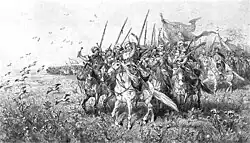
The Steep Banks Overflowed[a] (Ukrainian: Розлилися круті бережечки, romanized: Rozlylysja kruti berezhechky[b][c]) is a popular Ukrainian Cossack historical folk song from the mid-17th century.[3] The lyrics of the final part of The Steep Banks Overflowed were later reused in 1875 as the opening lines of Oi u luzi chervona kalyna, a popular patriotic song sometimes called the unofficial "second national anthem of Ukraine".[3]
History
The folk composition The Steep Banks Overflowed dates from the mid-17th century Khmelnytskyi Uprising. The most popular variant of the song was recorded by Volodymyr Antonovych and Mykhailo Drahomanov during their ethnographic studies in 1875 in the village of Marianivka, then part of Yelysavethrad county, Kherson Governorate.[6][1]
The text was probably composed in the mid-17th century, on the eve of or at the start of the Khmelnytsky Uprising.[7] The theme of the work, by providing an insight into Ukraine’s situation at the time, calls for an armed struggle for a better future.
In 1875, the song was published by Fritz's printing house in Kyiv in the collection «Историческія пѣсни малорусскаго народа. Пѣсни о борьбѣ съ Поляками при Богданѣ Хмельницкомъ.» ("Historical Songs of the Little Russian People. Songs about the struggle against the Poles under Bohdan Khmelnytsky."), with commentary by Mykhailo Drahomanov and Volodymyr Antonovych.[8] Soon thereafer, in the 1880s, the arrangement for male choir was made by Mykola Lysenko.[9]
In 1914, just before the First World War broke out, the director and producer of the Ukrainska Besida Theatre in Lviv, Stepan Charnetskyi, decided that the final verses of the song Rozlylysya kruti berezhechky became the opening of a new patriotic choral piece, Oi u luzi chervona kalyna:[10]
| Ukrainian original (1875) | Ukrainian Latin alphabet[b] | English translation |
|---|---|---|
Гей, у лузі червона калина, / Гей, гей, похилилася; |
Hej, u luzi chervona kalyna, / Hej, hej, pokhylylasja; |
Hey, in the meadow a red kalyna / Hey, hey, has bent down low, |
А ми ж тую червону калину, / Гей, гей, та піднімемо; |
A my zh tuju chervonu kalynu, / Hej, hej, pidnimemo, |
And we will take that red kalyna / Hey, hey, and we will raise it up, |
| Ukrainian original (1914) | Ukrainian Latin alphabet[b] | English translation |
|---|---|---|
Ой у лузі червона калина похилилася, |
Oj u luzi chervona kalyna pochylylasja, |
Oh, in the meadow a red kalyna has bent down low, |
In 1914, having staged Vasyl Pachovsky’s tragedy about Hetman Petro Doroshenko, The Sun of Ruin, Charnetskyi was dissatisfied with the final lamenting song Чи я в лузі не калина була? (Chy ya v luzi ne kalyna bula?, "Was I not a viburnum in the meadow?").[10][1] To give the play a more optimistic ending, Charnetskyi incorporated the song Rozlylysja kruti berezhechky into the drama.[5] He altered the lyrics slightly so that they would fit better with the play's narrative.[5] However, he left the final verse unchanged. In addition, Stepan Charnetskyi composed a new melody for the song, one reminiscent of folk music.[5]
The song soon gained popularity among the Galician youth.[5] Lieutenant Hryhoriy Trukh of the Ukrainian Sich Riflemen, having heard the final verse of the song in Charnetsky’s adaptation, added three more stanzas to it.[1][5] The two songs were merged, linking two different historical eras.[1] Oi u luzi chervona kalyna became a popular song among the Ukrainian Sich Riflemen, and eventually their anthem.[5]
In modern times, the song took on new meanings. Instead of ‘glorious Cossacks’, the lyrics now feature ‘our volunteers’.
Following the Declaration of Independence of Ukraine in 1991, Oi u luzi chervona kalyna became one of several unofficial anthems of Ukraine.[5] Another arrangement of the piece was created by Bohdan Sapelyuk, who composed one of the first marches for the Ukrainian Armed Forces military band, combining motifs from the melodies of Chervona Kalyna by Charnetskyi and "Let's Fill, Brothers, the Crystal Cups" by Viktor Lisovol.
Thus, the patriotic theme of this folk song embodies the centuries-old traditions of Ukrainian freedom fighters.[1]
Text
| Ukrainian original (1875[8]) | Ukrainian Latin alphabet[b] | English translation |
|---|---|---|
Розлилися круті бережечки, |
Rozlylysja kruti berezhechky, |
The steep banks overflowed, |
Гей ви, хлопці, ви, добрі молодці, |
Hej vy, khlopci, vy, dobri molodci, |
Hey you, guys, you fine fellows |
Та поїдем у чистеє поле, |
Ta pojidem u chysteje pole, |
We will head out into the open field, |
Гей, щоб наша червона китайка, |
Hej, shchob nasha chervona kytajka, |
Hey, so that our red kytajka,[d] |
Гей, щоб наша червона китайка, |
Hej, shchob nasha chervona kytajka, |
|
Гей, у лузі червона калина, |
Hej, u luzi chervona kalyna, |
Hey, in the meadow a red kalyna[d] |
А ми ж тую червону калину, |
A my zh tuju chervonu kalynu, |
|
In literature
In the early 2000s, Raisa Ivanchenko wrote a novella of the same name based on the song Rozlylysya kruti berezhechky.[11]
See also
Notes
- ↑ According to Starshova & Myronenko (2024).[1] Other English translations include The Steep Banks (Are) Flooded,[2][3] "The Steep Streams Spilled",[4] and "Oh, the river overflows the steep banks".[5]
- 1 2 3 4 According to DSTU 9112:2021 system B.
- ↑ Other transcriptions include Rozlylysia kruti berezhechky[5][4][1] or Rozlilisya kruti berezhechki.[2]
- 1 2 3 4 5 6 7 8 A red silken flag. The word китайка (kytajka or kytaika) literally means "Chinese". It was a generic early modern term for a lightweight silk fabric from China (Китай, Kytaj), usually coloured blue or red. In this case, it is explicitly 'red': червона, chervona. It is connected to the word червоніла (chervonila), literally "becomes red", but in context it means "the red kytajka catches the eye". Thus, when the red flag catches the eye, the Cossack glory is on display. In the last verses, the червона калина (chervona kalyna, "red viburnum", meaning the Viburnum opulus or guelder rose) is connected to the glory of Ukraine.
References
- 1 2 3 4 5 6 7 Starshova & Myronenko 2024, p. 118.
- 1 2 Shablovsky 1970, p. 34.
- 1 2 3 "Russia blocks Ukrainian folk song "Chervona Kalyna" on music platforms". Ukrainska Pravda. 9 November 2022. Retrieved 29 April 2026.
- 1 2 Harmash 2023, p. 205.
- 1 2 3 4 5 6 7 8 9 Kovtun 2023, p. 74.
- ↑ "Ой у лузі червона калина". Retrieved 4 February 2026.
- ↑ "Українські пісні. «Розлилися круті бережечки»" (in Ukrainian). Archived from the original on 16 July 2010. Retrieved 17 October 2011.
- 1 2 Antonovych, Volodymyr; Drahomanov, Mykhailo (1875). Исторические песни малорусского народа [Historical Songs of the Little Russian People] (in Ukrainian). Kyiv: Typography Fritz. p. 50.
- ↑ Bulat, T. P.; Filenko, Taras (2009). Світ Миколи Лисенка. Національна ідентичність, музика і політика України ХІХ — початку ХХ століття [The World of Mykola Lysenko: National Identity, Music and Politics in Ukraine in the 19th and Early 20th Centuries] (in Ukrainian). Kyiv: Майстерня книги. p. 408. ISBN 978-966-2260-17-5.
- 1 2 Kovtun 2023, pp. 73–74.
- ↑ "«Розлилися круті бережечки». Журнал «Вітчизна» № 11-12, 2004 р." Archived from the original on 12 April 2013. Retrieved 17 October 2011.
Literature
- Harmash, Liudmyla (2023). "Reflections of War Experience in Ukrainian Songs". Napis Pismo poświęcone literaturze okolicznościowej i użytkowej. 1: 203–217. doi:10.18318/napis.2023.1.10. Retrieved 29 April 2026.
- Kovtun, Kateryna (29 November 2023). "Oi u luzi chervona kalyna ("Oh, the Red Viburnum in the Meadow") as an Anthem-Song: Social Roles and Genre Transformations in the Time of War". Artistic Culture. Topical Issues. 19 (2): 74–79. doi:10.31500/1992-5514.19(2).2023.294625. ISSN 2618-0987. Retrieved 29 April 2026.
- Shablovsky, Yevhen Stepanovych (1970). Ukrainian Literature Through the Ages. Mistetstvo Publishers. pp. 34–35. Retrieved 29 April 2026.
- Starshova, Oksana; Myronenko, Polina (1 June 2024). "The Role of Popular Culture in Times of Disaster: A Case Study of the War Morale Songs in the Russo-Ukrainian War". East-West Cultural Passage. 24 (1): 110–132. doi:10.2478/ewcp-2024-0007. ISSN 2067-5712. Retrieved 29 April 2026.
- П. Д. Павлій та інші «Українські народні думи та історичні пісні.» К; Видавництво АН УРСР, 1955, 700 с.
External links
- Українські народні пісні. «Розлилися круті бережечки…»
- Українські народні пісні. Ліричні пісні. Archived 30 July 2019 at the Wayback Machine
- Сайт Державного самоврядування українців Угорщини. «Ой у лузі червона калина»
- «Розлилися круті бережечки». Аранжування Миколи Лисенка. Виконує Чоловічий хоровий ансамбль «Боян», диригент Богдан Антків
- "«Розлилися круті бережечки» (різні варіанти тексту пісні)" [The Steep Banks Overflowed (different versions of the song lyrics)] (in Ukrainian). Archived from the original on 22 February 2014.