Tetrachlorocyclopropene
 | |
| Identifiers | |
|---|---|
3D model (JSmol) |
|
| ChemSpider | |
| ECHA InfoCard | 100.025.835 |
PubChem CID |
|
| UNII | |
CompTox Dashboard (EPA) |
|
| |
| |
| Properties | |
| C3Cl4 | |
| Molar mass | 177.83 g·mol−1 |
| Appearance | Colorless liquid |
| Density | 1.45 g/mL |
| Boiling point | 125–130 °C (257–266 °F; 398–403 K) |
| Related compounds | |
Related tetrahalocyclopropenes |
Tetrafluorocyclopropene Tetrabromocyclopropene Tetraiodocyclopropene |
Except where otherwise noted, data are given for materials in their standard state (at 25 °C [77 °F], 100 kPa).
Infobox references | |

Tetrachlorocyclopropene is a chemical compound with the formula C3Cl4. A colorless liquid, the compound is a reagent used to prepare acetylene derivatives and in organic synthesis.[1] It was first reported by Tobey and West.[2] It is prepared by addition of dichlorocarbene to trichloroethylene and then further treating the resultant pentachlorocyclopropane with base to perform dehydrochlorination.[3]
Treatment with a good chloride-accepting Lewis acid affords trichlorocyclopropenium (C3Cl+3) salts, a carbocation that is aromatic like other cyclopropenium ions, as predicted by Hückel's rule. Aluminum trichloride is most commonly used as the Lewis acid, giving the tetrachloroaluminate salt:[1][4]
- C3Cl4 + AlC3 → [C3Cl+3][AlCl−4]
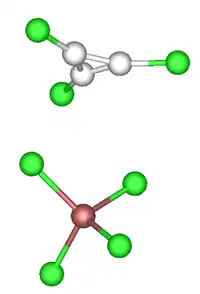
The structure of trichlorocyclopropenium has been confirmed by X-ray crystallography of this salt.[5] Salts of hexachloroantimonate (SbCl−6), tetrachloroferrate (FeCl−4), and tetrachlorogallate (GaCl−4) have also been prepared from other Lewis acids.[4] Tetrachlorocyclopropene appears inert towards boron trifluoride and trichloride, but reacts with boron tribromide to give tetrabromocyclopropene, with gaseous boron trichloride leaving solution:[2]
- 3 C3Cl4 + 4 BBr3 → 3 C3Br4 + 4 BCl3
Arylpropiolate esters may be prepared from trichlorocyclopropenium by reacting with arenes, followed by hydrolysis in alcohols.[1] This can be done without isolating the trichlorocyclopropenium ion.
Trichlorocyclopropene is also used to prepare arylcyclopropanones by a two-step, one-pot procedure beginning with a Friedel-Crafts-like arylation, with trichlorocyclopropenium as an intermediate prepared in situ:[1]
- C3Cl4 + ArH → ArC3Cl3 + HCl (ArH = arene)
The aryltetrachlorocyclopropenes are then hydrolyzed to give the keto-alcohol:
- ArC3Cl3 + 2 H2O → ArC3O(OH) + 3 HCl
References
- 1 2 3 4 Oliver Reiser; Armin de Meijere; Brittany M. Klootwyk; Gregory R. Boyce (2019). "Tetrachlorocyclopropene". EEROS. doi:10.1002/047084289X.rt028. ISBN 978-0-471-93623-7.
{{cite journal}}: CS1 maint: periodical has ISBN (link) - 1 2 Tobey, S. W.; West, R. (1963). "Tetrachlorocyclopropene and Hexachlorocyclopropane from Pentachlorocyclopropane". Tetrahedron Letters. 4 (18): 1179–1182. doi:10.1016/S0040-4039(01)90799-3.
- ↑ Tobey, S. W.; West, R. (1966). "Tetrachlorocyclopropene, Tetrabromocyclopropene, and Some Fluorinated Cyclopropenes and Cyclopropanes". Journal of the American Chemical Society. 88 (11): 2481–2488. Bibcode:1966JAChS..88.2481T. doi:10.1021/ja00963a023.
- 1 2 West, R.; Sadô, A.; Tobey, S. W. (1966). "Synthesis of Trihalocyclopropenium Salts and Normal Coordinate Analysis of C3Cl3+". Journal of the American Chemical Society. 88 (11): 2488–2494. doi:10.1021/ja00963a024.
- ↑ Clark, George R.; Taylor, Michael J.; Steele, Derek (1993). "Crystal Structure Determination of C3Cl3+AlCl4- and ab initio Studies of the Structure and Vibrational Spectrum of the Trichlorocyclopropenium Cation". Journal of the Chemical Society, Faraday Transactions. 89 (19): 3597. doi:10.1039/ft9938903597.