Tendaguripterus
| Tendaguripterus | |
|---|---|
Scientific classification  | |
| Kingdom: | Animalia |
| Phylum: | Chordata |
| Class: | Reptilia |
| Order: | †Pterosauria |
| Suborder: | †Pterodactyloidea |
| Family: | †Tendaguripteridae Kellner, 2007 |
| Genus: | †Tendaguripterus Unwin & Heinrich, 1999 |
| Species: | †T. recki |
| Binomial name | |
| †Tendaguripterus recki Unwin & Heinrich, 1999 | |
Tendaguripterus ('Tendaguru finger') is a genus of pterosaur that lived during the Late Jurassic period in what is now Tanzania. The only specimen – a dentary (lower jaw) – was discovered in strata of the Tendaguru Formation in southeastern Lindi. Between 1910 and 1912, members of a German fossil expedition to the Tendaguru Formation in then-German East Africa collected many pterosaur fossils from Site Jg. One fossil, an isolated dentary, was later taken to the Museum für Naturkunde in Berlin, Germany. This specimen was unnoticed for decades until in 1999, paleontologists David Unwin and Wolf-Dieter Heinrich scientifically described it as belonging to a new genus and species of pterosaur. They named it Tendaguripterus recki, the only known species, after German geologist Hans Reck.
Tendaguripterus' affinities are uncertain. In its original description, it was considered an intermediate stage of dsungaripteroid that was more derived than Germanodactylus but less derived than dsungaripterids like Dsungaripterus and Noripterus. However, in 2007 Brazilian paleontologist Alexander Kellner and colleagues placed it in its own family, Tendaguripteridae. The classification of this family within Pterodactyloidea is unknown. Based on Germanodactylus, its wingspan was about 1 meter (3.3 ft) wide. The dentary is short, robust, and tall, with four alveoli (tooth sockets) and two incomplete teeth preserved. Going posteriorly (towards the back), the dentary becomes over 1.5 times the height of the anterior (front) end, creating an extremely deep shape. Its toothrow looks scalloped (bumpy around the alveoli) in lateral view with intensely protruding teeth. It has been proposed that Tendaguripterus was durophagus, feeding on hard invertebrates like bivalves. Its fossils are known from the Tendaguru Formation, which was located on the southeastern coast of the landmass Gondwana during the Late Jurassic. Here it coexisted with other pterosaurs like "Rhamphorhynchus" tendagurensis and "Pterodactylus" brancai and dinosaurs like Giraffatitan and Kentrosaurus.
Discovery and naming
Fossils of African pterosaurs are extremely rare, only being known from a few geologic formations.[1][2][3] From 1909 to 1913, German paleontological expeditions to outcrops of the Tendaguru Formation[4] in southeastern Lindi, German East Africa (now Tanzania) unearthed the first pterosaur fossils from East Africa known to science.[5][6][7] During these excursions, fragmentary, isolated pterosaur material was unearthed that was initially described in 1914 by German paleontologist Werner Janensch.[7][8] The first major work on Tendaguru pterosaurs was published in 1931 by German geologist Hans Reck, who assigned many of these bones to new species of Pterodactylus and Rhamphorhynchus.[9] Most of this material consisted of incomplete wing and hindlimb bones, few of which are well preserved enough to be definitively classified. All of the species named by Reck are now considered nomen dubia.[1][3][10]

From 1910 to 1912, Reck directed members of the expedition to focus on collecting remains from Site Jg of Tendaguru Hill, a site in the northern reaches of the area. Site Jg belongs to the Middle Saurian Bed of the Tendaguru Formation, which dates to the Late Kimmeridgian to Early Tithonian stages of the Late Jurassic period.[7][11] At one point, most likely during 1912, expedition collectors discovered an incomplete mandibular symphysis (the area where lower jaws meet) of a pterosaur. Sometime after, the fossil was deposited at the Museum für Naturkunde of the Humboldt University, Berlin under specimen number MB.R.1290. However, this fossil was unprepared for decades and was not identified as from a pterosaur fossil until 1986. It stayed in-situ for decades, but was later prepared with the use of acetic acid by German museum worker H. H. Kreuger. In 1999, German paleontologists David M. Unwin and Wolf-Dieter Heinrich scientifically described MB.R.1290 as coming from a new genus and species of dsungaripteroid pterosaur, Tendaguripterus recki. The generic name comes from "Tendaguru", where the fossil was collected, and the Greek word ptero meaning "wing". Meanwhile, the specific name recki is in honor of Hans Reck. MB.R.1290 was selected as the holotype (name-bearing) specimen and remains the only fossil reported of Tendaguripterus. This was the first documentation of pterosaur skull material from Tendaguru.[7]
In a 2008 article, German paleontologists Oliver Rauhut and Adriana Lopez-Arbarello proposed that fossils of Pterodactylus brancai, consisting of a of tibiotarsus (lower leg bone) and wing phalanx one (finger bone), came from the same organism as Tendaguripterus. Reck described P. brancai based on the two elements, though whether they came from the same individual is unknown. Later studies have declared P. brancai a nomen dubium. In 1980, German researcher Peter Galton moved P. brancai to the genus Dsungaripterus,[10] but later studies have opposed this, stating that P. brancai dubious and an indeterminate dsungaripteroid.[7][12][13] Based on the purported dsungaripteroid affinities of Tendaguripterus, Rauhut and Lopez-Arbarello (2008) noted that although they may derive from the same species, the lack of overlap between specimens makes this difficult to verify.[13]
Description and classification
Overall, dsungaripteroids have stocky builds, with robustly constructed skull and limb bones in comparison to other pterosaur groups.[14]: 205 In 1999, Unwin and Heinrich stated the skull of Tendaguripterus was around 20 centimetres (7.9 in) when complete based on Germanodactylus, with an estimated wingspan width of 1 meter (3.3 ft). MB.R.1290 has a preserved length of 25.9 centimetres (10.2 in) and is dorsoventrally (top-botttom) deepest towards the posterior (back) end, at 9.9 centimetres (3.9 in) deep.[7] It is preserved in three dimensions, but underwent some taphonomic compression. Each mandible fragment bears four alveoli (tooth sockets), with only two, incomplete teeth preserved. When complete, each dentary had at least five aveoli. The symphysis narrows towards the anterior (front) end, with a deep triangular cross-section. Going posteriorly, the symphysis becomes significantly deeper, with the deepest point of the mandible being 1.5 times the height of the anterior jaw tip. This is similar to the condition found in Dsungaripterus and Germanodactylus, two dsungaripteroids. In contrast, pteranodontoids like Tropeognathus bear jaws that are deeper anteriorly rather than posteriorly. A characteristic diagnostic (distinguishing from related genera) of Tendaguripterus is a concave section on the ventral (bottom) face of the posterior end of the jaw. Although related dsungaripteroids have a similar condition, it is most extreme in Tendaguripterus. When viewed in lateral (side) view, the dental margin (toothrow) appears scalloped, with strongly protruding teeth. This causes the rims of the alveoli to seem inflated,[7][15] more so than in Germanodactylus and less so than in Dsungaripterus. Unlike any other dsungaripteroids, Tendaguripterus' teeth project posteriorly instead of vertically or anteriorly.[7][16] Its teeth are robust, in contrast to the elongated, thin dentition of ctenochasmatids.[17]
Classification

In 1999, Unwin and Heinrich grouped Tendaguripterus in Dsungaripteroidea due to traits such as its deep lower jaw and its largest teeth being at the posterior end of its tooth row.[7] In 2003, Unwin included it in Dsungaripteroidea as well, but did not place it in Dsungaripteridae itself.[18] However, in a 2007 study Brazilian paleontologist Alexander Kellner and colleagues stated that its resemblance to Germanodactylus and Dsungaripterus was superficial. The authors added by noting Tendaguripterus cannot even definitively be considered a pterodactyloid and that it lacked any synapomorphies of Dsungaripteroidea. As a result, they named a new family, Tendaguripteridae, exclusively for the genus.[1] Since its description, Tendaguripterus has not been included in a phylogenetic analysis. Its affinities remain unclear.[19]
Paleoecology
Tendaguripterus may have consumed bivalves and other hard-shelled invertebrates. Due to this, it is likely to have inhabited the coasts of a shallow sea or riverbanks.[20] The Tendaguru Formation contains dsungaripteroids, rhamphorynchoids, and basal pterodactyloids. This taxonomic composition is similar to that of the Tatal, Mongolia (Tsagan-Tsab Formation) and Xinjiang, China (Lianmuqin Formation) pterosaur assemblages from the Early Cretaceous of Asia.[7]
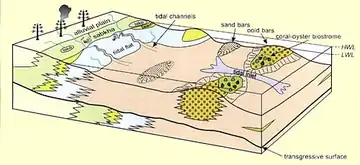
The Tendaguru Formation is a Late Jurassic-aged geologic formation in the Mandawa Basin in southeastern Tanzania. It is composed of six members,[11] though Tendaguripterus is exclusive to the late Kimmeridgian-aged Middle Saurian Member.[7] This section of the formation is defined by fine calcareous sandstones, siltstones, and crudely bedded silt and claystones. In the Late Jurassic, the landmass of Gondwana had not splintered into what is now Africa, South America, India, and Madagascar. The Tendaguru Formation is deposited in what was then the southeastern coast of the landmass, which featured a coastal semi-arid climate with a relatively high moisture content compared to the inland. The Tendaguru ecosystem primarily consisted of three types of environment: shallow, lagoon-like marine environments, tidal flats and low coastal environments; and vegetated inland environments. Its marine environment existed above the fair weather wave base and behind siliciclastic and ooid barriers. It appeared to have had little change in salinity levels and experienced tides and storms. The coastal environments consisted of brackish coastal lakes, ponds and pools. Unlike other layers of the formation, the Middle Dinosaur Member had an especially dry landscape with few marine waters and plentiful brackish and freshwater locales. This member was deposited in a series of tidal flats, lagoons, and coastal sabkhas.[11][21]
The Tendaguru Formation is among the most productive dinosaur-bearing fossil sites in Africa.[22] Dinosaurs known from the Tendaguru Formation include the predatory theropods Torvosaurus,[23] Elaphrosaurus,[24] Veterupristisaurus, and Ostafrikasaurus,[25] as well as the herbivorous ornithischians Dysalotosaurus[26] and Kentrosaurus.[27] Sauropods are the most common dinosaurs in the formation, represented by genera like Dicraeosaurus, Giraffatitan, Janenschia, Tendaguria, and Tornieria.[28][29] Other vertebrates that shared this paleoenvironment included mammals, lizards,[30] frogs,[31] crocodyliforms,[20] bony fish, rays, and sharks.[32] Marine invertebrates are common, represented by corals, bivalves, gastropods, and ostracods.[11][20] The flora included green algae, Araucariacites and Classopollis conifers, Ginkgoxylon ginkgoes, and more.[33]
See also
References
- 1 2 3 Kellner, Alexander; S. Mello, Amanda Martin; Ford, Tracy (2007). "A survey of pterosaurs from Africa with the description of a new specimen from Morocco" (PDF). Paleontologia: Cenarios de Vida. 2007: 257–267.
- ↑ Martill, David M.; Smith, Roy E. (2025-03-31). "Cretaceous pterosaur history, diversity and extinction". Geological Society, London, Special Publications. 544 (1): 501–524. Bibcode:2025GSLSP.544..126M. doi:10.1144/SP544-2023-126. ISSN 0305-8719.
- 1 2 Barrett, Paul M.; Butler, Richard J.; Edwards, Nicholas P.; Milner, Andrew R. (2008). "Pterosaur distribution in time and space: an atlas". Zitteliana. B28: 61–107. doi:10.5282/UBM/EPUB.12007.
- ↑ Heinrich, Wolf-Dieter; Bussert, Robert; Aberhan, Martin (2011). "A blast from the past: the lost world of dinosaurs at Tendaguru, East Africa". Geology Today. 27 (3): 101–106. Bibcode:2011GeolT..27..101H. doi:10.1111/j.1365-2451.2011.00795.x. ISSN 1365-2451.
- ↑ Costa, Fabiana Rodrigues; Sayão, Juliana Manso; Kellner, Alexander Wilhelm Armin (2015-08-18). "New pterosaur material from the Upper Jurassic of Tendaguru (Tanzania), Africa". Historical Biology. 27 (6): 646–655. Bibcode:2015HBio...27..646C. doi:10.1080/08912963.2014.901314. ISSN 0891-2963.
- ↑ Costa, Fabiana R.; Kellner, Alexander W. A. (2009). "On two pterosaur humeri from the Tendaguru beds (Upper Jurassic, Tanzania)". Anais da Academia Brasileira de Ciências. 81 (4): 813–818. Bibcode:2009AnABC..81..813C. doi:10.1590/S0001-37652009000400017. ISSN 0001-3765. PMID 19893904.
- 1 2 3 4 5 6 7 8 9 10 11 Unwin, David M.; Heinrich, Wolf-Dieter (1999). "On a pterosaur jaw from the Upper Jurassic of Tendaguru (Tanzania)". Mitteilungen aus dem Museum für Naturkunde in Berlin, Geowissenschaftliche Reihe. 2: 121–134.
- ↑ Janensch, Werner (1914). "Die Gliederung der Tendaguru-Schichten im Tendaguru-Gebiet und die Entstehung der Saurier-Lagerstätten". Archiv für Biontologie. 3: 227–261.
- ↑ Reck, Hans (1931). "Die deutschostafrikanischen Flugsaurier". Centralblatt für Mineralogie, Geologie und Paläontologie. 7: 321–336.
- 1 2 Galton, Peter M. (1980-12-01). "Avian-like tibiotarsi of pterodactyloids (Reptilia: Pterosauria) from the Upper Jurassic of East Africa". Paläontologische Zeitschrift. 54 (3): 331–342. Bibcode:1980PalZ...54..331G. doi:10.1007/BF02988135. ISSN 1867-6812.
- 1 2 3 4 Bussert, Robert; Heinrich, Wolf-Dieter; Aberhan, Martin (August 2009). "The Tendaguru Formation (Late Jurassic to Early Cretaceous, southern Tanzania): definition, palaeoenvironments, and sequence stratigraphy". Fossil Record. 12 (2): 141–174. Bibcode:2009FossR..12..141B. doi:10.1002/mmng.200900004.
- ↑ Martill, David M.; Frey, Eberhard; Diaz, Guillermo Chong; Bell, C. M. (2000). "Reinterpretation of a Chilean pterosaur and the occurrence of Dsungaripteridae in South America". Geological Magazine. 137 (1): 19–25. doi:10.1017/S0016756800003502. ISSN 1469-5081.
- 1 2 Rauhut, Oliver W. M.; Lopez-Arbarello (December 2008). "Archosaur evolution during the Jurassic: a southern perspective". Revista de la Asociación Geológica Argentina. 63 (4): 557–585. ISSN 0004-4822.
- ↑ Witton, Mark (2013). Pterosaurs (2nd ed.). Princeton University: Princeton University Press. ISBN 978-0-691-15061-1.
- ↑ Pentland, Adele H.; Poropat, Stephen F.; Duncan, Ruairidh J.; Kellner, Alexander W. A.; Bantim, Renan A. M.; Bevitt, Joseph J.; Tait, Alan M.; Grice, Kliti (2024-06-12). "Haliskia peterseni, a new anhanguerian pterosaur from the late Early Cretaceous of Australia". Scientific Reports. 14 (1): 11789. Bibcode:2024NatSR..1411789P. doi:10.1038/s41598-024-60889-8. ISSN 2045-2322. PMC 11169243. PMID 38866826.
- ↑ Maisch, Michael W.; Matzke, Andreas T.; Sun, Ge (2004-10-01). "A new dsungaripteroid pterosaur from the Lower Cretaceous of the southern Junggar Basin, north-west China". Cretaceous Research. 25 (5). doi:10.1016/j.cretre (inactive 6 August 2026). ISSN 0195-6671. Archived from the original on 2024-12-15.
{{cite journal}}: CS1 maint: DOI inactive as of August 2026 (link) - ↑ Witton, Mark P.; O’Sullivan, Michael; Martill, David M. (2015-05-08). Laurin, M. (ed.). "The relationships of Cuspicephalus scarfi Martill and Etches, 2013 and Normannognathus wellnhoferi Buffetaut et al., 1998 to other monofenestratan pterosaurs". Contributions to Zoology. 84 (2): 115–127. doi:10.1163/18759866-08402002. ISSN 1383-4517.
- ↑ Unwin, David M. (January 2003). "On the phylogeny and evolutionary history of pterosaurs". Geological Society, London, Special Publications. 217 (1): 139–190. Bibcode:2003GSLSP.217..139U. doi:10.1144/GSL.SP.2003.217.01.11. ISSN 0305-8719.
- ↑ Upchurch, Paul; Andres, Brian; Butler, Richard J.; Barrett, Paul M. (2015-08-18). "An analysis of pterosaurian biogeography: implications for the evolutionary history and fossil record quality of the first flying vertebrates". Historical Biology. 27 (6): 697–717. Bibcode:2015HBio...27..697U. doi:10.1080/08912963.2014.939077. ISSN 0891-2963. PMC 4536946. PMID 26339122.
- 1 2 3 Aberhan, M.; Bussert, R.; Heinrich, W.-D.; Schrank, E.; Schultka, S.; Sames, B.; Kriwet, J.; Kapilima, S. (2002-01-01). "Palaeoecology and depositional environments of the Tendaguru Beds (Late Jurassic to Early Cretaceous, Tanzania)". Fossil Record. 5 (1): 19–44. Bibcode:2002FossR...5...19A. doi:10.1002/mmng.20020050103. ISSN 2193-0066.
- ↑ Sames, Benjamin (2008). "Application of Ostracoda and Charophyta from the Late Jurassic to Early Cretaceous Tendaguru formation at Tendaguru, Tanzania (East Africa) — Biostratigraphy, palaeobiogeography and palaeoecology". Palaeogeography, Palaeoclimatology, Palaeoecology. 264 (3–4): 213–229. doi:10.1016/j.palaeo.2007.03.053.
- ↑ Mateus, Octávio (2006-01-01). "Late Jurassic dinosaurs from the Morrison formation (USA), the Lourinha and Alcobaca Formations (Portugal), and the Tendaguru Beds (Tanzania): a comparison". New Mexico Museum of Natural History and Science Bulletin. 36: 1–9.
- ↑ Soto, Matías; Toriño, Pablo; Perea, Daniel (2020). "A large sized megalosaurid (Theropoda, Tetanurae) from the late Jurassic of Uruguay and Tanzania". Journal of South American Earth Sciences. 98 102458. Bibcode:2020JSAES..9802458S. doi:10.1016/j.jsames.2019.102458. S2CID 213672502.
- ↑ Janensch, Werner (1920). "Über Elaphrosaurus Bambergi und die Megalosaurier aus den Tendaguru–Schichten Deutsch–Ostafrikas". Sitzungsberichte der Gesellschaft Naturforschender Freunde zu Berlin. 1920: 225–235.
- ↑ Rauhut, Oliver W. M. (2011). "Theropod dinosaurs from the Late Jurassic of Tendaguru (Tanzania)". Special Papers in Palaeontology. 86: 195–239.
- ↑ Hübner TR, Foth C, Heinrich WD, Schwarz D, Bussert R (2021). "Research history, taphonomy, and age structure of a mass accumulation of the ornithopod dinosaur Dysalotosaurus lettowvorbecki from the Upper Jurassic of Tanzania". Acta Palaeontologica Polonica. 66 (2): 275–300. doi:10.4202/app.00687.2019. S2CID 236713607.
- ↑ Galton, P. M. (1988). Skull bones and endocranial casts of stegosaurian dinosaur Kentrosaurus Hennig, 1915 from Upper Jurassic of Tanzania, East Africa. Geologica et Palaeontologica, 22, 123-143.
- ↑ Mannion, Philip D; Upchurch, Paul; Schwarz, Daniela; Wings, Oliver (2019-01-25). "Taxonomic affinities of the putative titanosaurs from the Late Jurassic Tendaguru Formation of Tanzania: phylogenetic and biogeographic implications for eusauropod dinosaur evolution". Zoological Journal of the Linnean Society. 185 (3): 784–909. doi:10.1093/zoolinnean/zly068. hdl:10044/1/64080. ISSN 0024-4082.
- ↑ Heinrich, Wolf-Dieter (1999). "The Taphonomy of Dinosaurs from the Upper Jurassic of Tendaguru (Tanzania) Based on Field Sketches of the German Tendaguru Expedition (1909-1913)". Mitteilungen aus dem Museum für Naturkunde in Berlin, Geowissenschaftliche Reihe. 2 (1): 25–61. Bibcode:1999FossR...2...25H. doi:10.5194/fr-2-25-1999.
- ↑ Evans, Susan E. (11 August 2022), "The Origin and Early Diversification of Squamates", in Gower, David J.; Zaher, Hussam (eds.), The Origin and Early Evolutionary History of Snakes (1 ed.), Cambridge University Press, pp. 7–25, doi:10.1017/9781108938891.004, ISBN 978-1-108-93889-1, retrieved 11 January 2024
- ↑ Lemierre, Alfred J. A.; Heinrich, Wolf-Dieter; Blackburn, David C. (2026-03-19). "The oldest Jurassic anurans from continental Africa (Tendaguru Hill, Tanzania)". Fossil Record. 29 (1): 115–133. Bibcode:2026FossR..29..115L. doi:10.3897/fr.29.175525. ISSN 2193-0074.
- ↑ Arratia, G.; Kriwet, J.; Heinrich, W.-D. (2002-01-01). "Selachians and actinopterygians from the Upper Jurassic of Tendaguru, Tanzania". Fossil Record. 5 (1): 207–230. Bibcode:2002FossR...5..207A. doi:10.1002/mmng.20020050112. ISSN 2193-0074.
- ↑ Schrank, E. (1999-01-01). "Palynology of the dinosaur beds of Tendaguru (Tanzania) – preliminary results". Fossil Record. 2 (1): 171–183. Bibcode:1999FossR...2..171S. doi:10.1002/mmng.1999.4860020113. ISSN 2193-0066.
External links
- Tendaguripterus in The Pterosauria