Telul eth-Thalathat
| Telul eth-Thalathat | |
|---|---|
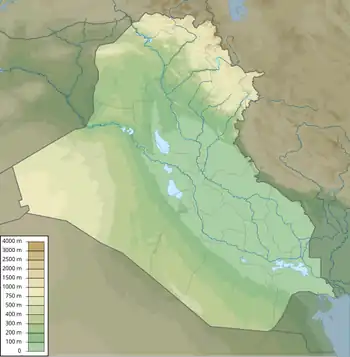  Location within Iraq  Location within Near East | |
| 36°34′N 42°32′E / 36.567°N 42.533°E | |
| Type | settlement |
| Periods | Ubaid, Uruk, Ninevite 5 periods |
| Location | Nineveh Governorate, Iraq |
| Region | Mesopotamia |
| Site notes | |
| Excavation dates | 1956-1957, 1964-1965, 1976 |
| Archaeologists | N. Egami, S. Fukai |
Telul eth-Thalathat is an ancient Near Eastern archaeological site located 40 miles (64 km) west of Mosul and just east of Tal Afar in Nineveh Governorate (Iraq). Its roughly five mounds (sometimes described as four) were occupied at various times, mainly the Ubaid, Uruk, and Ninevite 5 periods.
Archaeology

The site consists of at least five (sometimes described as four) tells or settlement mounds. Telul eth-Thalathat was excavated for four seasons between 1956 and 1965 and again in 1976 by a team from the University of Tokyo Iraq-Iran Archaeological Expedition. Only tells I, II, and V were excavated. The main focus was to establish a complete Ninevite 5 sequence at Tell V. The first two seasons, in 1956 and 1957, were led by N. Egami and worked at Telul eth-Thalathat II, chosen because it was the lowest mound and had the mildest slope, making it the easiest to excavate. Burials, residential areas, and a presumed temple were uncovered.[1][2] The final season was led by S. Fukai.[3][4][5] Among the small finds was a small square stamp seal with two human figures dated to the late 4th or early 5th millennium BC.[6] Late Ubaid Coba bowls were also found as well as beveled rim bowls, diagnostic pottery of the late uruk culture.[7][8]
Telul eth-Thalathat II is 100 meters by 60 meters and rises about 8 meters above the plain. In the surface layer (top 20-30 centimeters) A number of flint and obsidian artifacts were found including blades, scrapers, polished stone axes, club-heads and pendants as well as clay artifacts including spindle whorls, horn-shaped clay pegs, clay sling balls, and figurines of animals and a bird. These artifacts dated to the Ubaid, Uruk and Nineveh V periods indicated that there were originally later levels not eroded away. A number of burials, both adults and children, were excavated, a few containing bronze grave goods. One large building was much more solidly constructed (with 45 centimeter walls) was excavated and termed a Temple but could have also served an administrative function. Pottery shards found on the floors dated to the Uruk period.[1] Two samples were taken for radiocarbon dating (calibration method unknown). One, on Level XVI, dated to 5410 BC and the other, on Level XV, dated to 5570 BC.[9] Excavators defined an 16 level stratigraphy for Telul eth-Thalathat II:[10]
- Levels XV-XVI - Pottery Neolithic
- Levels XII-XIV - Early Northern Ubaid
- Levels Vllb-XI - Late Northern Ubaid
- Level VIla - Terminal Ubaid
- Levels I-VI - Middle Uruk
Telul eth-Thalathat V was occupied only in the Ninevite 5 period. A 16 meter by 8 meter trapezoidal granary with 10 rooms was excavated. Its foundation was a sub-structure of parallel walls covered by reed matting and it had been destroyed by fire. Large amounts of grain, mostly barley, was found in jars and on floors.[11] A building with two concentric round constructions, presumed to be a kiln, was also excavated. Two carbonized grain samples from the granary building were radiocarbon dated (calibration method unknown) to 2860-2395 BC and 3145-2550 BC.[12] Another source has 2250 BC for the later sample.[9][8][13]
History
Telul eth-Thalathat was occupied in the Ubaid, Nineveh 5, and Uruk periods, as well as during Middle Assyrian times. Excavations have revealed over 20 kilns and a number of burials, as well as some figurines and spindle whorls.[14] Eleven Neolithic clay tokens were also recovered.[15][16] On Telul eth-Thalathat V a single period Ninevite 5 settlement was found. It included a 6 by 18 meter building interpreted as a granary.[17]
See also
References
- 1 2 Egami, Namio, "The Preliminary Report of the Excavations at Telul ath-Thalathat (1956)", Sumer, vol. 13, pp. 5-11, 1957
- ↑ N. Egami, "Telul eth-Thalathat, Vol. I, The Excavations of Tell II, 1956-1957", The Institute of Oriental Culture, The University of Tokyo, Yamakawa Pub. Co, 1958
- ↑ S. Fukai, K. Horiuchi and T. Matsutani, "Telul eth-Thalathat, Vol. II, The Excavations of Tell II, The Third Season (1964)", The Institute of Oriental Culture, The University of Tokyo, Yamakawa Pub. Co, 1970
- ↑ S. Fukai, K. Horiuchi and T. Matsutani, "Telul eth-Thalathat, Vol. III, The Excavations of Tell V, The Fourth Season (1965)", The Institute of Oriental Culture, The University of Tokyo, Yamakawa Pub. Co, 1974
- ↑ S. Fukai, T. Matsutani, "Telul Eth-Thalathat, Vol. IV The Excavation of Tell II, the Fifth Season (1976)", Institute of Oriental Culture, University of Tokyo, Yamakawa Pub. Co, 1981
- ↑ Garfinkel, Yosef, "Later Examples from the Near East", Dancing at the Dawn of Agriculture, New York, USA: University of Texas Press, pp. 269-290, 2003
- ↑ Baldi, Johnny Samuele, "Coba bowls, mass-production and social change in Post-Ubaid times", Publications de l'Institut Français d'Études Anatoliennes 27.1, pp. 393-416, 2012
- 1 2 Numoto, H., "Late Uruk and The Transitional Ninevite 5 Pottery From Tell Thalathat No.5", Al-Rafidan 19, pp. 53-73, 1998
- 1 2 Sato, Jun, et al., "University of Tokyo radiocarbon measurements II", Radiocarbon 11.2, pp. 509-514, 1969
- ↑ Sudo, Hiroshi, "The development of wool exploitation in Ubaid-period settlements of North Mesopotamia", Beyond the Ubaid: Transformation and integration in the late prehistoric societies of the Middle East. Studies in Ancient Oriental Civilization 63, Oriental Institute of the University of Chicago, pp. 169-179, 2010 ISBN 978-1-885923-66-0
- ↑ Schwartz, Glenn M., "The Ninevite V period and the development of complex society in Northern Mesopotamia", Paléorient, pp. 93-100, 1987
- ↑ Schwartz, Glenn M., "The Ninevite V period and current research", Paléorient, pp. 53-70, 1985
- ↑ Akçay, A., "A late uruk-early bronze age transitional period cemetery in the upper Tigris region: Asagi Salat", Olba, 25, pp. 49-90, 2017
- ↑ Robert A. Carter and Graham Philip, "Beyond the Ubaid: Transformation and integration in the late prehistoric societies of the Middle East", Studies in Ancient Oriental Civilization 63, Oriental Institute of the University of Chicago, 2010 ISBN 978-1-885923-66-0
- ↑ Schmandt-Besserat, Denise, "Before writing: From counting to cuneiform", Vol. II, University of Texas Press, 1992
- ↑ Overmann, Karenleigh A., "The Material Origin of Numbers: Insights from the Archaeology of the Ancient Near East", Piscataway, NJ, USA: Gorgias Press, pp. 169-170, 2019
- ↑ Roaf, Michael, and Robert Killick, "A Mysterious Affair of Styles: The Ninevite 5 Pottery of Northern Mesopotamia", Iraq, vol. 49, pp. 199–230, 1987
Further reading
- Egami, N., T. Sono, and K. Horiuchi, "Brief Report on the third seasons excavations at Tell 2 of Telul Eth-Thalathat and some observations", Sumer 22.1-2, pp. 1-16, 1966
- Egami, N., T. Sono, "On the Granary Excavated at Telul-eth-Thalathat in 1965-1966", Actes du VIIe Congrès International des Sciences Préhistoriques et Protohistoriques, Prague, 1970
- Fukai, S. and T. Matsutani, Excavations at Telul eth-Thalathat, 1976, Sumer, vol. 33, no. 1: pp. 48–64, 1977
- Nishiaki, Yoshihiro, "Domestic Flake Production Technology of the Early Bronze Age in Upper Mesopotamia: Tell Ghanem Al-Ali (Syria) and Telul Eth-Thalathat V (Iraq)", al-Rāfidān Journal of Western Asiatic Studies 38, pp. 47-53, 2017
- Nishiaki, Yoshihiro, and H. I. H. Prince Takahito Mikasa, "Reexamination of neolithic stone artifacts from Telul eth-Thalathat, northern Iraq", Essays on Ancient Anatolia and its Surrounding Civilizations. Harassowitz, Tübingen, pp. 153–172, 1995
- Nishiaki, Y., "Sickle Manufacturing Technologies at Two Chalcolithic Sites in Northern Mesopotamia: Tell Kosak Shamali (Syria) and Telul eth-Thalathat II (Iraq)", BAR INTERNATIONAL SERIES 1263, pp. 383-394, 2004
- Nishiaki, Yoshihiro, "Hafting Systems of Sickle Elements from the Chalcolithic Levels of Telul eth-Thalathat II, Iraq", in Caneva I., Lemorini C., Zampetti D. and Biaggi P. (eds), Beyond tools : Redefining the PPN Lithic Assemblages of the Levant, Berlin : ex oriente (SENEPSE 9), pp. 55-72, 2011
- Padovani, Claire, "Beyond Ceramic Product. Large-Scale Pottery Production and the Construction of Labour Networks in Mesopotamia (4th–3rd Millennium BCE)", Paléorient. Revue pluridisciplinaire de préhistoire et de protohistoire de l’Asie du Sud-Ouest et de l’Asie centrale 51, pp. 99-118, 2025
- Trentin, Maria Giuseppina, "North-Western Uruk period pottery assemblages", University of London, University College London (United Kingdom), Disertation, 1991
- Uwe Sievertsen, "Frühe Pfeiler-Nischen-Architektur Aus Tepe Gawra Und Telul Eth-Thalathat", Iraq, vol. 67, no. 1, pp. 399–409, 2005