The collapsing of a telescope, in which successive segments slide into one another and disappear within the structure so that only the outermost parts remain visible, analogously illustrates telescoping in mathematics, where consecutive terms in algebraic expressions cancel each other out after expansion, leaving only the boundary terms.
In mathematics, telescoping refers to a property of certain algebraic expressions or iterated binary operations in which successive terms cancel each other after expansion. As a result, the overall expression simplifies significantly, since most intermediate terms eliminate one another, leaving only a small number of boundary terms from the original structure.[1]
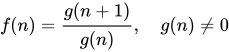
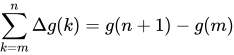
Most commonly, expressions of the form
or
are considered, where is a function defined on the set of natural numbers.
Definition
Let and let .
We say that a function has the telescoping property with respect to if one of the following holds: