Te Paki Sand Dunes
Te Paki Sand Dunes
Giant Sand Dunes | |
|---|---|
 A Te Paki Sand Dune | |
  Te Paki Sand Dunes Location within Northland Region 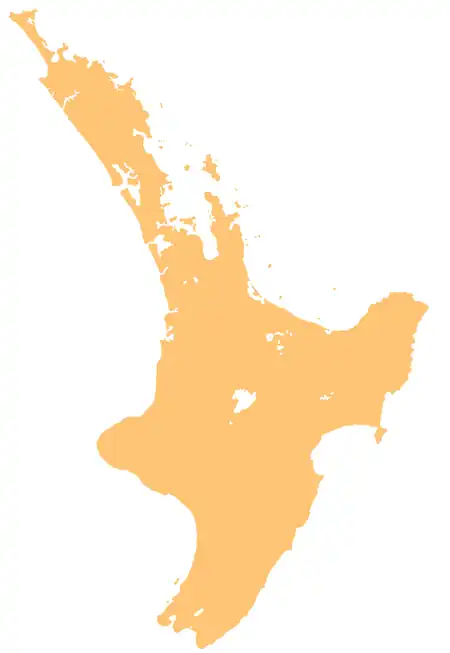 Te Paki Sand Dunes Location within North Island  Te Paki Sand Dunes Location within New Zealand | |
| Coordinates: 34°32′S 172°46′E / 34.54°S 172.77°E | |
| Location | Northland, New Zealand |
| Area | |
| • Total | 10 square kilometres (3.9 mi2) |
| Elevation | 150 m (490 ft) |
Te Paki Sand Dunes, also called the Giant Sand Dunes, are a collection of sand dunes located on the Northland Peninsula of New Zealand. The dunes abut the Ninety Mile Beach and are a popular spot for sandboarding.
Geography
The dunes are located on the western (Tasman Sea) side of the Aupouri Peninsula and are southeast of Cape Reinga Lighthouse. They cover an area of approximately 10 kilometres (6.2 mi) by 1 kilometre (0.62 mi), with some individual dunes rising up to 150 metres (490 ft).[1]
Te Paki Stream runs through the area and contains many native flora and fauna.[2][3]
History
In 1966 the Department of Lands and Survey purchased the Te Paki Station to create a coastal park.[4][5] In 1969 the Department contracted archaeologist Janet Davidson to undertake an archaeological survey.[6] Her fieldwork, which was completed between 1969 and 1971, found that the Te Paki dunes have a rich archaeological history which can be threatened by erosion and difficult to protect.[6] A variety of site types were recorded: 45 pa sites; 207 pit, terrace and hut sites; middens; and 19th century sandstone walls.[6] Taro were also found growing.[6]
Ecology
The wider Te Paki area is home to a diverse range of ecosystems and of native flora and fauna.[7]
Sandboarding
Sandsurfing is a popular activity at the dunes.[3] Guided tours around Cape Reinga often stop at the dunes to sandboard.[8]
Climate
| Climate data for Te Paki (1951–1980) | |||||||||||||
|---|---|---|---|---|---|---|---|---|---|---|---|---|---|
| Month | Jan | Feb | Mar | Apr | May | Jun | Jul | Aug | Sep | Oct | Nov | Dec | Year |
| Mean daily maximum °C (°F) | 23.2 (73.8) |
23.7 (74.7) |
22.9 (73.2) |
20.7 (69.3) |
18.4 (65.1) |
16.6 (61.9) |
15.7 (60.3) |
16.0 (60.8) |
16.8 (62.2) |
18.0 (64.4) |
19.8 (67.6) |
21.6 (70.9) |
19.5 (67.0) |
| Daily mean °C (°F) | 18.8 (65.8) |
19.3 (66.7) |
18.6 (65.5) |
16.5 (61.7) |
14.5 (58.1) |
12.9 (55.2) |
11.7 (53.1) |
12.2 (54.0) |
12.8 (55.0) |
14.1 (57.4) |
15.7 (60.3) |
17.3 (63.1) |
15.4 (59.7) |
| Mean daily minimum °C (°F) | 14.3 (57.7) |
14.9 (58.8) |
14.2 (57.6) |
12.3 (54.1) |
10.6 (51.1) |
9.1 (48.4) |
7.7 (45.9) |
8.3 (46.9) |
8.8 (47.8) |
10.1 (50.2) |
11.6 (52.9) |
13.0 (55.4) |
11.2 (52.2) |
| Average rainfall mm (inches) | 90 (3.5) |
116 (4.6) |
95 (3.7) |
135 (5.3) |
141 (5.6) |
171 (6.7) |
173 (6.8) |
170 (6.7) |
127 (5.0) |
94 (3.7) |
83 (3.3) |
75 (3.0) |
1,470 (57.9) |
| Mean monthly sunshine hours | 229 | 181 | 176 | 162 | 144 | 119 | 135 | 150 | 168 | 185 | 209 | 220 | 2,078 |
| Source: NIWA[9] | |||||||||||||
References
- ↑ Spodyneiko, Kseniia (2 September 2020). "The big trio of Northland - Cape Reinga, 90 Mile Beach and Te Paki Sand Dunes". focus magazine. Retrieved 16 January 2021.
- ↑ "Sandboarding in Cape Reinga, Northland". Bay Of Islands. 2 May 2019. Retrieved 16 January 2021.
- 1 2 Larsen, Michael. "Te Paki sand dunes: seriously steep, seriously fun". AA Traveller. Retrieved 16 January 2021.
- ↑ "Land development transforms north". Press. 20 July 1974. p. 11. Retrieved 25 June 2026 – via Papers Past.
- ↑ "Te Paki Coastal Park: A Valuable Development in the Far North". Forest and Bird (181 (supplement)): 1. 1 August 1971.
- 1 2 3 4 Davidson, Janet (1971). Te Paki Archaeological Survey. Auckland Institute and Museum. OCLC 153708166.
- ↑ "Natural areas of Te Paki Ecological District". www.doc.govt.nz. Retrieved 24 June 2026.
- ↑ "Visit Te Paki Sand Dunes in Cape Reinga". Expedia. Retrieved 16 January 2021.
- ↑ "NIWA Datahub (Agent number: 1005)". NIWA. Retrieved 24 November 2024.
Further reading
- Dragicevich, K. (2016). Te Paki Station. New Zealand Memories, Dec 2016/Jan 2017; n.123, 38–43.