Tatara clan (Japan)
| Tatara 多々良 | |
|---|---|
| Home province | Kaya confederacy |
| Parent house |
|
| Founder | Irigumo of Kaya? |
| Founding year | 6th century |
| Dissolution | Unknown (likely succeeded or absorbed by cadet branch clans) |
| Cadet branches | |
The Tatara clan (Japanese: 多々良氏, Hepburn: Tatara-shi) was an immigrant clan from Korea that was active in Japan since the Kofun period that claimed descent from King Irigumo of the Kaya confederacy according to the Shinsen Shōjiroku (815).
Origin
The clan is one of the many Toraijin clans that immigrated to Japan from Korea during the Kofun period.
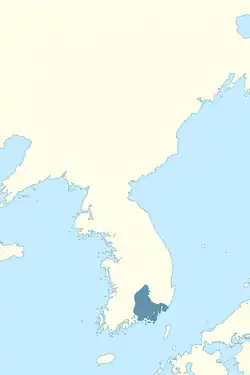
According to the Shinsen Shōjiroku, it is said that the Tatara clan claimed descent from King Irigumo of the "Mimana kingdom (御間名国主)".[1] The kingdom, although written in different characters, was an alternate spelling of the Kaya confederacy which is commonly known as Mimana (任那) in Japan.
Japanese: 天國排開広庭天皇[謚欽明。]御世。投化。献金多々利金乎居等。天皇誉之。賜多々良公姓也。
— Shinsen Shōjiroku, Japanese: 出自御間名国主尓利久牟王也
According to historical records, the clan presented tributes to Emperor Kinmei such as the "Kintatari (金多多利)" and "Kinkakyo (金乎居)" upon naturalizing, however, the true meaning behind these tributes is unknown and is speculated to be ritualistic weapons such as the Seven-Branched Sword or the Inariyama Sword, due to the names containing the "metal (金)" character.[2] The confederacy was also known for its metal (iron) productions.[3]
In other instance, the names could represent people as Kaya was known to be the birthplace of the Kaya "Kim" of Korea which uses the same metal character;[4] the Gimhae Kim clan (金海 金氏) being the most populous surname with more than six million present day Koreans claiming descent from the family. However, due to Kaya being a confederacy of smaller kingdoms, it is unknown whether King Irigumo was from Geumgwan Gaya (home province of the Gimhae Kim clan) or another state, as information surrounding the king is scarce and heavily limited.[Notes 1] The nature of the Shinsen Shōjiroku, being a historically unreliable book also creates skepticism in regards to the existence of Irigumo as his original kingdom is neither mentioned or specified. However, due to the reign of Emperor Kinmei overlapping with the fall of Kaya, it can be assumed that the clan was most likely refugees from the recently fallen confederacy.
Regardless, the tributes given by the clan satisfied the emperor where he bestowed the name "Tatara (多々良)" to the newly arrived immigrants.
History
The Tatara clan became a local government official with jurisdiction in the Suō Province.[5]
- In the year 1152 August 1st: the Suō Province office decree dated August 1st, states that three of the nine office bearers who signed the decree were Tatara.
- In the year 1178 October 5th: Tatara Moriyasu (多々良盛保), Tatara Morifusa (多々良盛房), Tatara Hiromori (多々良弘盛), and Tatara Tadato (多々良忠遠) were spared from exile.
- In the year 1182 April 28th: Among the ten local government officials who co-signed the petition for the Nodera monk Benkei, the highest ranking person appears to be Gonsuke Tara (Morobusa).
- In the year 1187 February: Local government officials jointly signed a petition to the Imperial Court alleging that vassals in Suō Province had obstructed the transport of timber for the construction of Todaiji Temple, and the name of Tatara no Sukune Hiromori appears among the 13 local government officials who jointly signed this letter of dismissal. On the other hand, in 1191, Hiromori himself was sued by Chogen in Kamakura for obstructing the transport of pillars for the construction of Todaiji Temple, but the shogunate dismissed the petition, stating that Ōuchi no Suke (Hiromori) was "not a person under the jurisdiction of the Kanto region," and recommended that he report to the Imperial Court. This series of contradictory actions is said to have been due to the fact that the Ōuchi clan needed cooperative relationships with kokushi and deputies in order to use the provincial government organization as a foothold to organize the various local powerful families under their control.[5]
- In the year 1250: Ōuchi no Suke Tatara Hirosada was assigned the responsibility for the construction of the Kan'in Imperial Palace in Kyoto, which was overseen by the shogunate. Also, when a dispute arose between the lord of Yoda no Yasu and Komon the following year, Rokuhara instructed Ōuchi no Suke to handle the matter. Therefore, it is believed that the Tatara clan (Ōuchi clan) at this time was essentially akin to a shugo (military constable).
Legacy
The powerful Ōuchi clan is famous for claiming descent from the Tatara clan, despite also claiming that Prince Imseong of Paekche was their clan founder. However, modern historians have long questioned this claim and speculate that it is most likely only of Kaya (Tatara) descent and not the prince's[6][7] evident in the clan members claiming descent from the Tatara clan in the Shinsen Shōjiroku and the Sue clan (a lateral branch clan of the Ōuchi) adopting the character from a pottery style that is famous for its Kaya roots. The clan is also heavily related to the Toyoda/Toyota clan, known for the famous car manufacturer, the Toyota Group. According to the official Toyota Family Genealogy (豊田家系譜; とよたけいふ; Toyotakeifu), the clan descends from Prince Imseong who in turn was a descendant of King Dongmyeong of Goguryeo.[8] According to this narrative, it makes the Toyota clan a relative family to the Tatara clan, as well as its cadet branch, the Ōuchi clan.
In recent times, at the north of the current provincial government office in Hōfu City, Yamaguchi Prefecture, there is a place called "Tatara (same spelling)" and a mountain called "Mount Tatara (多々良山)", which are thought to be the remains of the Tatara clan.
See also
- Japanese clans § Immigrant clans: List of Toraijin clans of different origins.
- Ōuchi clan
- Toyoda clan
References
- ↑ Shinsen Shōjiroku (新撰姓氏録): 諸蕃
- ↑ "金", Wiktionary, the free dictionary, 2025-07-13
- ↑ Farris, William (1996). "Ancient Japan's Korean Connection". Korean Studies. 20: 6–7. doi:10.1353/ks.1996.0015. S2CID 162644598.
- ↑ Academy of Korean Studies 김해김씨 金海金氏. Academy of Korean Studies.
- 1 2 下松市史編纂委員会 (in Japanese). 下松市: 『下松市史 通史編』. 1989.
- ↑ 松岡, 久人 (2011). 大内氏の研究. 清文堂出版. ISBN 9784792409524.
- ↑ 太田, 亮 (1934). 姓氏家系大辞典 (in Japanese). 姓氏家系大辞典刊行会. p. 1084.
- ↑ 豊田家系譜 [Toyota Family Genealogy] (in Japanese). November 1932. Archived from the original on 18 February 2005.
抑ゝ先祖ハ百済国ノ始祖都慕大王に始まり其第拾参代威徳王第三王子琳聖太子推古天皇之十九年本朝に移り来里同帝能思召に因りて山陽八箇國を賜はり子々孫々相嗣ぎ武を煉り勇を磨き傍ら殖産工業及び鉱業を奨め尚ほ海外貿易を司り其富強海内無雙と称えられ且は第四十弐代大内義弘に至りて南北両朝統一に盡して大功有り。 [...] 本書一子相傳不出門外不繙妄者此儀堅相守可申者也
- ↑ His name only appears in the Shinsen Shōjiroku and in no other sources. The name is not found in Korea or Japan, outside the book.