TB-500
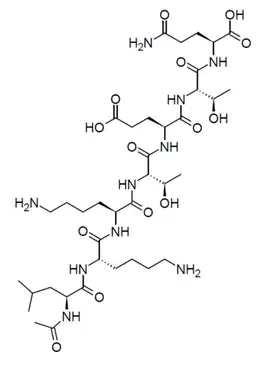 The structure of TB-500. | |
| Identifiers | |
|---|---|
| |
| CAS Number | |
| PubChem CID | |
| ChemSpider | |
| UNII | |
| Chemical and physical data | |
| Formula | C38H68N10O14 |
| Molar mass | 889.018 g·mol−1 |
| 3D model (JSmol) | |
| |
| |
TB-500 (Ac-LKKTETQ) is a synthetic heptapeptide that corresponds to the N-acetylated active fragment (amino acids 17–23)[1] of the endogenous signaling factor thymosin beta-4.[2] It is claimed to increase muscle growth and accelerate wound healing and tissue repair,[3] reduce inflammation, and improve flexibility.[4][5] There is concern it could be used in sports doping.[4] It gained attention during the 2020's uptick in off-label peptide use.[6] It has not undergone any human trials and high levels of it are associated with tumor development.[7][8]
It has been encountered as a designer drug mainly in racehorses,[9] but is also prohibited for use by athletes in competition by the World Anti-Doping Agency, and is classified as a prescription medicine in some jurisdictions such as Australia and New Zealand.[10]
N-acetylated LKKTETQ (Ac-LKKTETQ) and several of its metabolites can be detected in equine urine and plasma following administration of TB-500 using liquid chromatography–mass spectrometry, with metabolite profiling enabling identification of peptide-derived products in biological samples.[11]
See also
References
- ↑ Esposito S, Deventer K, Goeman J, Van der Eycken J, Van Eenoo P (September 2012). "Synthesis and characterization of the N-terminal acetylated 17-23 fragment of thymosin beta 4 identified in TB-500, a product suspected to possess doping potential". Drug Testing and Analysis. 4 (9): 733–738. doi:10.1002/dta.1402. PMID 22962027.
- ↑ Van Troys M, Dewitte D, Goethals M, Carlier MF, Vandekerckhove J, Ampe C (January 1996). "The actin binding site of thymosin beta 4 mapped by mutational analysis". The EMBO Journal. 15 (2): 201–210. doi:10.1002/j.1460-2075.1996.tb00350.x. PMC 449934. PMID 8617195.
- ↑ Rahaman KA, Muresan AR, Min H, Son J, Han HS, Kang MJ, et al. (March 2024). "Simultaneous quantification of TB-500 and its metabolites in in-vitro experiments and rats by UHPLC-Q-Exactive orbitrap MS/MS and their screening by wound healing activities in-vitro". Journal of Chromatography. B, Analytical Technologies in the Biomedical and Life Sciences. 1235 124033. doi:10.1016/j.jchromb.2024.124033. PMID 38382158.
- 1 2 Davison G, Brown S (2013). "The potential use and abuse of thymosin β-4 in sport and exercise science". Journal of Sports Sciences. 31 (9): 917–918. doi:10.1080/02640414.2013.771958. PMID 23421910.
- ↑ Ying Y, Lin C, Tao N, Hoffman RD, Shi D, Chen Z, et al. (2023). "Thymosin β4 and Actin: Binding Modes, Biological Functions and Clinical Applications". Current Protein & Peptide Science. 24 (1): 78–88. doi:10.2174/1389203724666221201093500. PMID 36464872.
- ↑ Prisk DV. "TB-500 Exposed: The Risks Outweigh the Benefits". www.orthoandwellness.com. Prisk Orthopaedics and Wellness. Retrieved 2026-08-15.
- ↑ Dodge D (2025-11-18). "The Internet Loves Peptide Therapy. Is It Really a Miracle Cure?". The New York Times. ISSN 0362-4331. Retrieved 2026-08-15.
- ↑ Chi LH, Chang WM, Chang YC, Chan YC, Tai CC, Leung KW, et al. (August 2017). "Global Proteomics-based Identification and Validation of Thymosin Beta-4 X-Linked as a Prognostic Marker for Head and Neck Squamous Cell Carcinoma". Scientific Reports. 7 (1) 9031. doi:10.1038/s41598-017-09539-w. PMC 5567379. PMID 28831179.
- ↑ Kwok WH, Ho EN, Lau MY, Leung GN, Wong AS, Wan TS (March 2013). "Doping control analysis of seven bioactive peptides in horse plasma by liquid chromatography-mass spectrometry". Analytical and Bioanalytical Chemistry. 405 (8): 2595–2606. doi:10.1007/s00216-012-6697-9. PMID 23318763.
- ↑ "Classification of Unscheduled Peptides. Submission to the Medicines Classification Committee" (PDF). Medsafe. New Zealand Medicines and Medical Devices Safety Authority. June 2025.
- ↑ Ho EN, Kwok WH, Lau MY, Wong AS, Wan TS, Lam KK, et al. (2012). "Doping control analysis of TB-500, a synthetic version of an active region of thymosin β₄, in equine urine and plasma by liquid chromatography-mass spectrometry". Journal of Chromatography. A. 1265: 57–69. doi:10.1016/j.chroma.2012.09.043. PMID 23084823.