Toki (video game)
| Toki | |
|---|---|
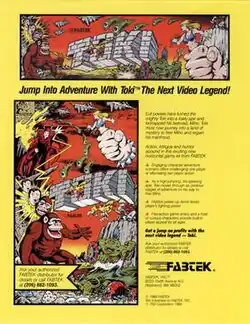 North American arcade flyer | |
| Developer | TAD Corporation
|
| Publishers | |
| Designer | Haruki Kitahara |
| Programmer | Akira Sakuma |
| Artists | Hiro Kakiuchi Jun Fujisaku Jun Matsubara |
| Composer | Yukihiko Kitahara |
| Platform | |
| Release | |
| Genre | Platform |
| Modes | |
Toki[a] is a run and gun platform game released in arcades in Japan in 1989 by TAD Corporation. It was published in North America by Fabtek. Designed by Akira Sakuma, the game has tongue-in-cheek humor mixed with the action. The player controls an enchanted ape who must battle hordes of jungle monsters with energy balls from his mouth. The ultimate goal is to destroy the evil wizard who cast a spell on the title protagonist; thereby transforming him from an ape back into a human, and rescuing the kidnapped princess. The game was ported to several video game consoles and home computers.
Gameplay

The player must traverse several levels with a miniboss at the end. Despite his apparent handicap, his slowness as an ape, and the fact that almost any attack can kill him, Toki is able to spit powerful shots that will help him in defeating enemies and obstacles that try to slow him down in his mission. There is a timer for each stage.
Toki can make use of items such as power-ups for his spit; lucky rabbit feet which can give Toki bursts of superhuman agility and jumping skill; clocks which add extra time to the countdown; fruit which can add to Toki's bonus points; keys which unlock bonus areas; a special helmet that protects him from upwards attacks (the helmet rather comically resembles an American football helmet); extra lives; and magic coins (food in the Genesis version) which when collected in abundance can obtain Toki an extra life.
Plot
The protagonist of the game is a muscular, loincloth-wearing, Tarzanesque tribesman named Toki (known in Japan and in some ports as JuJu), who up until recently lived a primitive yet contented life in the jungles of a vast and wild island in the South Seas.
This all ends tragically when the beautiful Miho, princess of Toki's tribe of jungle men, and a potential suitor to Toki, is kidnapped by the treacherous witch doctor Vookimedlo. Miho is taken to a vast golden palace at the summit of the island, which Vookimedlo has conjured up for himself to reside in. The wicked shaman then casts a spell to transform all the human inhabitants of the island into various animals and beasts, before they can defend themselves against the evil magic.
Toki himself is transformed into a Geeshergam, one of the ape-like minions of Vookimedlo, although in his primate form, Toki more resembles a gorilla. Fortunately, the great warrior discovers that he is still in control of his own faculties and as an unexpected side effect of the spell cast on him, he can breathe fire and shoot forth various projectiles from his mouth.
Toki then sets off on a quest to pursue and defeat Vookimedlo, rescue princess Miho, and undo the curse which has befallen the island. However, to reach Vookimedlo's golden palace, Toki will have to travel through murky lakes, steep canyons, over frozen ice-capped mountain ranges and lava-spewing volcanoes alike. To progress in his quest and be ultimately victorious, Toki will have to battle all manner of dangerous wild animals and various mutants of Vookimedlo's creation; not to mention Vookimedlo's own abominable guardians who act as level bosses.
Ports
Within the next two years ports were released for home systems. Ocean Software published versions for the Amiga, Atari ST, and Commodore 64, They advertised versions for the ZX Spectrum and Amstrad CPC and the Spectrum version was previewed in issue 90 of CRASH, but neither port materialized. Taito published ports for the Lynx and the NES. The latter version was slightly altered and has a health bar so that Toki doesn't die after one hit.
Sega developed an exclusive version for the Mega Drive/Genesis: Toki: Going Ape Spit.[3] This version lacks the non-spit power-ups, but it has additional levels and more detailed graphics compared to the NES version.
In some ports, Toki is named "JuJu", Miho is named "Wanda" and Vookimedlo is named "Dr. Stark". Also, in some ports it is not Vookimedlo who kidnaps princess Miho, but his chief henchman, the half-invisible giant known as Bashtar. In some ports Bashtar is the final boss of the game, and not Vookimedlo.
Reception
In North America, Toki was ranked second among arcade games in a January 1990 equipment survey by Play Meter, while RePlay listed it in its January 1990 issue as being the second most-popular arcade game of the previous month.[4][5] In Japan, Game Machine listed it on their March 15, 1990 issue as being the fifth most-popular arcade game for the previous two weeks.[6] It received a generally favorable reception from critics.[7][8][9][10] Computer and Video Games considered the game difficult but fun and addictive.[7] The Games Machine's Mark Caswell felt the game was very playable and worth checking out.[8] Henrik Fisch and Martin Gaksch, from Power Play, opined that it was a beautiful, varied, imaginative and very entertaining arcade game.[9] Tilt's Alain Huyghues-Lacour stated that "Toki is an arcade game unlike any other; it will appeal to all fans of classic Japanese games, like Super Mario Bros."[10] Hardcore Gaming 101's Kurt Kalata proclaimed that "There were plenty of prehistoric themed sidescrollers in the late 80s/early 90s (...) but none are as quite as delightfully deranged as Toki".[11]
Home computers
| Publication | Score | |
|---|---|---|
| Amiga | Atari ST | |
| ACE | 805/1000[12] | N/A |
| Amiga Action | 86%,[13] 58%[14] | N/A |
| Amiga Force | 88/100[15] | N/A |
| Amiga Format | 78%,[16] 86%[17] | N/A |
| Amiga Power | 87%,[18] 83%[19] | N/A |
| Computer and Video Games | 82/100[20] | N/A |
| Games-X | 4.5/5[21] | N/A |
| ST Action | N/A | 87%[22] |
| ST Format | N/A | 78%,[23] 81%[24] |
| ST Review | N/A | 5/5[25] |
| The One | 88%[26][27] | 88%[28] |
| Zero | 88/100[29] | N/A |
| Atari ST User | N/A | 89%[30] |
| CU Amiga | 83%,[31] 81%[32] | N/A |
Toki won the "Best Coin-Op Conversion" award at the 1991 Golden Joystick Awards.[33] The Amiga version received generally favorable reception from critics.[13][15][18][21]
The Atari ST version also received generally favorable reviews.[22][23][25][28]
The Commodore 64 version was also generally well received.[34][35][36][37]
Consoles
| Publication | Score | |
|---|---|---|
| Atari Lynx | Sega Genesis | |
| AllGame | 2.5/5[38] | N/A |
| Beep! MegaDrive | N/A | 5.5/10[39] |
| Computer and Video Games | N/A | 85/100[40] |
| Electronic Gaming Monthly | 8/10, 7/10, 7/10, 8/10[2] | N/A |
| Famitsu | N/A | 6/10, 5/10, 6/10, 4/10[41] |
| Games-X | 4.5/5[42] | 3/5[43] |
| IGN | 7/10[44] | N/A |
| Mean Machines Sega | N/A | 47%[45] |
| ST Format | 92%[46] | N/A |
| VideoGames & Computer Entertainment | 9/10[47] | N/A |
| The Atari Times | 70%[48] | N/A |
| Console XS | N/A | 77/100[49] |
| Game Zero Magazine | 80.5/100[50] | N/A |
| Game Zone | 91/100[1] | 73/100[51] |
| Go! Hand-Held Video Games | 85/100[52] | N/A |
| Mean Machines | N/A | 47%[53] |
| Mega | N/A | 78%[54] |
| Mega Drive Advanced Gaming | N/A | 69%[55] |
| MegaTech | N/A | N/A |
| Sega Force | N/A | 73%[56] |
| Sega Power | N/A | 69%[57] |
| Sega Pro | N/A | 78%/100[58] |
The Nintendo Entertainment System (NES) version received a score of 19.6/30 in a readers' poll conducted by Family Computer Magazine.[59] The NES version received mixed reviews.[60][61][62][63] Famitsu's four reviewers considered it a "memorization game" due to its high difficulty. The reviewers also noted its weird setting and found the protagonist unappealing. They commented that, despite having a unique charm, it was just an average action game.[60] Ichirō Tezuka of Hippon Super! found the game challenging and felt it could have been fun if the gameplay was more enjoyable.[61] Italian publication Game Power labelled it as mediocre, citing its ugly visuals, inadequate sound, and low difficulty.[64]
The Sega Genesis/Mega Drive version received a 6.0833/10 score in a 1995 readers' poll conducted by the Japanese Sega Saturn Magazine, ranking among Genesis/Mega Drive titles at number 389.[65] The Genesis/Mega Drive version was also met with a mixed critical reception.[40][49][54][66]
The Atari Lynx version was received favorably.[46][47][1][67]
Legacy
A platform game with similarly-looking simian characters was in development by Ocean Software for the Jaguar under the working title Apeshit. It was renamed to Toki Goes Apespit at one point during development.[68][69][70][71] It was planned to be published in Winter 1994,[72][73][74][75] but it was never released.[76][77]
The original game, ported by Magic Team, was released for iOS on September 7, 2009 in the United States.
A remake was published by Microids in 2018 for Nintendo Switch,[78] followed by versions for Windows, PlayStation 4, Xbox One, and Luna.[79][80]
Notes
References
- 1 2 3 Daldry, Jeremy (February 1992). "Handheld Review: Toki (Atari Lynx)". Game Zone. No. 4. Dennis Publishing. p. 52.
- 1 2 Harris, Steve; Semrad, Ed; Alessi, Martin; Sushi-X (March 1992). "Review Crew: Toki (Lynx - Atari)". Electronic Gaming Monthly. Vol. 5, no. 3. Sendai Publishing. p. 32. Retrieved 2026-08-18 – via Video Game History Foundation.
- ↑ Gamepro, April 1992, page 58.
- ↑ "Equipment Poll". Play Meter. Vol. 16, no. 1. Skybird Publishing. January 1990. pp. 10–11.
- ↑ "The Player's Choice: Top Games Now in Operation, Based on Earnings-Opinion Poll of Operators". RePlay. Vol. 15, no. 4. RePlay Publishing. January 1990. p. 4.
- ↑ "Game Machine's Best Hit Games 25" (PDF). Game Machine (in Japanese). No. 376. Amusement Press, Inc.. March 15, 1990. p. 25. Archived (PDF) from the original on 2020-01-31. Retrieved 2026-08-13.
- 1 2 "Arcade Action: Ugh". Computer and Video Games. No. 98. EMAP. January 1990. p. 104.
- 1 2 Caswell, Mark (February 1990). "Arcade Alley". The Games Machine. No. 27. Newsfield. pp. 90–91.
- 1 2 Fisch, Henrik; Gaksch, Martin (April 1990). "Power Tests / Automatenspiele: Zurück in die Zu kunft". Power Play (in German). No. 25. Markt & Technik. pp. 130–133.
- 1 2 Huyghues-Lacour, Alain (April 1990). "Arcades". Tilt (in French). No. 77. Éditions Mondiales S.A.. p. 47.
- ↑ Kalata, Kurt (September 30, 2019). "Toki". Hardcore Gaming 101. Archived from the original on 2019-10-01. Retrieved 2026-08-20.
- ↑ Merrett, Steve (May 1991). "Computer Screentest: Toki (Amiga)". ACE. No. 44. EMAP. p. 72.
- 1 2 "Toki". Amiga Action. No. 23. Europress. August 1991. pp. 40–41.
- ↑ Roundell, Paul (October 1993). "Budget Games: Toki". Amiga Action. Europress. p. 91.
- 1 2 Osborne, Ian; King, Phil; Millichamp, Rob (May 1993). "Budget! Budget Bargains!". Amiga Force. No. 9. Europress Impact. pp. 44–48.
- ↑ Evans, Maff (July 1991). "Screenplay: Toki". Amiga Format. No. 24. Future Publishing. pp. 92–93. Archived from the original on 2008-10-11. Retrieved 2026-08-16.
- ↑ Bradley, Stephen (September 1993). "Budget Reviews: Cheap 'n' Cheerful". Amiga Format. No. 50. Future Publishing. pp. 88–89. Archived from the original on 2008-08-29. Retrieved 2026-08-16.
- 1 2 Penn, Gary (July 1991). "Game Reviews: Toki". Amiga Power. No. 3. Future Publishing. pp. 26–29.
- ↑ Norris, Tim; McGill, Steve (October 1993). "Game Reviews: Formula One Challenge + Toki". Amiga Power. No. 30. Future Publishing. p. 89.
- ↑ Swan, Robert; Leadbetter, Richard (May 1991). "Review: Toki (Amiga)". Computer and Video Games. No. 114. EMAP. pp. 78–79.
- 1 2 "Gain Axess To All The Lastest Info On Your Format". Games-X. No. 9. Europress. June 21–26, 1991. p. 22.
- 1 2 Dutton, Jason (July 1991). "Reviews: Toki" (PDF). ST Action. No. 39. Europress. pp. 40–41. Archived (PDF) from the original on 2024-03-09. Retrieved 2026-08-16.
- 1 2 Hutchinson, Andy (August 1991). "Screenplay: Toki". ST Format. No. 25. pp. 50–51.
- ↑ Campbell, Stuart (October 1993). "Screenplay - Game Reviews: Toki". ST Format. No. 51. p. 76.
- 1 2 Jones, Dave (December 1993). "Screenscene: VFM". ST Review. ST Action. No. 21. EMAP. p. 65.
- ↑ Watsham, Jools (July 1991). "The One Review: Toki". The One for Amiga Games. No. 34. EMAP. pp. 54–55.
- ↑ Broughton, Matt (July 1993). "Cheapos! Toki". The One Amiga. No. 58. EMAP. p. 89.
- 1 2 Watsham, Jools (July 1991). "The One Review: Toki". The One for ST Games. No. 34. EMAP. pp. 54–55.
- ↑ Wilson, David (May 1991). "Review: Toki (Amiga)". Zero. No. 19. Dennis Publishing. p. 45.
- ↑ Clays, Simon (October 1993). "The Cheap Seats". Atari ST User. ST Action. No. 92. Europress. pp. 74–75. Archived from the original on 2016-02-16. Retrieved 2026-08-16.
- ↑ Merrett, Steve (April 1991). "Screen Scene: Toki". CU Amiga. No. 14. EMAP. pp. 53–55.
- ↑ "Budget Games: Toki". CU Amiga. No. 43. EMAP. September 1993. p. 78.
- ↑ "News: Luvvies! Dahlings!". The One Amiga. No. 44. EMAP. May 1992. p. 17.
- ↑ Jarratt, Steve (November 1991). "Powertest: Toki". Commodore Format. No. 14. Future plc. pp. 36–37.
- ↑ Taylor, Richard (January 1992). "Outlook: Toki". Commodore Power. No. 1. Lime Lizard Limited. p. 43.
- ↑ Wynne, Stuart; King, Phil (January 1992). "Zzap! Test! Toki". Zzap!64. No. 64. Europress. p. 80.
- ↑ Guttery, Miles (May 1993). "Round-Up! Cute To Kill". Commodore Force. No. 5. Europress Impact. pp. 16–20.
- ↑ Knight, Kyle (1998). "Toki (Atari Lynx) - Review". AllGame. All Media Network. Archived from the original on 2014-11-14. Retrieved 2026-08-18.
- ↑ "BEメガ・ドッグレース: Juju伝説". Beep! Mega Drive (in Japanese). Vol. 8, no. 2. SoftBank Creative. February 1992. p. 33.
- 1 2 O'Connor, Frank (June 1991). "CVG Review: Toki Going Ape Spit". Computer and Video Games. No. 127. EMAP. p. 72.
- ↑ "New Games Cross Review: Juju伝説 (メガドライブカートリッジ)". Famitsu (in Japanese). No. 164. ASCII Corporation. February 7, 1992. p. 39.
- ↑ "Console Connexions - Software Review: Toki (Lynx)". Games-X. No. 43. Europress. February 20–26, 1992. p. 22.
- ↑ "Console Connexions - Software Review: Toki (Sega Mega Drive)". Games-X. No. 42. Europress. February 13–19, 1992. p. 24.
- ↑ Jung, Robert A. (July 6, 1999). "Toki Review". IGN. Snowball.com. Archived from the original on 2000-04-17. Retrieved 2026-08-18.
- ↑ "Games Index: Megadrive". Mean Machines Sega. No. 1. EMAP. October 1992. pp. 137–143.
- 1 2 Hutchinson, Andy (November 1992). "Screenplay - Lynx Reviews: Lynx Roundup". ST Format. No. 40. pp. 126–127. Archived from the original on 2016-02-17. Retrieved 2026-08-18.}
- 1 2 Bieniek, Chris (March 1992). "Gaming on the Go: Toki - For the Atari Lynx". VideoGames & Computer Entertainment. No. 38. Larry Flynt Publications. p. 65.
- ↑ Loosen, Dan (January 2005). "Lynx Lair: Toki — Going ape for this arcade to Lynx conversion". 2005 Compendium. The Atari Times. pp. 23–35. Archived from the original on 2016-03-30. Retrieved 2026-08-18.
- 1 2 "Software A-Z: Mega Drive". Console XS. No. 1. Paragon Publishing. June–July 1992. pp. 126–137.
- ↑ Ferrari Man; ????; Carter, Bryan; Salamander (August–September 1992). "The Final Word game reviews: Toki -- Tao". Game Zero Magazine. Vol. 1, no. 3. Cheap Zines-O'-Plenty. (Transcription by Game Zero. Archived 1998-01-21 at the Wayback Machine).
- ↑ Martin, Tyler (April 1992). "Console Review: Toki (Mega Drive)". Game Zone. No. 6. Dennis Publishing. pp. 30–31.
- ↑ Rand, Paul; Boone, Tim (April 1992). "Review: Toki (Lynx)". Go! Hand-Held Video Games (supplement). No. 6. EMAP. pp. 12–13.
- ↑ Rignall, Julian; Leadbetter, Richard (March 1992). "Megadrive Review: Toki". Mean Machines. No. 18. EMAP. pp. 106–107.
- 1 2 "£19.99 Games: Cheap and not so nasty". Mega. No. 9. Future Publishing. June 1993. pp. 18–23.
- ↑ "The Incredibly Complete Mega File". Mega Drive Advanced Gaming. No. 5. Maverick Magazines. January 1993. pp. 90–95.
- ↑ Pitt, Adrian; Mellerick, Paul (March 1992). "Reviewed! Toki (Mega Drive)". Sega Force. No. 3. Europress. pp. 60–61.
- ↑ Cousteau, Desirée (July 1992). "Power Review: Toki". Sega Power. No. 32. Future Publishing. p. 25.
- ↑ Ellis, Les (March 1992). "Mega Drive ProReview: Toki". Sega Pro. No. 5. Paragon Publishing. p. 58.
- ↑ "超絶 大技林 '98年春版". PlayStation Magazine (Special) (in Japanese). Vol. 42. Tokuma Shoten Intermedia. April 15, 1998. p. 60.
- 1 2 "新作ゲームクロスレビュー: JuJu伝説". Famitsu (in Japanese). No. 137. ASCII Corporation. August 2, 1991.
- 1 2 Tezuka, Ichirō (August 4, 1991). "TV Game Broad-Way FC: JuJu伝説". Hippon Super! (in Japanese). Vol. 6, no. 8. JICC Publishing Bureau. p. 77.
- ↑ "Now Playing: Toki". Nintendo Power. Vol. 30. Nintendo of America. November 1991. pp. 85, 87.
- ↑ Halfhill, Tom R. (February 1992). "Review: Toki (NES)". Game Players Nintendo Guide. Vol. 5, no. 2. Signal Research. p. 95.
- ↑ Log (February 1993). "Prove Game Power: Toki (Nintendo NES)". Game Power (in Italian). No. 14. Studio Vit. pp. 74–75.
- ↑ "メガドラ読者レース". Sega Saturn Magazine (in Japanese). Vol. 11, no. 9. SoftBank Creative. September 1995. pp. 82–85.
- ↑ Jinky the Monkey (April 1992). "Genesis ProReview: Toki Goes Ape Spit". GamePro. No. 33. IDG. p. 58.
- ↑ Gideon (May 1992). "Lynx: Toki". GamePro. No. 34. IDG. p. 77.
- ↑ "News: Jaguar - Watch the skies". Ocean Power. No. 2. Bastion Publishing. Spring 1994. p. 7.
- ↑ "Prescreen - Ocean Software". Edge. No. 8. Future Publishing. May 1994. pp. 32–33.
- ↑ Ripper, The (May 1994). "Europa!". GameFan. Vol. 2, no. 6. DieHard Gamers Club. pp. 132–134.
- ↑ "News - L'ECTS: le fur en marche - La Jaguar montre ses crocs!". Génération 4 (in French). No. 66. Computec Media France. May 1994. p. 14. Archived from the original on 2018-09-23. Retrieved 2018-09-23.
- ↑ "The Game Fan 32Bit System Shoot Out - Who Will Lead Us Into The Next Generation?". GameFan. Vol. 2, no. 7. DieHard Gamers Club. June 1994. pp. 146–147.
- ↑ Hackett, Tina (June 1994). "Action Feature - The Jaguar: ready to pounce!". Atari ST User. No. 101. Europress. pp. 68–71. Archived from the original on 2018-09-27. Retrieved 2018-10-24.
- ↑ The Laird (July 17, 2015). "Toki Goes Apeshit - Atari Jaguar". gameon.freeforums.net. Archived from the original on 2018-09-23. Retrieved 2018-09-23.
- ↑ "Atari Jaguar Lost Games". janatari.de. Archived from the original on 2018-09-06. Retrieved 2018-09-23.
- ↑ Ripper, The (December 1994). "Europa!". GameFan. Vol. 2, no. 12. Shinno Media. p. 214.
- ↑ "Apeshit [Atari Jaguar – Unreleased]". unseen64.net. April 7, 2008. Archived from the original on 2018-09-23. Retrieved 2018-09-23.
- ↑ Reseigh-Lincoln, Dom (April 5, 2018). "Arcade Classic Toki Will Return With A Brand New Remake On Nintendo Switch". Nintendo Life. Archived from the original on 10 July 2018. Retrieved 2018-09-23.
- ↑ "Toki remake coming to PS4, Xbox One, and PC in Q2 2019". 28 March 2019.
- ↑ New on Luna: Toki, 13 October 2022, retrieved 2022-12-18


External links
- Toki at AtariAge
- Toki at GameFAQs
- Toki at Giant Bomb
- Toki at Killer List of Videogames
- Toki at MobyGames
- 1989 video games
- Amiga games
- Arcade video games
- Atari games
- Atari ST games
- Atari Lynx games
- Cancelled Amstrad CPC games
- Cancelled Atari 7800 games
- Cancelled ZX Spectrum games
- Fabtek games
- Golden Joystick Award winners
- Video games about shapeshifting
- IOS games
- Classic Mac OS games
- Microïds games
- Multiplayer and single-player video games
- Nintendo Entertainment System games
- Nintendo Switch games
- Ocean Software games
- Platformers
- PlayStation 4 games
- Run and gun games
- Sega video games
- Sega Genesis games
- TAD Corporation games
- Taito arcade games
- Video game remakes
- Video games about apes
- Video games developed in France
- Video games set on fictional islands
- Windows games
- Xbox One games
- Video games developed in Japan
- Tectoy games