Synaphea tamminensis
| Synaphea tamminensis | |
|---|---|
Scientific classification  | |
| Kingdom: | Plantae |
| Clade: | Embryophytes |
| Clade: | Tracheophytes |
| Clade: | Angiosperms |
| Clade: | Eudicots |
| Order: | Proteales |
| Family: | Proteaceae |
| Genus: | Synaphea |
| Species: | S. tamminensis |
| Binomial name | |
| Synaphea tamminensis | |
Synaphea tamminensis is a species of flowering plant in the family Proteaceae and is only known a single location near Tammin in the south-west of Western Australia. It is a shrub with glabrous branchlets, deeply divided, hairy leaves, and spikes of yellow flowers.
Description
Synaphea tamminensis is a shrub with stems up to 50 cm (20 in) long and covered with soft hairs that are hidden by the leaf bases. The leaves are multiplanar, 50–100 mm (2.0–3.9 in) long and 60–140 mm (2.4–5.5 in) wide on a petiole 60–150 mm (2.4–5.9 in) long, the end lobes linear to lance-shaped, 2–3 mm (0.079–0.118 in) long with a fine network of veins. The flowers are yellow, somewhat crowded on a spike 40–80 mm (1.6–3.1 in) long on a openly branched peduncle 120–200 mm (4.7–7.9 in) long. The bracts are 1.5–2.0 mm (0.059–0.079 in) long and almost glabrous. The perianth is ascending with a more or less narrow opening and glabrous. The upper tepal is 4–5 mm (0.16–0.20 in) long, about 2 mm (0.079 in) wide, more or less straight and slightly curved downwards, the lower tepal 3.2 mm (0.13 in) long. The stigma is trapezoid and more or less flat, 0.8 mm (0.031 in) long and 1 mm (0.039 in) wide and the ovary is covered with silky hairs. Flowering occurs in August and September, and the fruit is barrel-shaped, about 2 mm (0.079 in) long and covered with soft hairs.[2][3]
Taxonomy
Synaphea tamminensis was first formally described in 1995 by Alex George in the Flora of Australia from specimens he found in the Charles Gardner Flora Reserve south of Tammin.[2][4] The specific epithet (tamminensis) means 'native of Tammin'.[5]
Distribution and habitat
This species of Synaphea is only known from the type location where it grows in sandy loam over laterite, in open kwongan.[3]
Conservation status
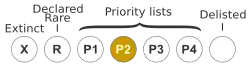
Synaphea tamminensis is listed as "Priority Two" by the Western Australian Government Department of Biodiversity, Conservation and Attractions,[3] meaning that it is poorly known and from only one or a few locations.[6]
References
- ↑ "Synaphea tamminensis". Australian Plant Census. Retrieved 13 July 2026.
- 1 2 George, Alex S. "Synaphea tamminensis". Flora of Australia. Australian Biological Resources Study, Department of Climate Change, Energy, the Environment and Water: Canberra. Retrieved 13 July 2026.
- 1 2 3 "Synaphea tamminensis". FloraBase. Western Australian Government Department of Biodiversity, Conservation and Attractions.
- ↑ "Synaphea tamminensis". Australian Plant Name Index. Retrieved 13 July 2026.
- ↑ George, Alex S.; Sharr, Francis A. (2023). Western Australian Plant Names and Their Meanings - A Glossary (fifth ed.). Kardinya: Four Gables Press. p. 332. ISBN 9780645629538.
- ↑ "Conservation codes for Western Australian Flora and Fauna" (PDF). Government of Western Australia Biodiversity, Conservation and Attractions. Retrieved 13 July 2026.