Synaphea stenoloba
| Synaphea stenoloba | |
|---|---|
Scientific classification  | |
| Kingdom: | Plantae |
| Clade: | Embryophytes |
| Clade: | Tracheophytes |
| Clade: | Angiosperms |
| Clade: | Eudicots |
| Order: | Proteales |
| Family: | Proteaceae |
| Genus: | Synaphea |
| Species: | S. stenoloba |
| Binomial name | |
| Synaphea stenoloba | |
Synaphea stenoloba is a species of flowering plant in the family Proteaceae and is only known from a few locations in the south-west of Western Australia. It is a shrub with many hairy stems, tripinnatipartite leaves, the end lobes erect, and spikes much longer than the foliage with crowded, yellow flowers.
Description
Synaphea stenoloba is a tufted shrub that typically grows to a height of 30–45 cm (12–18 in) and has many stems covered with soft hairs. The leaves are tripinnatipartite, 50–180 mm (2.0–7.1 in) long and 29–90 mm (1.1–3.5 in) wide on a petiole 50–270 mm (2.0–10.6 in) long, each lobe divided three times, the end lobes erect, linear, 1–2 mm (0.039–0.079 in) wide. The flowers are yellow and crowded on spikes much longer than the foliage, up to 100–150 mm (3.9–5.9 in) long on a sometimes branched peduncle 100–180 mm (3.9–7.1 in) long. The bracts are egg-shaped, 1.0–1.5 mm (0.039–0.059 in) long and glabrous. The perianth opens more or less widely, the upper tepal 4.5–5.0 mm (0.18–0.20 in) long and 2 mm (0.079 in) wide and the lower tepal about 3.5 mm (0.14 in) long. The stigma is egg-shaped and lobed, 1 mm (0.039 in) long and 1.0–1.2 mm (0.039–0.047 in) wide and the ovary is covered with soft hairs. Flowering occurs in September and October, and the fruit is oval, 6 mm (0.24 in) long and covered with short hairs.[2][3]
Taxonomy
Synaphea stenoloba was first formally described in 1995 by Alex George in the Flora of Australia from specimens he collected north-east of Pinjarra in 1993.[2][4] The specific epithet (stenoloba) means 'narrow-lobed', referring to the leaf lobes.[5]
Distribution and habitat
This species of Synaphea is found on winter wet flats with low heath sedgeland and on granite outcrops in several small locations near Pinjarra in the Swan Coastal Plain bioregion of south-western Western Australia.[3]
Conservation status
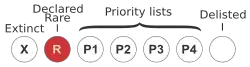
Synaphea stenoloba is listed as Threatened under the Biodiversity Conservation Act 2016.[3][6]
References
- ↑ "Synaphea stenoloba". Australian Plant Census. Retrieved 6 July 2026.
- 1 2 George, Alex S. "Synaphea stenoloba". Flora of Australia. Australian Biological Resources Study, Department of Climate Change, Energy, the Environment and Water: Canberra. Retrieved 9 June 2026.
- 1 2 3 "Synaphea stenoloba". FloraBase. Western Australian Government Department of Biodiversity, Conservation and Attractions.
- ↑ "Synaphea stenoloba". Australian Plant Name Index. Retrieved 6 July 2026.
- ↑ George, Alex S.; Sharr, Francis A. (2023). Western Australian Plant Names and Their Meanings - A Glossary (fifth ed.). Kardinya: Four Gables Press. p. 325. ISBN 9780645629538.
- ↑ "Conservation codes for Western Australian Flora and Fauna" (PDF). Government of Western Australia Biodiversity, Conservation and Attractions. Retrieved 6 July 2026.