Suviana and Brasimone lakes regional park
| Suviana and Brasimone Lakes Regional Park | |
|---|---|
| Italian: Parco regionale dei laghi di Suviana e Brasimone | |
IUCN category IV (habitat/species management area) | |
 Lake Suviana seen from Monte Calvi | |
  Location within Emilia-Romagna | |
| Location | Metropolitan City of Bologna, Emilia-Romagna, Italy |
| Nearest city | Bologna |
| Coordinates | 44°06′56.88″N 11°05′06″E / 44.1158000°N 11.08500°E |
| Area | 3,329.89 ha (33.2989 km2; 12.8568 sq mi) |
| Designation | Regional park |
| Established | 14 April 1995 |
| Governing body | Ente di gestione per i Parchi e la Biodiversità - Emilia Orientale |
| Website | enteparchi |
The Suviana and Brasimone lakes regional park (Italian: Parco regionale dei laghi di Suviana e Brasimone) is a regional park and protected natural area in the Bolognese Apennines, in Emilia-Romagna, northern Italy. It lies in the Metropolitan City of Bologna, near the border with Tuscany, and extends around the artificial reservoirs of Lake Suviana and Lake Brasimone, together with the surrounding forests, ridges, villages and hydroelectric infrastructure.[1]
The park was established by Regional Law no. 38 of 14 April 1995 and covers 3,329.89 hectares in the municipalities of Camugnano, Castel di Casio and Castiglione dei Pepoli.[1] Its territory includes two large reservoirs created for hydroelectric purposes, a largely forested mountain landscape, historical settlements such as Bargi, Baigno, Badi, Stagno and Chiapporato, and the Natura 2000 site IT4050020 "Laghi di Suviana e Brasimone".[2]
The park is unusual among protected areas of the Apennines because its landscape is closely connected with twentieth-century energy infrastructure. The difference in elevation between Brasimone and Suviana is used by the Bargi hydroelectric power station, a pumped-storage plant commissioned in the 1970s.[3] The southern shore of Lake Brasimone is also the site of the ENEA Brasimone Research Centre, one of Italy's main facilities for research on advanced energy systems, liquid-metal technologies, fourth-generation nuclear fission, fusion-related technologies and experimental systems for nuclear and non-nuclear applications.[4]
Geography
The park occupies a central sector of the mountains south of Bologna, between the valleys of the Brasimone stream and the Limentra di Treppio. Its southern boundary follows the watershed near the Tuscan border. The ridge between the two principal reservoirs is formed by Monte Calvi, the highest summit of the park at 1,283 m (4,209 ft), and by Monte di Stagno.[1]
The two main lakes are artificial reservoirs at different elevations. Lake Suviana lies at about 465 m (1,526 ft) above sea level, while Lake Brasimone lies at about 845 m (2,772 ft).[1] This difference in altitude later became central to the pumped-storage hydroelectric system linking the two basins.
The landscape is mostly wooded. Mixed oak woods, beech woods, chestnut groves and conifer plantations cover much of the slopes, while open meadows and former cultivated areas occur within the forest. Sandstone outcrops and steep wooded walls are visible along the western side of the main ridge and below the Brasimone basin, especially in the area known as the Cinghi delle Mogne.[5]
Geology and scenic features
One of the most characteristic scenic features of the park is the rocky front of the Cinghi delle Mogne, immediately downstream from the Brasimone dam. Here the left bank of the stream is dominated by steep cliffs showing regular stratification of turbiditic sandstones, with sparse vegetation of European hop hornbeam, manna ash, oak, sweet chestnut, beech and shrubs.[6]
The cliffs of the Brasimone gorges provide habitat for raptors such as kestrels and peregrine falcons. Along the ridge, at about 950 m (3,120 ft) above sea level, is the Grotta delle Fate, a natural cave formed along a fracture in the sandstone layers, about 70 m (230 ft) long and 3 m (9.8 ft) deep, with specialised subterranean fauna.[6]
Monte Calvi, the highest mountain in the park, has a steep western slope above the Limentra di Treppio valley, where mixed broad-leaved woods and conifer plantations are interrupted by sandstone outcrops. On the gentler eastern side, former fields and pastures are now colonised by bracken, shrubs and broom, while stone walls still mark old meadows and rural settlements.[7]
Monte di Stagno is another major panoramic point. Its flat and windy summit offers views over Lake Suviana, the Limentra di Treppio valley, the Reno valley and several Apennine peaks, including Corno alle Scale, Monte Cimone, Monte Vigese and Sasso Balinello.[8]
History
The park was created in 1995 to protect the natural and historical landscape around the two reservoirs and the surrounding Apennine territory.[1] Traditional settlement in the area was based on small mountain villages, chestnut groves, woodland management, pastoral activity and local routes across the ridges. For centuries the local economy relied mainly on livestock, timber, charcoal production and chestnut cultivation.[9]
From the early twentieth century the area was transformed by large public works connected with hydroelectric production. In 1910 works began on a dam near the Scalere mill, where the Brasimone valley narrowed and the stream formed a series of drops. The dam was also used for a new road linking Castiglione dei Pepoli with Riola through Camugnano, improving access to the Porrettana road and the Bologna–Pistoia railway.[10]
The hydroelectric plant connected with the Brasimone reservoir was built farther downstream, near the old church of Santa Maria, where a second dam was built in 1917 to increase production. Ten years later the State Railways completed the Pavana reservoir, in the nearby Limentra di Sambuca valley, to provide electricity for the electrification of the Porrettana railway.[10]
In 1928 works began on the damming of the Limentra di Treppio near Bargi and Suviana. The Suviana dam, completed in 1933, was described by the park authority as the highest dam then existing in Italy, at 97 m (318 ft). New roads and a cableway between Suviana and Porretta railway station were built to support construction and to transport cement. Water from Pavana was also conveyed into the new reservoir through an underground conduit.[10]
At the beginning of the 1970s the two basins of Brasimone and Suviana were connected by penstocks and a plant capable both of generating electricity and of pumping water back to the upper reservoir. In the 1960s construction had also begun on the PEC experimental nuclear reactor project on the southern shore of Lake Brasimone; the project was abandoned after the Italian nuclear referendum of 1987.[10]
Reservoirs and hydroelectric system
Lake Suviana
Lake Suviana is one of the largest bodies of water in the Emilian Apennines. It has an approximate surface area of 1.5 km2 (0.58 sq mi), a maximum depth of about 70 m (230 ft) and a capacity of about 46 million cubic metres.[11] The reservoir was built between 1928 and 1932, taking advantage of the form and geology of the valley, which allowed a large quantity of water to be stored.[11]
The lake has steep shores in many sections, and its water level varies according to the operation of the hydroelectric system.[11] It is the more visited and equipped of the two main lakes. Tourist sources describe picnic areas, seasonal accommodation, bathing areas and outdoor activities such as windsurfing, sailing, rowing and sport fishing, subject to local regulations.[12]
Lake Brasimone
Lake Brasimone is smaller and higher than Suviana. It has an approximate surface area of 0.5 km2 (0.19 sq mi), a maximum depth of about 29 m (95 ft) and a capacity of about 6 million cubic metres. Its waters are held by the Scalere dam, about 35 m (115 ft) high.[13]
The dam was built at a narrow section of the valley, where the Brasimone stream enters its gorge and the valley sides are formed by solid sandstone. The reservoir flooded a broader basin where mainly clayey terrains crop out.[6]
Compared with Suviana, Brasimone has a quieter and more wooded character. Its shores include small rest and picnic areas, and the lake is closely associated with forest walks, the surrounding mountain landscape and the ENEA research facilities on its southern side.[13]
Bargi hydroelectric power station
The two reservoirs are connected by the Bargi hydroelectric power station, a pumped-storage hydroelectric plant owned by Enel. The plant was commissioned in 1975 and has an installed capacity of about 330 MW.[3] It uses the difference in elevation between Lake Brasimone and Lake Suviana, with a gross head of about 375 m (1,230 ft).[3]
In generation mode, water descends from the upper Brasimone basin to the lower Suviana basin through the turbines. In pumping mode, water can be moved back from Suviana to Brasimone, allowing the system to store energy and support grid management. The hydroelectric system gives the park a strong connection not only with landscape conservation and recreation, but also with the history of energy infrastructure in the northern Apennines.
On 9 April 2024 an explosion and fire occurred at the Bargi plant during works at the hydroelectric facility. Seven workers died in the accident.[14] The incident concerned the power station rather than the dams themselves.
ENEA Brasimone Research Centre
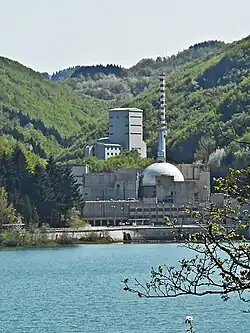
The ENEA Brasimone Research Centre is located at Brasimone, in the municipality of Camugnano, on the southern shore of Lake Brasimone. It is one of the most distinctive scientific sites in the Bolognese Apennines and forms a major technological element in the landscape of the park.[4]
ENEA describes Brasimone as one of the main national and international research centres devoted to the study and development of technologies for fourth-generation nuclear fission and magnetic-confinement nuclear fusion. Its activities include innovative energy systems, green technologies and environmental monitoring, nuclear safety technologies, liquid-metal technologies, advanced materials, ionising radiation technologies, radiation protection, and the prototyping of systems and components for energy applications.[4][15]
The centre covers more than 400 hectares, of which about 100 hectares are urbanised and the rest is mainly woodland. The urbanised area contains 17 buildings and several experimental halls, with about 31,000 m² of usable space, including more than 19,000 m² equipped for experimental activities.[16]
Origins and conversion
The centre originated in the 1960s as a facility of the CNEN, the Italian National Committee for Nuclear Energy. It was initially intended to host the experimental reactor known as PRO, or Progetto Reattore Organico, a project that was later abandoned.[17]
In the early 1970s, during the Italian-French fast-reactor programme, Brasimone was selected for the PEC project, or Prova Elementi Combustibili, an experimental reactor intended for fuel-element testing. From 1972 onwards, major infrastructure works were carried out, including service buildings and four large technological halls known as ESPRESSO, ISI, CPC-1 and RSA, which hosted experimental plants for tests on components and materials.[17]
The PEC was designed as a sodium-cooled fast experimental reactor with a thermal power of 118 MWth. Its main purpose was to study the behaviour of fuel elements under thermal and neutron conditions comparable with those of fast power reactors. The reactor core included a central test channel for an experimental fuel element of 3 MWth, served by independent sodium circuits.[18]
The complex was designed with a metallic containment building surrounded by three main buildings: the sodium and gas building, the control and services building, and the fuel handling building. In 2017 ENEA began, in collaboration with Italian universities, a project to recover and digitise part of the paper archive of the PEC reactor project. ENEA describes this archive as a unique record of the detailed design of a sodium-cooled nuclear reactor whose construction had begun and was then permanently halted after the 1987 referendum.[18]
In 1985 the centre employed about 240 ENEA staff members, while construction activities involved more than 1,000 workers from external companies.[17] After the Chernobyl disaster in 1986 and the Italian nuclear referendum of 1987, the PEC programme was halted and the centre was gradually converted to other research fields. By 1990 its activities had been redirected mainly towards controlled thermonuclear fusion technologies and, later, towards advanced nuclear systems and fourth-generation fission technologies.[17]
Fourth-generation nuclear research
One of the main areas of activity at Brasimone is research on fourth-generation nuclear systems, especially lead-cooled fast reactors. ENEA considers heavy liquid-metal technologies, particularly liquid lead, one of the centre's strongest fields of expertise.[15]
In 2022 ENEA signed a framework agreement with newcleo, a company developing Generation-IV nuclear systems, for the development of safe and innovative lead-cooled fast reactor technologies. The agreement concerns the design and construction of non-nuclear experimental systems, safety analysis, training, testing and the use of ENEA's infrastructure and expertise at Brasimone.[19]
The agreement envisaged the refurbishment and use of experimental halls and laboratories at Brasimone, together with new research infrastructure. ENEA stated that investments by newcleo could exceed 50 million euros over ten years and that the company planned to employ a team of 25 to 30 engineers working permanently at the centre for about a decade.[19]
In 2024 ENEA and newcleo announced work at Brasimone on PRECURSOR, an electrical simulator of a liquid-lead-cooled reactor system. The project aims to reproduce the technological, thermofluidodynamic, control and monitoring aspects of a non-nuclear prototype and to support the development of newcleo's first Lead-cooled Fast Reactor, planned outside Italy.[20]
The same ENEA report identifies CIRCE, located at Brasimone, as a major European facility for technologies related to liquid-lead-cooled fast reactors. The facility is used to develop and validate systems and components relevant to fourth-generation reactors, to support safety analysis and to validate calculation codes.[20]
Other research activities
Brasimone is also involved in technologies connected with magnetic-confinement nuclear fusion, materials for severe environments, radiation protection, environmental monitoring and advanced experimental systems.[4] Some projects apply nuclear-derived or high-technology expertise to fields outside power generation.
SORGENTINA-RF is a project for the production of radiopharmaceuticals for nuclear medicine.[21] LINC-ER concerns a multifunctional infrastructure for innovative applications of ionising radiation in oncological diagnosis and radiotherapy.[22]
The centre has also hosted the EXADRONE project, conducted by ENEA with METAPROJECTS and co-funded by the Emilia-Romagna Region. The project developed high-technology drones equipped with IoT systems, big-data capabilities and sensors for safety and environmental monitoring, including LIDAR sensors for water analysis and the monitoring of strategic infrastructure such as bridges, viaducts and dams.[23]
Brasimone has also been included in Italian research on space nuclear applications. In 2023 ENEA and the Italian Space Agency announced an agreement to study a compact and safe nuclear reactor for future lunar bases and deep-space exploration, using the expertise and infrastructure of the ENEA centres of Bologna and Brasimone.[24] In 2025 ENEA reported that Brasimone was among the ENEA research centres involved in SELENE, a project funded by the Italian Space Agency to study a Moon Energy Hub based on small surface nuclear reactors.[25]
Natural environment
The park is mostly covered by woodland. Mixed oak woods, beech woods, chestnut groves and conifer plantations dominate the slopes, while grasslands, former pastures and areas of shrub recolonisation occur in openings within the forest.[5] The decline of traditional rural activities has allowed woodland and shrub vegetation to expand in many parts of the area.
The Natura 2000 site IT4050020 – Laghi di Suviana e Brasimone is entirely included within the regional park and covers 1,902 hectares in the municipality of Camugnano.[2] The site lies in the sub-montane and montane belt of the central Bolognese Apennines, between the Brasimone and Suviana lakes, and includes the spring areas of the Rio Torto and Brasimone stream and part of the buttress extending north from Monte Calvi.[2]
The Natura 2000 description also states that 1,533 hectares of the site fall within the Abetina-Coroncina wildlife protection oasis. The site includes the spring areas of the Rio Torto and Brasimone stream and part of the ridge system extending north from Monte Calvi towards the Balzi del Cigno.[2]
The regional Natura 2000 description records 18 habitats of Community interest, including four priority habitats. Forest habitats, chestnut woods, hay meadows, semi-natural dry grasslands, orchid-rich grasslands, shrub formations, rocky habitats and wetland-related environments are among the most significant features of the site.[2]
The park is especially known for its population of red deer, which has become one of its symbols. The rutting season in September and October is one of the most characteristic wildlife events of the area.[26] Other mammals include wild boar, roe deer and wolf.[1][2]
Birds and other species of conservation interest recorded in the Natura 2000 area include peregrine falcon, European honey buzzard, European nightjar, woodlark, red-backed shrike, quail, wryneck, spotted flycatcher, horseshoe bats, spectacled salamander, white-clawed crayfish, stag beetle, great capricorn beetle and Osmoderma eremita.[2]
Villages and cultural heritage
The park includes several villages, hamlets and historical sites that reflect the older mountain settlement of the Bolognese Apennines. Traditional rural life in the area was connected with chestnut groves, woodland management, pastoral activity, small-scale agriculture and routes across the ridges. Medieval and early modern features survive especially at Bargi, Baigno, Badi, Stagno and Chiapporato.[27]
Bargi is a medieval village overlooking Lake Suviana. Its castle was long contested between Bologna and Pistoia and was later held by the counts of Panico; it was destroyed by the Bolognese in 1451.[28] The village was historically associated with metalworking, bronze work and arms manufacture. Near Bargi, the locality of Pianacci was the birthplace of the Acquafresca family, a family of metalworkers and armourers. Matteo Acquafresca became known for his arquebuses, examples of which are reported in museums in Turin, Florence and Birmingham, and for a refined snuffbox held by the Victoria and Albert Museum in London.[28] The area is also associated with Casa Comelli, a stone building of local architectural interest with a historic sundial.[29]
Baigno is a locality in the central part of the park area, along the routes connecting the Suviana side with Poranceto and the Brasimone basin. It is mentioned by the park authority among the historical settlements preserving medieval traces in the protected area.[27] The nearby Monte di Baigno and the Poranceto area form part of the wooded landscape between the two lakes, crossed by hiking routes and dominated by chestnut and beech woods. The park's Forest Museum is officially located at Poranceto-Baigno, in the municipality of Camugnano.[30]
Badi, on the western side of the Suviana area, preserves several historical and religious buildings. The village has a seventeenth-century church dedicated to San Prospero, while nearby Monte di Badi has the Romanesque church of Sant'Ilario, built in the early twelfth century. Other rural sites in the area include Ca' Vecchia, with a decorated sixteenth-century portal, Massovrana, Moscacchia and Poggio di Badi.[31]
Stagno is a medieval village above the Limentra valley. Its former castle was once involved in conflicts between Bologna and Pistoia, and the village remained reachable only on foot until 1972. Stagno preserves traditional Apennine architecture, including sandstone slab roofs, portals, windows, small porticoes and inscriptions carved into stone. The church of San Michele Arcangelo originated as an oratory in 1570 and became a parish church in 1840.[32] Trails from Stagno lead towards Chiapporato, Monte di Stagno and the western slopes of Monte Calvi.[33]
Chiapporato is an abandoned mountain hamlet at the foot of the western slope of Monte Calvi. It developed between the seventeenth and nineteenth centuries among centuries-old chestnut trees and contains stone houses, sandstone door and window frames, stone-slab roofs, votive niches, a former kiln, a wash house, an oratory, a rectory and a small cemetery. The hamlet has no running water or electricity and is uninhabited.[34]
Poranceto is one of the most important visitor and cultural sites of the park. It lies within an extensive chestnut grove and is closely associated with the Forest Museum, which presents the ecology of mountain woodlands and the traditional chestnut economy. The surrounding chestnut grove includes centuries-old trees with large hollow trunks, and the undergrowth is characterised by eagle fern.[35]
Recreation and tourism
The park is one of the main outdoor recreation areas of the Bolognese Apennines. Lake Suviana is the more intensively visited of the two principal reservoirs, with picnic areas, seasonal accommodation and facilities connected with bathing, boating, windsurfing, rowing and sport fishing, subject to local regulations.[12][36]
Lake Brasimone has a quieter character, with smaller rest areas along the shore and a stronger association with forest walks, mountain scenery and the ENEA research complex.[13] The surrounding area provides access to wooded trails, ridges and panoramic points, including Monte Calvi, Monte di Stagno and the slopes above the Brasimone basin.
The park contains more than 130 km of marked trails suitable for hiking and mountain biking.[29] One of the best-known routes is From Lake to Lake, which links the Suviana basin with the Brasimone area through Stagno, Monte di Stagno and Poranceto.[33] Another itinerary, Discovering the Deer, crosses habitats regularly used by red deer and starts from the visitor centre at Poranceto.[26]
Several routes also cross the wooded area between Monte di Baigno and Poranceto, linking the Brasimone basin with the chestnut groves and visitor facilities of the central part of the park.[30] Among the most scenic routes is the ridge itinerary from Stagno to Chiapporato and Monte di Stagno, which combines panoramic views, sandstone cliffs, historical hamlets and wildlife habitats on the western side of Monte Calvi.[37]
The park is also crossed by the Alta Via dei Parchi, a long-distance hiking route through the Apennines of Emilia-Romagna, Tuscany and Marche. The route is about 500 km long and divided into 27 stages, crossing two national parks, five regional parks and one interregional park.[38]
Visitor facilities
The main visitor facilities of the park include the Park Centre at Camugnano, the Water Laboratory at Suviana and the Forest Museum at Poranceto.[39]
The Forest Museum at Poranceto-Baigno is housed in restored rural buildings within a centuries-old chestnut grove, including a former barn, hayloft and chestnut drying room. Its displays explain the main types of mountain woodland, the relationship between forests and wildlife, traditional woodland management, charcoal production and the chestnut-based rural economy.[30]
At Brasimone, an ENEL-ENEA information centre is located on the shore of the lake, opposite the ENEA Research Centre. It is not directly part of the park organisation but is sometimes opened for events concerning energy, environment, resource use, climate change, renewable energy, energy saving, research and technological innovation.[39]
Regional context
The park is part of the wider landscape of the Bolognese Apennines, an area that includes other natural, historical and architectural sites of regional interest. In the upper Reno valley and nearby mountain areas these include the Basin of Pavana, the Porretta thermal springs, Montovolo, Rocchetta Mattei, Riola, Emilia-Romagna, and Santa Maria Assunta, Riola di Vergato.
See also
References
- 1 2 3 4 5 6 "Parco Regionale dei Laghi di Suviana e Brasimone: The Protected Area". Parks.it. Retrieved 16 May 2026.
- 1 2 3 4 5 6 7 "IT4050020 - ZSC-ZPS - Laghi di Suviana e Brasimone". Regione Emilia-Romagna (in Italian). Retrieved 16 May 2026.
- 1 2 3 "Power plant profile: Bargi, Italy". Power Technology. Retrieved 16 May 2026.
- 1 2 3 4 "Il Centro Ricerche ENEA del Brasimone". ENEA Centro Ricerche Brasimone (in Italian). Retrieved 16 May 2026.
- 1 2 "Parco Regionale dei Laghi di Suviana e Brasimone". Parks.it (in Italian). Retrieved 16 May 2026.
- 1 2 3 "Il Brasimone". Ente di gestione per i Parchi e la Biodiversità - Emilia Orientale (in Italian). Retrieved 16 May 2026.
- ↑ "Monte Calvi". Ente di gestione per i Parchi e la Biodiversità - Emilia Orientale (in Italian). Retrieved 16 May 2026.
- ↑ "Mount Stagno". Ente di gestione per i Parchi e la Biodiversità - Emilia Orientale. Retrieved 16 May 2026.
- ↑ "Vita e mestieri dei secoli passati". Ente di gestione per i Parchi e la Biodiversità - Emilia Orientale (in Italian). Retrieved 16 May 2026.
- 1 2 3 4 "L'avvento delle grandi opere pubbliche". Ente di gestione per i Parchi e la Biodiversità - Emilia Orientale (in Italian). Retrieved 16 May 2026.
- 1 2 3 "Suviana Lake". Parks.it. Retrieved 16 May 2026.
- 1 2 "Suviana Lake". Official Tourist Information Site of Appennino Bolognese. Retrieved 16 May 2026.
- 1 2 3 "The Brasimone System". Parks.it. Retrieved 16 May 2026.
- ↑ "Final death toll of Italy hydroelectric plant blast rises to 7". Reuters. 12 April 2024. Retrieved 16 May 2026.
- 1 2 "Centro Ricerche Brasimone". ENEA Centro Ricerche Brasimone (in Italian). Retrieved 16 May 2026.
- ↑ "Il Centro in cifre". ENEA Centro Ricerche Brasimone (in Italian). Retrieved 16 May 2026.
- 1 2 3 4 "Storia del Centro". ENEA Centro Ricerche Brasimone (in Italian). Retrieved 16 May 2026.
- 1 2 "Il Reattore PEC". ENEA Centro Ricerche Brasimone (in Italian). Retrieved 16 May 2026.
- 1 2 "Energy: newcleo signs agreement with ENEA to develop safe and innovative nuclear systems". ENEA Media. 18 March 2022. Retrieved 16 May 2026.
- 1 2 "Energy: ENEA and newcleo work at first 'simulator' of fourth generation nuclear reactor". ENEA Media. 28 November 2024. Retrieved 16 May 2026.
- ↑ "Il Progetto Sorgentina RF". ENEA Centro Ricerche Brasimone (in Italian). Retrieved 16 May 2026.
- ↑ "Il Progetto Linc-ER". ENEA Centro Ricerche Brasimone (in Italian). Retrieved 16 May 2026.
- ↑ "Innovation: Super-technological drones to be developed at ENEA Research Center of Brasimone". ENEA Media. 16 February 2023. Retrieved 16 May 2026.
- ↑ "Space: ENEA-ASI agreement to generate energy on the moon with mini-reactors". ENEA Media. 19 January 2023. Retrieved 16 May 2026.
- ↑ "Space: Nuclear, from ENEA and ASI a Moon Energy Hub". ENEA Media. 9 January 2025. Retrieved 16 May 2026.
- 1 2 "Discovering the Deer". Ente di gestione per i Parchi e la Biodiversità - Emilia Orientale. Retrieved 16 May 2026.
- 1 2 "Il Patrimonio del Parco". Ente di gestione per i Parchi e la Biodiversità - Emilia Orientale (in Italian). Retrieved 16 May 2026.
- 1 2 "Bargi". Official Tourist Information Site of Appennino Bolognese. Retrieved 16 May 2026.
- 1 2 "Suviana and Brasimone Lakes Regional Park". Official Tourist Information Site of Appennino Bolognese. Retrieved 16 May 2026.
- 1 2 3 "Forest Museum Visitor Center". Ente di gestione per i Parchi e la Biodiversità - Emilia Orientale. Retrieved 16 May 2026.
- ↑ "Badi". Official Tourist Information Site of Appennino Bolognese. Retrieved 16 May 2026.
- ↑ "Stagno". Official Tourist Information Site of Appennino Bolognese (in Italian). Retrieved 16 May 2026.
- 1 2 "From Lake to Lake". Ente di gestione per i Parchi e la Biodiversità - Emilia Orientale. Retrieved 16 May 2026.
- ↑ "Chiapporato". Ente di gestione per i Parchi e la Biodiversità - Emilia Orientale. Retrieved 16 May 2026.
- ↑ "Poranceto". Ente di gestione per i Parchi e la Biodiversità - Emilia Orientale. Retrieved 16 May 2026.
- ↑ "Suviana and Brasimone Lakes Regional Park". Emilia-Romagna Tourism. 24 July 2024. Retrieved 16 May 2026.
- ↑ "Flora and history of the mountain ridge". Ente di gestione per i Parchi e la Biodiversità - Emilia Orientale. Retrieved 16 May 2026.
- ↑ "Alta Via dei Parchi". Ente di gestione per i Parchi e la Biodiversità - Emilia Orientale (in Italian). Retrieved 16 May 2026.
- 1 2 "Facilities". Ente di gestione per i Parchi e la Biodiversità - Emilia Orientale. Retrieved 16 May 2026.
Further reading
- Marulli, Carlo (2003). Renzi, Renzo, ed. Guida alla provincia di Bologna. Bologna: Pendragon. ISBN 978-88-8342-181-5.