By the early 13th century the family's holdings spanned both banks of the Rhine; on the right bank they dominated the confluence of the Sülz and the Agger and the principal military and commercial artery from Cologne through Dortmund and Soest into Westphalia.[7][12]Fahne judged their position powerful enough to rival that of the Counts of Berg.[12] It is during this period that the arms, a silver shield bearing eight torteaux, first appear in contemporary sources;[7][12] according to tradition the charge commemorates the family having fed eight castles and their surrounding villages through a severe famine during the Crusades.[13] Although Holstein Castle was destroyed amid the recurring regional feuds of the late 13th century, the family continued to bear the toponymic surname.[7] From 1282 on, the name Flecke was displaced by the byname Stael (also written Stail or Stahl).[7] The name Staël von Holstein therefore translates as "Steel of Holstein".
In 1288 three grandsons of Ludewicus, the knights Henricus, Theodericus, and Henricus called Stail, fought together at the Battle of Worringen on the side of Siegfried II of Westerburg, Archbishop of Cologne, which ended in the archbishop's defeat.[7] In 1290, the brothers released Count Dietrich of Limburg, whom they had captured in an ensuing feud, and swore fealty to Count Adolf of Berg.[7]William, Duke of Berg repeatedly named Wilhelm Staël von Holstein as his trusted vassal, including in his peace settlement with the Archbishop of Cologne in 1396,[14] and for the ducal succession in 1397.[15] His nephew Roprecht, known as der Prächtige ("the Magnificent"),[12] lord of Hardenstein Castle, was councilor of the duke of Cleves,[16] and became Statthalter (governor) of the neighboring County of Mark and the Sauerland. Roprecht's son Rabolt served in the retinue of Duke Gerhard VII of Jülich-Berg, founder of the Order of Saint Hubert; his arms appear six times in the Heroldsbuch des jülich-bergischen Hubertusordens (Herald's Book of the Order of St. Hubert),[17] including in the duke's own miniature.[18] As the family continued to rank prominently among the knightly houses of the Rhineland, members increasingly followed the crusading orders into the Baltic, establishing new branches in Livonia, the contested region governed by the Livonian Order.[7]
The family's service in the Baltic can be traced from the Livonian Brothers of the Sword through that order's absorption into the Teutonic Order in 1237.[7][13] By the 15th century, members held commanding positions in the Order state, serving as Vögte of key Livonian fortresses and as close advisers to the Livonian Masters.[19] Johann Stael von Holstein (d. 1512), son of Roprecht "the Magnificent", served as Vogt of Wesenberg from 1487 to 1492, then as Vogt of Järvamaa from 1492 to 1511, in what is now central Estonia, and was lord of the Order estates at Torma and Ubja.[20][21] His nephew Robert Staël von Holstein (c. 1465–1527), settled permanently in Estonia through his marriage to Elsebe von Gilsen, heiress of Sonorm. He became councilor of Livonian Master Wolter von Plettenberg, who dispatched him as emissary to the court of Hans, King of Denmark, and other foreign courts. In 1505 Emperor Maximilian I enfeoffed him with half the County of Dortmund.[20][21]
The Livonian War (1558–1583) brought catastrophe to the Baltic branch. Hildebrand Staël von Holstein (c. 1535–1587), lord of Teenuse Manor and Pebalg Castle,[7][22] was captured by Russian forces, transported to Moscow, and held prisoner for seven years before returning to Livonia shortly before his death; his sons Johann and Matthias were left in poverty in Pärnu.[7][20]
Following the war and the transition to Swedish governance, the brothers rebuilt the family's position. Having forfeited their claim to noble status by engaging in commerce, they were regranted letters of nobility by Queen Christina in 1652, and all surviving sons of both Matthias and Johann were formally introduced at the Swedish House of Nobility in Stockholm in 1675.[20][23]Jakob Staël von Holstein (1628–1679) was a major general of artillery, director of fortification works in Livonia, Estonia, and Ingria, war councilor, Landmarschall of Livonia (Captain of the Livonian Knighthood), and governor of Reval. His son, Fabian Ernst Stael von Holstein (1672–1730), served as the Captain of the Estonian Knighthood. On 29 September 1710 he signed the knighthood's capitulation to the Russian lieutenant general Rudolf Felix Bauer at Hark near Reval, marking the transition of the Baltic provinces to Russian imperial rule while preserving broad self-government as Baltic Governorates.[20] In 1742 the family was enrolled in the Livonian Knighthood, and in 1745 in the Estonian Knighthood, which declared it "a noble family known since the time of the Livonian Order Masters".[7][20]
Swedish period
Arms of Baron Georg Bogislaus Staël von Holstein, Armorial of Westphalian Nobility[24]
With their noble status restored, members of the family rose to prominence in Swedish military and administrative service.[23] Three lines of the family were raised to baronial status: Otto Wilhelm Staël von Holstein in 1719, Georg Bogislaus Staël von Holstein in 1731 (extinct 1763), and Erik Magnus Staël von Holstein in 1788.[25]
A prolific gambler, Erik Magnus was nonetheless regarded by contemporaries as a skilled diplomat.[33] On 23 April 1795 he stood before the National Convention to recognize the French Republic on Sweden's behalf, the first monarchy to do so.[31][34] His wife Germaine, known as Madame de Staël, became an influential writer and political theorist.[35][36]
Among the more distinguished members of this line was Baron Vladimir Ivanovich Staël von Holstein (1853–1921), a lieutenant general who served as the last vice-commandant of the Peter and Paul Fortress in Saint Petersburg.[40] On 12 March 1917, as revolutionary crowds stormed the city's prisons, Vladimir Ivanovich sealed the Peter and Paul Fortress, whose Trubetskoy Bastion was the capital's main political prison. The insurgents laid siege, and the next day a delegation of Duma deputies was admitted through the Saint John Gate, demanding the release of the prisoners.[41]
Into the 20th century
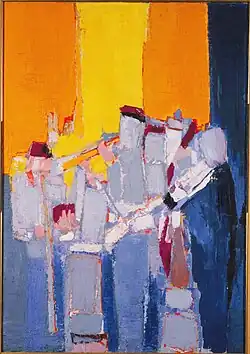
Les Musiciens, souvenir de Sidney Bechet, by Nicolas de Staël (1953)
Like many White Russians, the family was forced into exile; when both Vladimir and his wife Lubov died, the orphans Marina, Nicolas, and Olga were sent to Brussels to be raised by a Russian émigré family. After studying at the Académie Royale des Beaux-Arts and serving in the French Foreign Legion, Nicolas de Staël settled in Paris and emerged as one of the defining painters of post-war Europe.[42][43]
In Sweden, Mathilda Staël von Holstein (1876–1953) became the second[46] woman to practice law in the country. A powerful advocate for women's rights, she served on the Ministry of Justice committee whose work produced the Competence Law of 1923, opening government office to women.[47]
Branches and current status
The family is recorded as Uradel (immemorial nobility) in the Almanach de Gotha.[48] The Rhenish-Westphalian Freiherren branches became extinct in the 19th century.[7][21] The surviving Swedish and Russian branches both stem from the family's settlement in Livonia in the Late Middle Ages.
The Swedish branch remains centered on Vapnö Castle in Halland, now home to Sweden's largest dairy farm.[49]Kosta Glasbruk, founded in 1742, continues to operate today as Kosta Boda. The Russian branch, scattered by the Revolution of 1917, established itself across Europe, North America, and Asia, with descendants active today in the arts and academia.
Coat of arms
The family's arms are blazoned argent, eight torteaux in orle: three in chief, two on the flanks, and one in base (3-2-2-1).[50] The crest, borne on the helm, is two buffalo horns, each charged on the outer edge with four torteaux; some bearers added a tournament hat or a torse.[50] From the 17th century the arms also appear ensigned with a crown and supported by two lions,[50] two horses,[51] or two griffins.[52]
The arms are recorded in numerous medieval armorials, including the Armorial Gelre, the Armorial Bellenville, the Codex Seffken,[53] the Codex Bergshammar,[7] and the Heroldsbuch des jülich-bergischen Hubertusordens.[18] Some individual members varied the arms. Roprecht (1410–1462) bore rings in place of the roundels, and several members in the 15th and 16th centuries bore coins; marks of cadency include a star in the fess point (Theoderich 1320, Conrad 1333), a tournament label (Daniel 1320), and a bendlet (Johann 1463). The Zündorf cadet line bore the roundels in orle with an escallop in the fess point.[50] Two instances in the Heroldsbuch des jülich-bergischen Hubertusordens show nine torteaux (3-3-2-1).[18]
The family arms were taken into the civic heraldry of several places linked to its estates. The arms of the Essen district of Heisingen include roundels drawn from the Staël arms, recalling the family's lordship of Heisingen Castle.[54] Those of Holzhausen (Georgsmarienhütte) near Osnabrück, granted in 1968, combine the lion of the lords of Varendorff with the eight Staël roundels.[55] In Russia, the arms of Otradnoe in Novousmansky district, Voronezh Oblast, a former Staël estate, bear eight bezants from the family's arms.[56]
Tilmann Staël von Holstein (d. 1333), knight; killed in a street affray with Cologne citizens in 1333, for which the city paid 150 marks annually in bloodwit to his heirs[63]
Lutter Staël von Holstein (fl. 1333–c. 1363), son of Tilmann Staël von Holstein; founder of the family's Lanquit and Sülz lines and direct ancestor of all surviving branches of the family[7][64]
Rabolt Staël von Holstein (fl. 1462–1494), lord of Heisingen Castle, Amtmann of Orsoy;[68] his arms appear in the Heroldsbuch des jülich-bergischen Hubertusordens (c. 1480)
Neveling Staël von Holstein (fl. 1496), Amtmann (bailiff) of Neustadt[69]
Hildebrand Staël von Holstein (c. 1535–1587), major in Polish–Lithuanian service during the Livonian War, lord of Teenuse Manor and Pebalg Castle; died shortly after seven years of Russian captivity in Moscow;[70] progenitor of the family's Swedish branch[7][22]
Otto Wilhelm Staël von Holstein (1668–1730), Swedish major general, commander of Holstein infantry forces, colonel of the Adelsfanan (Noble Banner) and the Halland and Uppland Regiments
Fabian Ernst Staël von Holstein (1672–1730), Swedish lieutenant general and Captain of the Estonian Knighthood[23]
Jakob Axel Staël von Holstein (1680–1730), Swedish colonel and adjutant general to King Stanislaus of Poland; killed the Danish-Norwegian naval hero Peter Tordenskjold in a duel at Hildesheim in 1720, after Tordenskjold had accused him of being a card cheat[23][71]
Corfitz Ludwig Staël von Holstein (1753–1819), Swedish army captain and leading voice of the liberal opposition in the Riksdag of the Estates (1800–1818); at the Riksdag of 1800 he backed proposals to open ownership of tax-exempt manors to commoners, and remained a persistent critic of royal power and noble privilege through the constitutional crises of 1809–1818[72][22]
Karl Gustav Staël von Holstein (1761–1816), Russian Imperial colonel, lord of Kotzum Manor[7]
Germaine de Staël, née Necker (1766–1817), French writer, political thinker, and leading adversary of Napoleon; known as Madame de Staël
Auguste-Louis de Staël-Holstein (1790–1827), French writer and abolitionist
From the 18th century, the Russian branch established itself in Saint Petersburg, Moscow, and Voronezh through marriage alliances into the imperial aristocracy, acquiring estates across these regions:[93]
↑Rettinger, Elmar. "Brodenheim (Wüstung, Gmk. Brodenbach)". Historisches Ortslexikon Rheinland-Pfalz (in German). Vol.2: Ehemaliger Kreis St. Goar. Institut für Geschichtliche Landeskunde an der Universität Mainz. Retrieved 22 July 2026.
↑Lacomblet, Theodor Joseph, ed. (1858). Urkundenbuch für die Geschichte des Niederrheins (in German). Vol.4. Düsseldorf. Nr. 638.{{cite book}}: CS1 maint: location missing publisher (link)
↑Knipping, Richard (1909). Die Regesten der Erzbischöfe von Köln im Mittelalter (in German). Vol.3. Bonn. Nr. 174, 256.{{cite book}}: CS1 maint: location missing publisher (link)
↑Knipping, Richard (1909). Die Regesten der Erzbischöfe von Köln im Mittelalter (in German). Vol.3. Bonn. Nr. 707.{{cite book}}: CS1 maint: location missing publisher (link)
↑Lacomblet, Theodor Joseph, ed. (1846). Urkundenbuch für die Geschichte des Niederrheins (in German). Vol.2. Düsseldorf. Nr. 284.
↑The county's territory extended across the Ahrvalley and the Eifel.
12Lacomblet, Theodor Joseph, ed. (1846). Urkundenbuch für die Geschichte des Niederrheins (in German). Vol.2. Düsseldorf. Nr. 238.
↑Knipping, Richard (1909). Die Regesten der Erzbischöfe von Köln im Mittelalter (in German). Vol.3. Bonn. Nr. 1303, 1624.{{cite book}}: CS1 maint: location missing publisher (link)
1234Staël von Holstein, Thomas. "Stammbaum". stael-von-holstein.de (in German). Retrieved 4 July 2026.
12Lacomblet, Theodor Joseph, ed. (1858). Urkundenbuch für die Geschichte des Niederrheins (in German). Vol.4. Düsseldorf. Nr. 658.{{cite book}}: CS1 maint: location missing publisher (link)
12Greilsamer, Laurent (1998). Le Prince Foudroyé: La vie de Nicolas de Staël. Fayard. p.17. ISBN2-213-59552-6.
↑Lacomblet, Theodor Joseph, ed. (1853). Urkundenbuch für die Geschichte des Niederrheins (in German). Vol.3. Düsseldorf. Nr. 904, 905, 926, 1015.{{cite book}}: CS1 maint: location missing publisher (link)
↑Lacomblet, Theodor Joseph, ed. (1853). Urkundenbuch für die Geschichte des Niederrheins (in German). Vol.3. Düsseldorf. Nr. 1032, 1033.{{cite book}}: CS1 maint: location missing publisher (link)
↑Lacomblet, Theodor Joseph, ed. (1858). Urkundenbuch für die Geschichte des Niederrheins (in German). Vol.4. Düsseldorf. Nr. 269.{{cite book}}: CS1 maint: location missing publisher (link)
↑Arms of Staël von Holstein with nine torteaux
Some depictions of the arms bore nine torteaux, as in the accompanying image from the Heroldsbuch des jülich-bergischen Hubertusordens.
123Heroldsbuch des jülich-bergischen Hubertusordens. Kraków: Biblioteka Jagiellońska. Berol. ms. germ. quart. 1479.
↑Greilsamer, Laurent (1998). Le Prince Foudroyé: La vie de Nicolas de Staël. Fayard. p.18. ISBN2-213-59552-6.
↑Greilsamer, Laurent (1998). Le Prince Foudroyé: La vie de Nicolas de Staël. Fayard. p.36. ISBN2-213-59552-6.
↑Laclotte, Michel; Cuzin, Jean-Pierre (1987). Dictionnaire de la peinture occidentale du Moyen-Âge à nos jours. Paris: Larousse. p.864. ISBN978-2-03-511341-2.
↑Plakans, Andrejs (2011). A Concise History of the Baltic States. Cambridge Concise Histories. Cambridge: Cambridge University Press. ISBN9780521541558.
↑Clark, Walter Eugene (1937). Two Lamaistic Pantheons. Harvard-Yenching Institute Monograph Series. Harvard University Press.
↑Gothaisches Genealogisches Taschenbuch der Adeligen Häuser, Teil A (in German). Gotha. 1928. pp.92 ff.{{cite book}}: CS1 maint: location missing publisher (link)
12"Historia". Wapnö Gård (in Swedish). Retrieved 19 May 2026.
1234Fahne, Anton (1871). Geschichte der Herren Staël von Holstein (in German). Cologne. Section II, "Wappen und Titel".{{cite book}}: CS1 maint: location missing publisher (link)
↑Spießen, Max von (1903). Wappenbuch des Westfälischen Adels. Vol.2. Görlitz: C.A. Starke. p.Tfl. 275.
↑Spießen, Max von (1903). Wappenbuch des Westfälischen Adels. Vol.2. Görlitz: C.A. Starke. p.Tfl. 302.
↑Lacomblet, Theodor Joseph, ed. (1858). Urkundenbuch für die Geschichte des Niederrheins (in German). Vol.4. Düsseldorf. Nr. 646.{{cite book}}: CS1 maint: location missing publisher (link)
↑Knipping, Richard (1913). Die Regesten der Erzbischöfe von Köln im Mittelalter (in German). Vol.3. Bonn. Nr. 2086.{{cite book}}: CS1 maint: location missing publisher (link)
↑Knipping, Richard (1913). Die Regesten der Erzbischöfe von Köln im Mittelalter (in German). Vol.3. Bonn. Nr. 1918.{{cite book}}: CS1 maint: location missing publisher (link)
12Knipping, Richard (1913). Die Regesten der Erzbischöfe von Köln im Mittelalter (in German). Vol.3. Bonn. Nr. 3088, 3317, 3323.{{cite book}}: CS1 maint: location missing publisher (link)
↑Lacomblet, Theodor Joseph, ed. (1846). Urkundenbuch für die Geschichte des Niederrheins (in German). Vol.2. Düsseldorf. Nr. 806.; Historisches Archiv der Stadt Köln, Bestand 234 (Deutscher Orden, Kommende St. Katharina), U 2/164 (25 May 1301), printed in Fahne, Anton (1871). Urkundenbuch der Herren Stael von Holstein. Cologne. no. 15.{{cite book}}: CS1 maint: location missing publisher (link); Mosler, Hans (1912). Urkundenbuch der Abtei Altenberg. Vol.I. Bonn: Behrendt. no. 542.
↑Lacomblet, Theodor Joseph, ed. (1846). Urkundenbuch für die Geschichte des Niederrheins (in German). Vol.2. Düsseldorf. Nr. 1027.
↑Ennen, Leonard; Eckertz, Gottfried (eds.). Quellen zur Geschichte der Stadt Köln (in German). Vol.4. Cologne: DuMont-Schauberg. Nr. 190.
↑Lacomblet, Theodor Joseph, ed. (1853). Urkundenbuch für die Geschichte des Niederrheins (in German). Vol.3. Düsseldorf. Nr. 582.{{cite book}}: CS1 maint: location missing publisher (link)
↑Lacomblet, Theodor Joseph, ed. (1853). Urkundenbuch für die Geschichte des Niederrheins (in German). Vol.3. Düsseldorf. Nr. 947.{{cite book}}: CS1 maint: location missing publisher (link)
↑Długosz, Jan (1958). Górski, Karol (ed.). Banderia Prutenorum (in Polish). Warsaw: PWN.
↑Lacomblet, Theodor Joseph, ed. (1858). Urkundenbuch für die Geschichte des Niederrheins (in German). Vol.4. Düsseldorf. Nr. 257.{{cite book}}: CS1 maint: location missing publisher (link)
↑Lacomblet, Theodor Joseph, ed. (1858). Urkundenbuch für die Geschichte des Niederrheins (in German). Vol.4. Düsseldorf. Nr. 371.{{cite book}}: CS1 maint: location missing publisher (link)
↑Lacomblet, Theodor Joseph, ed. (1858). Urkundenbuch für die Geschichte des Niederrheins (in German). Vol.4. Düsseldorf. Nr. 474.{{cite book}}: CS1 maint: location missing publisher (link)
12345Elgenstierna, Gustaf (1932). Den introducerade svenska adelns ättartavlor. Vol.7. Stockholm: Norstedt. s.v. Staël von Holstein.
↑ Весь Петербург на 1914 год: адресная и справочная книга г. С.-Петербурга [All Petersburg for 1914: Address and Reference Book of the City of St. Petersburg] (in Russian). Saint Petersburg: Т-во А. С. Суворина «Новое время». 1914. Part III, p. 628; Part IV, cols. 45, 122, 217, 277–278, 302, 319.


 Heisingen
 Holzhausen
 Otradnoe (Novousmansky, Voronezh)


