St. John's Episcopal Church (Worthington, Ohio)
St. John's Episcopal Church | |
 St. John's Episcopal Church, Christmas 2010. | |
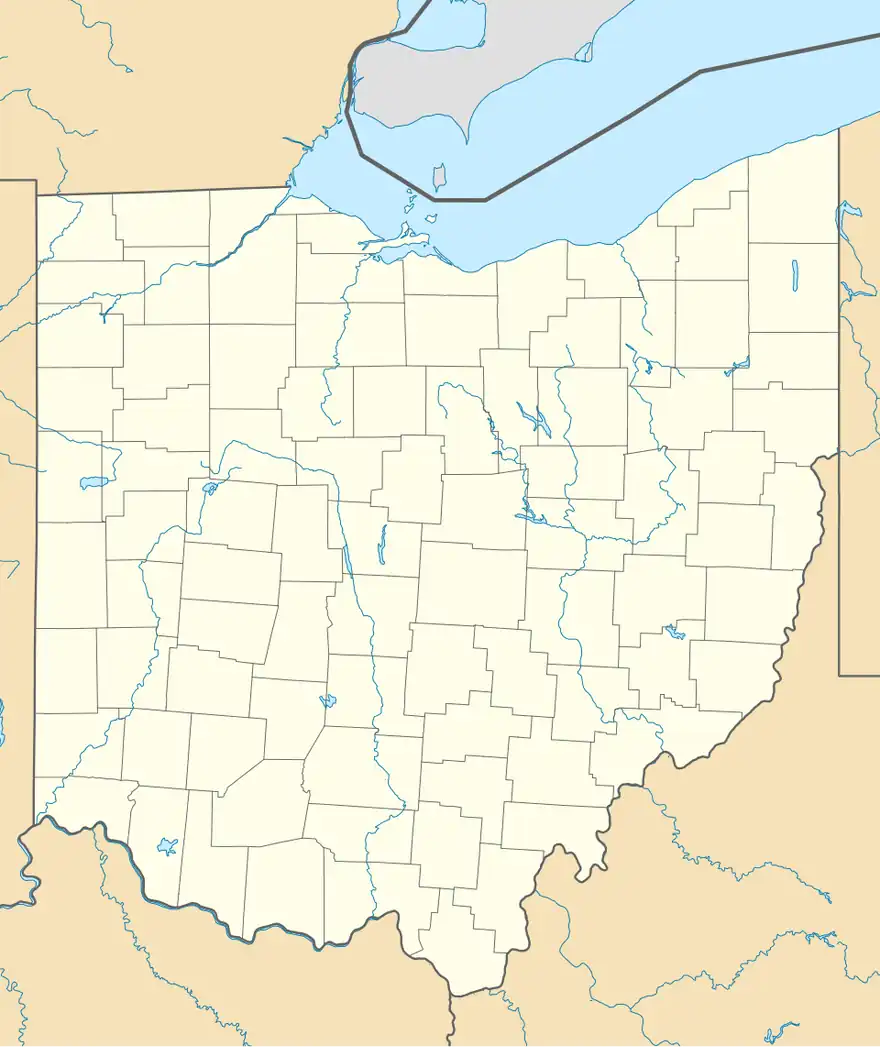  Location within Ohio  Location within the United States | |
| Location | 700 High Street, Worthington, Ohio |
|---|---|
| Coordinates | 40°05′18.2″N 83°01′02.3″W / 40.088389°N 83.017306°W |
| Area | 1.66 acres [1] |
| Built | 1827-31 |
| Architectural style | Gothic Revival |
| NRHP reference No. | 80003019[2] |
| Added to NRHP | April 17, 1980[2][3] |
St. John's Episcopal Church can refer to an Episcopal congregation in the Episcopal Diocese of Southern Ohio, or to the church in which this congregation worships.
Average Sunday Attendance (ASA) reported in 2024 was 144 persons. This was a relative decrease on ASA of 206 in 2020.[4]
In 2019, the church reported 464 members; in 2023, it reported 496 members.[5] No membership statistics were reported in 2024 national parochial reports.[6] Plate and pledge financial support reported by the church in 2023 was $561,751.[7]
History
The congregation was organized as St. John's Church in Worthington and Parts Adjacent on February 6, 1804, in a meeting of the town founders led by James Kilbourne, the same Episcopal deacon who founded the city in which the church resides.[8] It was the first Episcopal congregation established in the former Northwest Territory and State of Ohio, and the earliest organized faith community of any denomination in central Ohio.[9] In 1807 the parish was incorporated by an act of the Ohio legislature, only the second incorporated parish in the young state. The Reverend Philander Chase, St. John's first rector, arrived in 1817. From St. John's he also served the needs of central Ohio Episcopal congregations in Berkshire (Grace Church), Columbus (Trinity Church) and Delaware (St. Peter's).
The property occupied by the church and churchyard (cemetery) were allocated for use by the future congregation when the Scioto Company platted their purchased land in early 1803, prior to their departure from New England to settle Worthington.[10] On their arrival, the congregation first worshipped in a multi-purpose log building erected just north of the current church, and then in the Worthington Academy (school) building. The Gothic Revival church was built between 1827 and 1831, its construction probably managed by Aurora Buttles, Worthington's master brickmason. It is among the longest continuously used houses of worship in Ohio. The nave was extended slightly eastward beyond the original footprint in 1917. There is no longer a rectory on the campus, but the current parish house, Kilbourne Hall, was built in 1927 on the site of an earlier structure, and the church's Early Education Center was built in 1962. Township Hall, built in 1856 to serve as a school building, was purchased by the church in 1975 and is used for community outreach activities.[11]
In addition to the church itself, Township Hall and the churchyard (cemetery) were all inducted to the National Register of Historic Places on April 17, 1980.[2][3]
Burials
The churchyard served as a burial ground for both the parish and the community until 1859 when Worthington's first municipal cemetery was opened. It contains over 300 documented burials between 1804 and 1882 including the earliest recorded African-American burials in Franklin County.[12] The log maintained by St. John's sexton, George Griswold, between April 1825 and 1843 provides a glimpse into infant and maternal mortality, and prevalence of fatal diseases like cholera and "consumption" (tuberculosis). At least 11 Revolutionary War Patriots are believed to be buried in the graveyard: Private Joel Adams of Connecticut; Sergeant James Butterfield of Massachusetts; Private Israel Case of Connecticut; Noah Comstock of Connecticut; Private John Goodrich of Connecticut; Private Moses Maynard of Connecticut; Fifer Stephane Maynard of Connecticut; Private Alexander Morrison of Massachusetts; Private Lemuel Orton of Connecticut; Drummer Abner Pinney of Connecticut; Private William Thompson of Massachusetts.[13][14][15]

References
- ↑ "Franklin County Auditor public records search". 100-000329-00. Retrieved December 6, 2016.
- 1 2 3 "National Register Information System". National Register of Historic Places. National Park Service. July 9, 2010.
- 1 2 "Ohio: Franklin County". "National Register Historic Places". Retrieved December 6, 2016.
- ↑ "Explore Individual Parochial Report Trends". General Convention of the Episcopal Church. Retrieved July 30, 2026.
- ↑ "Explore Individual Parochial Report Trends". General Convention of the Episcopal Church. Retrieved July 30, 2026.
- ↑ Paulsen, David. "Episcopal Church reports no baptized membership data for 2024, citing parochial report 'confusion'". episcopalnewsservice.org. Episcopal News Service. Retrieved July 30, 2026.
- ↑ "Explore Individual Parochial Report Trends". General Convention of the Episcopal Church. Retrieved July 30, 2026.
- ↑ "First Book of Record, St. John's Episcopal Church" (PDF). www.worthingtonmemory.org.
- ↑ Smythe, George F. (1931). A History of the Diocese of Ohio to 1918. Cleveland: Episcopal Diocese of Ohio. pp. 20–23.
- ↑ McCormick, Virginia E. and Robert W. (1998). New Englanders on the Ohio Frontier. Kent, OH: The Kent State University Press. pp. 65–67. ISBN 0-87338-586-1.
- ↑ McCormick, Robert and Jennie (1992). Worthington Landmarks. Worthington, OH: Cottonwood Publications. pp. 70–72. ISBN 0-918887-05-4.
- ↑ "A Short History of St. John's Episcopal Church in Worthington, Ohio". Retrieved December 6, 2016.
- ↑ "DAR". DAR Genealogical Research Database. DAR.org. Retrieved May 10, 2025.
- ↑ Johnston, Henry Phelps. "Record of service of Connecticut men in the I. War of the Revolution, II. War of 1812, III. Mexican War". Connecticut Adjutant-General's Office.
- ↑ Massachusetts, Office of Secretary of State (1896). Massachusetts soldiers and sailors of the revoluntionary war. Vol. 2. Boston: Wright and Potter Printing Co. p. 962.
External links

- Churches on the National Register of Historic Places in Ohio
- Episcopal church buildings in Ohio
- Churches completed in 1831
- Churches in Franklin County, Ohio
- 19th-century Episcopal church buildings
- National Register of Historic Places in Franklin County, Ohio
- Religious organizations established in 1804
- High Street (Columbus, Ohio)
- Gothic Revival church buildings in Ohio