Tillandsia utriculata
| Tillandsia utriculata | |
|---|---|
 | |
 | |
| T. utriculata tank | |
Scientific classification  | |
| Kingdom: | Plantae |
| Clade: | Embryophytes |
| Clade: | Tracheophytes |
| Clade: | Angiosperms |
| Clade: | Monocots |
| Clade: | Commelinids |
| Order: | Poales |
| Family: | Bromeliaceae |
| Genus: | Tillandsia |
| Subgenus: | Tillandsia subg. Tillandsia |
| Species: | T. utriculata |
| Binomial name | |
| Tillandsia utriculata | |
| Synonyms[3] | |
| |

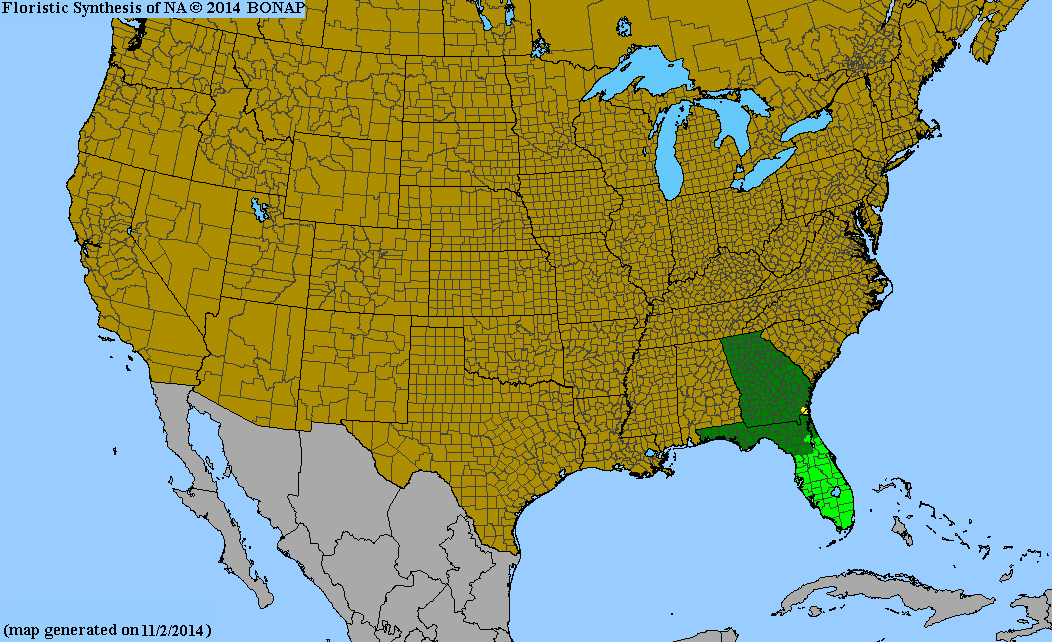
Tillandsia utriculata, commonly known as the spreading airplant, the giant airplant,[4] or wild pine is a species of bromeliad that is native to Florida and Georgia in the United States, the Caribbean, southern and eastern Mexico (Tamaulipas, Veracruz, Oaxaca, the Yucatán Peninsula), Central America, and Venezuela.[3][5][6][7][8][9][10][11][12]
Two varieties are recognized:[3]
- Tillandsia utriculata subsp. pringlei (S.Watson) C.S.Gardner – eastern Mexico
- Tillandsia utriculata subsp. utriculata – most of species range
Florida populations of Tillandsia utriculata are highly susceptible to attack by the invasive weevil Metamasius callizona, and have been devastated throughout their range.[13] Tillandsia utriculata holds more impounded water in its leaf axils, known as its tank, (up to a liter) than does any other Florida bromeliad. It is a major host of many species of aquatic invertebrates. With T. utriculata on a steady decline, a loss of habitat is occurring for many of these animal species.[14][15]
References
- ↑ "Tillandsia utriculata". NatureServe Explorer. Retrieved 6 November 2025.
- ↑ Isley, Paul T. (1987). Tillandsia: The World's Most Unusual Air Plants. Botanical Press. p. 122. ISBN 978-0-9617675-0-1.
- 1 2 3 "Tillandsia utriculata L." Plants of the World Online. Royal Botanic Gardens, Kew. Retrieved 2026-07-05.
- ↑ NRCS. "Tillandsia utriculata". PLANTS Database. United States Department of Agriculture (USDA). Retrieved 9 December 2015.
- ↑ "Tillandsia utriculata". Germplasm Resources Information Network. Agricultural Research Service, United States Department of Agriculture. Retrieved 2011-11-11.
- ↑ "Tillandsia utriculata Linnaeus". Flora of North America – via efloras.org.
- ↑ "Tillandsia utriculata" (Map). Biota of North America Program. 2 November 2014.
- ↑ Espejo-Serna, Adolfo; López-Ferrari, Ana Rosa; Ramírez-morillo, Ivón; Holst, Bruce K.; Luther, Harry E.; Till, Walter (1 June 2004). "Checklist of Mexican Bromeliaceae with Notes on Species Distribution and Levels of Endemism". Selbyana. 25 (1): 33–86. ISSN 2689-0682. JSTOR 41760147.
- ↑ Holst, Bruce K. (1 February 1994). "Checklist of Venezuelan Bromeliaceae with Notes on Species Distribution by State and Levels of Endemism". Selbyana. 15 (1): 132–149. ISSN 2689-0682. JSTOR 41759858.
- ↑ Luther, Harry E. (1995). "An Annotated Checklist of the Bromeliaceae of Costa Rica". Selbyana. 16 (2): 230–234. ISSN 0361-185X. JSTOR 41759911.
- ↑ Acevedo-Rodríguez, P.; Strong, M. T., eds. (2012). Catalogue of seed plants of the West Indies. Smithsonian Contributions to Botany. Vol. 98. Smithsonian Institution. hdl:10088/17551. LCCN 2011036134.
- ↑ Carnevali, G.; Tapia-Muñoz, J. L.; Duno de Stefano, R.; Ramírez Morillo, I. M. (2010). Flora Ilustrada de la Peninsula Yucatán: Listado Florístico.
- ↑ Frank, J. H.; Cave, R. D. (2005). "Metamasius callizona is destroying Florida's native bromeliads" (PDF). In Hoddle, M. S. (ed.). Second International Symposium on Biological Control of Arthropods, Davos, Switzerland, September 12–16, 2005. Vol. 1. USDA Forest Service. pp. 91–101. FHTET-2005-08.
- ↑ Frank, J. H.; Fish, D. (2008). "Potential biodiversity loss in Florida bromeliad phytotelmata due to Metamasius callizona (Coleoptera: Dryophthoridae), an invasive species". Florida Entomologist. 91 (1): 1–8. doi:10.1653/0015-4040(2008)091[0001:PBLIFB]2.0.CO;2.
- ↑ Cooper, T. M.; Frank, J. H.; Cave, R. D. (2014). "Loss of phytotelmata due to an invasive bromeliad-eating weevil and its potential effects on faunal diversity and biogeochemical cycles". Acta Oecologica. 54: 51–56. Bibcode:2014AcO....54...51C. doi:10.1016/j.actao.2013.01.016.
External links
 Media related to Tillandsia utriculata at Wikimedia Commons
 Data related to Tillandsia utriculata at Wikispecies