Southwestern North American megadrought


The southwestern North American megadrought is a multidecadal drought in the southwestern region of North America that began in 2000. The 2000–2021 period was the driest 22-year period the region had experienced since at least 800 CE. The megadrought contributed to the first-ever declaration of a water shortage at Lake Mead, one of the two largest reservoirs in the United States by storage capacity.[1] Climate models project increased drought risk and drier soil-moisture conditions in the region through the end of the 21st century.[2]
Background
Williams et al. defined southwestern North America (SWNA) for their megadrought analysis as the region from 30° to 45° N and 105° to 125° W.[3] The rectangular study area encompasses portions of northern Mexico and the western United States, extending north into Oregon and Wyoming and east through Colorado and New Mexico.[4] It overlaps portions of the Basin and Range Province and Colorado Plateau, as well as the Great Basin Desert, Mojave Desert, Sonoran Desert, and Chihuahuan Desert.[5][6]
 Southwestern North America (SWNA) study area used by Williams et al. (2020).
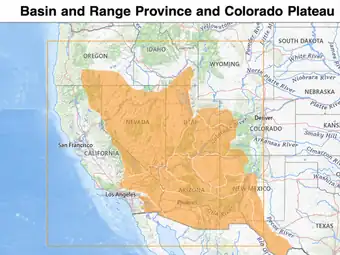 Basin and Range Province and Colorado Plateau in relation to the SWNA study area.
 Great Basin Desert region in relation to the SWNA study area.
 Mojave, Sonoran, and Chihuahuan deserts in relation to the SWNA study area.
Megadroughts, a term used to describe periods of multidecadal drought, are a recurring feature of the North American Southwest over the past millennium.[7] For example, droughts lasting at least a decade occurred in Texas in each century of the past millennium.[8] Researchers used tree-ring chronologies to reconstruct summer soil moisture back to 800 CE. This allowed the identification of 40 SWNA drought events lasting at least 19 years.[3] Of these, four megadroughts met the study's severity criterion, occurring in the late 800s, mid-1100s, 1200s, and late 1500s.[3] The twelfth- and thirteenth-century droughts bracketed the Ancestral Puebloans' Pueblo III Period. A significant drought after 1115 has often been associated with the depopulation of Chaco Canyon around 1130.[9] In the central Mesa Verde region, population decline and migration were already underway before the severe drought of 1276–1299; researchers concluded that the drought intensified a migration already in progress but that climate alone could not explain the region's depopulation.[10] The sixteenth-century megadrought coincided with the 1576 cocoliztli epidemic in New Spain; researchers have suggested that extreme drought conditions aggravated the epidemic.[11]
Drought is a recurring feature of California's climate. California experienced intermittent dry conditions during the 1920s and 1930s. The United States Geological Survey identifies 1928–1934 as a seven-year drought notable for its duration and severity in both precipitation and streamflow.[12] The California Department of Water Resources describes the broader 1920s–1930s period as off-and-on dry conditions spanning more than a decade and comparable to the largest 10-year droughts in paleoclimate records extending back more than 1,000 years.[13] Other notable California droughts include 1976–1977, 1987–1992, 2007–2009, and 2012–2016.[13] California also experienced a major drought from 2020 to 2022, the state's three driest consecutive years on record.[14]
Climate change
The megadrought that began in 2000 immediately followed a late-20th-century megapluvial. A 2025 reconstruction identified the 1978–1999 event as a 22-year megapluvial and the wettest pluvial in a 1,224-year record extending from 800 to 2023 CE.[15] Williams et al. (2020) found that the 2000–2018 drought was the second-driest 19-year period since 800 CE, exceeded only by a late-1500s megadrought. Anthropogenic trends in temperature, relative humidity, and precipitation were estimated to account for 47% of its severity (model interquartile range, 35–105%), pushing what otherwise would have been a moderate drought onto a trajectory comparable to the most severe reconstructed SWNA megadroughts.[3] From 2000 to 2021, mean water-year (October–September) precipitation in SWNA was 8.3% below the 1950–1999 average and mean temperature was 0.91 °C above average. Williams et al. (2022) found that 2000–2021 was the driest 22-year period since at least 800 CE. The years 2002 and 2021 ranked as the 11th and 12th driest years, respectively, between 800 and 2021, and were likely drier than any other year in nearly three centuries.[16]
Pacific ocean–atmosphere conditions have also contributed to drought in southwestern North America. Five of the six La Niña events since 1998 persisted for two to three years, an unusual clustering of multiyear La Niña events. A 2023 study noted that such events, together with global warming and land-surface feedbacks, may help explain the recent North American megadrought.[17] A 2025 attribution study found that the post-1980 decline in winter–spring precipitation in the southwestern United States cannot be explained by the region's La Niña-like tropical Pacific cooling trend alone; anthropogenic aerosols and tropical ocean warming also contributed to the drying atmospheric circulation over the North Pacific.[18]
Human-caused climate change has intensified the megadrought through changes in temperature, relative humidity, and precipitation. Williams et al. (2022) used modeled human-caused trends in all three variables when assessing the 2000–2021 event. For the exceptionally dry conditions in 2021, the study attributed about 19% of the drought severity to these climate trends.[16]
Climate change has also reduced water availability in the Colorado River Basin. A 2023 study estimated that anthropogenic warming since 1880 reduced present-day basin runoff, with the vegetation response to increased atmospheric carbon dioxide partially offsetting the loss; the combined effect was a 10.3% reduction in runoff. Runoff in snowpack-dominated regions was nearly twice as sensitive to warming as runoff in non-snowpack regions. Over the 2000–2021 megadrought, the estimated cumulative reduction in natural flow attributable to these influences was roughly equivalent to the storage capacity of Lake Mead.[19]
The 2023 Fifth National Climate Assessment (NCA5) concluded that climate change has reduced surface-water and groundwater availability for people and nature in the Southwestern United States. It found that higher temperatures have intensified drought and will lead to a more arid future. NCA5 also projected reductions in snow water equivalent and changes in soil moisture and annual runoff across the region.[20]
A 2021 study using CMIP6 climate-model projections found that under the most conservative warming scenario examined, SSP1-2.6 (+2.1 °C relative to 1851–1880), there was an approximately 50% probability of a 21-year soil-moisture drought at least as severe as the 2000–2020 drought in southwestern North America by the end of the 21st century. In the study's 18-member CMIP6 multi-model ensemble, the modeled probability of such prolonged droughts varied relatively little across the three Shared Socioeconomic Pathways examined, although climate-change mitigation reduced their severity and the risk of extreme single-year droughts. Future precipitation remains a major source of uncertainty in projections of long-term drought risk.[2]
Deforestation in tropical rainforests
In 2013, researchers using a high-resolution atmospheric model found that Amazon deforestation could alter winter climate in the northwestern United States. Their simulations produced precipitation reductions of 10–20% in the coastal Northwest and Sierra Nevada and declines of up to 50% in Sierra Nevada snowpack. The modeled precipitation reductions were not reproduced in lower-resolution simulations, indicating that the projected response was sensitive to model resolution.[21]
Tropical forests can influence precipitation through atmospheric moisture recycling and changes in large-scale atmospheric circulation. An observational study using satellite precipitation data and modeled atmospheric trajectories found that, across more than 60% of tropical land, air that had passed over extensive vegetation produced at least twice as much rain as air that had passed over little vegetation. The researchers found this relationship to be consistent with evapotranspiration maintaining atmospheric moisture.[22] A review of tropical deforestation studies found that large-scale forest loss can reduce rainfall and that its agricultural effects can extend beyond the tropics through atmospheric teleconnections.[23]
Effects


From 2012 to 2015, dryness in California was unprecedented in the instrumental record dating to 1896. Paleoclimate reconstructions extending to 1571 indicate that the southern Central Valley and South Coast regions likely experienced unprecedented precipitation deficits during 2012–2015. Some areas accumulated precipitation deficits exceeding two years of average moisture delivery, and recovery to long-term average moisture delivery in the hardest-hit areas could take several decades.[26] Some climate models project an increased risk of megadroughts in western North America during the 21st century as greenhouse forcing reduces precipitation and increases evaporative demand.[27]


Water scarcity has also strained relations between the United States and Mexico along their shared border. The 1944 water treaty allocates waters of the Colorado River and the Rio Grande between the two countries and is administered by the International Boundary and Water Commission (IBWC).[28] The treaty was negotiated during a period of unusual water abundance on the two rivers. By 2021, researchers identified prolonged drought, climate change, aging water infrastructure, and rapid population growth as increasing stresses on the treaty system. The population of the 10 largest paired cities along the border had grown from about 560,000 in 1940 to about 10 million.[29] On 8 September 2020, protesters opposed to water releases intended to help Mexico meet its obligations under the 1944 treaty clashed with Mexican National Guard troops at La Boquilla Dam in Chihuahua. The protesters subsequently occupied the dam and closed its sluice gates.[30] Later in 2020, Texas Governor Greg Abbott urged U.S. Secretary of State Mike Pompeo to ensure that Mexico fulfilled its water-delivery obligations under the 1944 treaty. In October, U.S. and Mexican officials reached an agreement allowing Mexico to meet the remaining obligation for the five-year treaty cycle through transfers of Mexican-owned water stored in Amistad and Falcon reservoirs.[31]
In March 2021, hydrologists with the New Mexico Interstate Stream Commission asked farmers along the Rio Grande and Rio Chama to cut back farming or prepare for a shortened irrigation season because of drought conditions.[32] In August 2021, the United States Bureau of Reclamation announced that Lake Mead would operate under its first-ever Level 1 Shortage Condition for calendar year 2022. The resulting shortage reductions and water-savings contributions were 512,000 acre-feet for Arizona, 21,000 acre-feet for Nevada, and 80,000 acre-feet for Mexico.[33] In August 2021, the Edward Hyatt Powerplant at Lake Oroville was taken offline because of falling reservoir levels, the first time the plant had ceased generation as a result of low water levels.[34] In early 2022, declining levels at Lake Powell brought the reservoir close to elevations that threatened hydropower generation at Glen Canyon Dam. The Bureau of Reclamation identified elevation 3,525 feet as a target intended to provide a 35-foot buffer above the 3,490-foot minimum power pool, the lowest reservoir elevation at which the dam can generate hydropower.[35] For calendar year 2023, Lake Mead operated under its first Level 2a Shortage Condition. The Bureau of Reclamation required shortage reductions and water-savings contributions of 592,000 acre-feet for Arizona, about 21% of the state's annual apportionment; 25,000 acre-feet for Nevada, 8% of its annual apportionment; and 104,000 acre-feet for Mexico, about 7% of its annual allotment. California had no required water-savings contribution under the 2023 operating condition.[36]
References
- ↑ "Reclamation announces 2022 operating conditions for Lake Powell and Lake Mead". U.S. Bureau of Reclamation. 16 August 2021. Retrieved 18 August 2026.
- 1 2 Cook, B. I.; Mankin, J. S.; Williams, A. P.; Marvel, K. D.; Smerdon, J. E.; Liu, H. (September 2021). "Uncertainties, Limits, and Benefits of Climate Change Mitigation for Soil Moisture Drought in Southwestern North America". Earth's Future. 9 (9) e2021EF002014. Bibcode:2021EaFut...902014C. doi:10.1029/2021EF002014. S2CID 239648992.
- 1 2 3 4 Williams, A. Park; Cook, Edward R.; Smerdon, Jason E.; Cook, Benjamin I.; Abatzoglou, John T.; Bolles, Kasey; Baek, Seung H.; Badger, Andrew M.; Livneh, Ben (17 April 2020). "Large contribution from anthropogenic warming to an emerging North American megadrought" (PDF). Science. 368 (6488): 314–318. Bibcode:2020Sci...368..314W. doi:10.1126/science.aaz9600. PMID 32299953. S2CID 215789824. Archived (PDF) from the original on 15 February 2022. Retrieved 20 February 2022.
- ↑ Gardner, Chester S.; She, Chiao-Yao (2022). "Signature of the Contemporary Southwestern North American Megadrought in Mesopause Region Wave Activity". Geophysical Research Letters. 49 (19) e2022GL100569. Bibcode:2022GeoRL..4900569G. doi:10.1029/2022GL100569.
- ↑ "USGS Physiographic Provinces". U.S. Geological Survey. Retrieved August 17, 2026.
- ↑ "Deserts". U.S. Geological Survey. April 2026. Retrieved August 17, 2026.
- ↑ Coats, Sloan; Smerdon, Jason E.; Cook, Benjamin I.; Seager, Richard (1 January 2015). "Are Simulated Megadroughts in the North American Southwest Forced?". Journal of Climate. 28 (1): 124–142. Bibcode:2015JCli...28..124C. doi:10.1175/JCLI-D-14-00071.1. ISSN 0894-8755. JSTOR 26194662.
- ↑ Nielsen-Gammon, John W.; Banner, Jay L.; Cook, Benjamin I.; Tremaine, Darrel M.; Wong, Corinne I.; Mace, Robert E.; Gao, Huilin; Yang, Zong-Liang; Gonzalez, Marisa Flores; Hoffpauir, Richard; Gooch, Tom; Kloesel, Kevin (August 2020). "Unprecedented Drought Challenges for Texas Water Resources in a Changing Climate: What Do Researchers and Stakeholders Need to Know?". Earth's Future. 8 (8) e2020EF001552. Bibcode:2020EaFut...801552N. doi:10.1029/2020EF001552. S2CID 225486984.
- ↑ Scarborough, Vernon L.; Fladd, Samantha G.; Dunning, Nicholas P.; Plog, Stephen; Owen, Lewis A.; Carr, Christopher; Tankersley, Kenneth B.; McCool, Jon-Paul; Watson, Adam S.; Haussner, Elizabeth A.; Crowley, Brooke; Bishop, Katelyn J.; Lentz, David L.; Vivian, R. Gwinn (2018). "Water uncertainty, ritual predictability and agricultural canals at Chaco Canyon, New Mexico". Antiquity. 92 (364): 870–889. doi:10.15184/aqy.2018.114.
- ↑ Schwindt, Dylan M.; Bocinsky, R. Kyle; Ortman, Scott G.; Glowacki, Donna M.; Varien, Mark D.; Kohler, Timothy A. (2016). "The Social Consequences of Climate Change in the Central Mesa Verde Region". American Antiquity. 81 (1): 74–96. Bibcode:2016AmAnt..81...74S. doi:10.7183/0002-7316.81.1.74. PMC 7523884. PMID 33001060.
- ↑ Acuna-Soto, Rodolfo; Stahle, David W.; Cleaveland, Malcolm K.; Therrell, Matthew D. (April 2002). "Megadrought and Megadeath in 16th Century Mexico". Emerging Infectious Diseases. 8 (4). Centers for Disease Control and Prevention: 360–362. doi:10.3201/eid0804.010175. PMC 2730237. PMID 11971767. Archived from the original on 20 February 2022. Retrieved 20 February 2022.
- ↑ "Drought in California". U.S. Geological Survey. November 2021. Retrieved 18 August 2026.
- 1 2 "Drought". California Department of Water Resources. Retrieved 18 August 2026.
- ↑ "Local Agencies Across California Continue Advancements Toward Groundwater Sustainability". California Department of Water Resources. 12 March 2026. Retrieved 18 August 2026.
- ↑ Cook, Benjamin I.; Williams, A. Park; Smerdon, Jason E.; Marvel, Kate; Seager, Richard (25 March 2025). "Megapluvials in Southwestern North America". AGU Advances. 6 (2) e2024AV001508. Bibcode:2025AGUA....601508C. doi:10.1029/2024AV001508.
- 1 2 Williams, A. Park; Cook, Benjamin I.; Smerdon, Jason E. (14 February 2022). "Rapid intensification of the emerging southwestern North American megadrought in 2020–2021". Nature Climate Change. 12 (3): 232–234. Bibcode:2022NatCC..12..232W. doi:10.1038/s41558-022-01290-z. ISSN 1758-678X.
- ↑ Wang, Bin; Sun, Weiyi; Jin, Chunhan; Luo, Xiao; Yang, Young-Min; Li, Tim; Xiang, Baoqiang; McPhaden, Michael J.; Cane, Mark A.; Jin, Feifei; Liu, Fei; Liu, Jian (2023). "Understanding the recent increase in multiyear La Niñas". Nature Climate Change. 13 (10): 1075–1081. Bibcode:2023NatCC..13.1075W. doi:10.1038/s41558-023-01801-6.
- ↑ Kuo, Yan-Ning; Lehner, Flavio; Simpson, Isla R.; Deser, Clara; Phillips, Adam S.; Newman, Matthew; Shin, Sang-Ik; Wong, Spencer; Arblaster, Julie M. (2025). "Recent southwestern US drought exacerbated by anthropogenic aerosols and tropical ocean warming". Nature Geoscience. 18 (7): 578–585. Bibcode:2025NatGe..18..578K. doi:10.1038/s41561-025-01728-x.
- ↑ Bass, Benjamin; Goldenson, Naomi; Rahimi, Stefan; Hall, Alex (20 July 2023). "Aridification of Colorado River Basin's Snowpack Regions Has Driven Water Losses Despite Ameliorating Effects of Vegetation". Water Resources Research. 59 (7) e2022WR033454. Bibcode:2023WRR....5933454B. doi:10.1029/2022WR033454.
- ↑ White, Dave D.; Elias, Emile H.; Thomas, Kathryn A.; Bradatan, Cristina E.; Brunson, Mark W.; Chischilly, Ann Marie; Enquist, Carolyn A. F.; Fisher, Leah R.; Froehlich, Halley E.; Koebele, Elizabeth A.; Méndez, Michael; Ostoja, Steven M.; Steele, Caitriana; Vanos, Jennifer K. (2023). Crimmins, Allison R.; Avery, Christopher W.; Easterling, David R.; Kunkel, Kenneth E.; Stewart, Brooke C.; Maycock, Thomas K. (eds.). Chapter 28: Southwest. Fifth National Climate Assessment (Report). U.S. Global Change Research Program. doi:10.7930/NCA5.2023.CH28.
- ↑ Medvigy, David; Walko, Robert L.; Otte, Martin J.; Avissar, Roni (15 November 2013). "Simulated Changes in Northwest U.S. Climate in Response to Amazon Deforestation". Journal of Climate. 26 (22): 9115–9136. Bibcode:2013JCli...26.9115M. doi:10.1175/JCLI-D-12-00775.1.
- ↑ Spracklen, D. V.; Arnold, S. R.; Taylor, C. M. (5 September 2012). "Observations of increased tropical rainfall preceded by air passage over forests". Nature. 489 (7415): 282–285. Bibcode:2012Natur.489..282S. doi:10.1038/nature11390. PMID 22951966.
- ↑ Lawrence, Deborah; Vandecar, Karen (January 2015). "Effects of tropical deforestation on climate and agriculture". Nature Climate Change. 5 (1): 27–36. Bibcode:2015NatCC...5...27L. doi:10.1038/nclimate2430.
- ↑ "Lake Mead Hoover Dam and Powerplant Daily Lake/Reservoir Elevation-ft Time Series Data". U.S. Bureau of Reclamation. Retrieved 18 August 2026.
- ↑ "Lake Powell - Pool elevation (feet)". US Bureau of Reclamation. Archived from the original on 7 August 2026. Retrieved 19 August 2026. Click on "CSV DATA", then "Pool Elevation" to download data. See Lake Powell Water Level re minimum power pool and dead pool levels.
- ↑ Wahl, Eugene R.; Diaz, Henry F.; Vose, Russell S.; Gross, Wendy S. (1 August 2017). "Multicentury Evaluation of Recovery from Strong Precipitation Deficits in California". Journal of Climate. 30 (15): 6053–6063. Bibcode:2017JCli...30.6053W. doi:10.1175/JCLI-D-16-0423.1.
- ↑ Cook, Benjamin I.; Cook, Edward R.; Smerdon, Jason E.; Seager, Richard; Williams, A. Park; Coats, Sloan; Stahle, David W.; Villanueva Díaz, José (2016). "North American megadroughts in the Common Era: reconstructions and simulations". WIREs Climate Change. 7 (3): 411–432. Bibcode:2016WIRCC...7..411C. doi:10.1002/wcc.394.
- ↑ "About Us". International Boundary and Water Commission. Retrieved 18 August 2026.
- ↑ Gerlak, Andrea K.; Varady, Robert Gabriel; Mumme, Stephen Paul (1 July 2021). "'Megadrought' along border strains US-Mexico water relations". The Conversation. Retrieved 18 August 2026.
- ↑ Gonzalez, Jose Luis (9 September 2020). "Tossing Molotov cocktails, drought-hit Mexicans demand halt to water sharing with U.S." Reuters. Retrieved 18 August 2026.
- ↑ "Governor Abbott Announces Mexico Fulfillment Of Water Delivery Obligations Under 1944 Water Treaty". Office of the Governor of Texas. 22 October 2020. Retrieved 18 August 2026.
- ↑ Nelson, Cody (8 March 2021). "New Mexico's Coming Megadrought Highlights Farmers' Control of Water". Capital & Main. Retrieved 21 February 2022.
- ↑ "Reclamation announces 2022 operating conditions for Lake Powell and Lake Mead". U.S. Bureau of Reclamation. 16 August 2021. Retrieved 18 August 2026.
- ↑ "DWR Statement on the Status of Hyatt Powerplant at Lake Oroville". California Department of Water Resources. 5 August 2021. Retrieved 18 August 2026.
- ↑ "Reclamation modifies monthly water releases from Lake Powell to protect reservoir's critical elevations". U.S. Bureau of Reclamation. 7 January 2022. Retrieved 18 August 2026.
- ↑ "Interior Department Announces Actions to Protect Colorado River System, Sets 2023 Operating Conditions for Lake Powell and Lake Mead". U.S. Bureau of Reclamation. 16 August 2022. Retrieved 18 August 2026.
External links
- National Integrated Drought Information System (NIDIS) at Drought.gov; the National Integrated Drought Information System
- Western Regional Climate Center of the Desert Research Institute
- "Impact of Anthropogenic Warming on an Emerging North American Megadrought," NIDIS webinar on 13 May 2020
- "Coping With Megadrought in the Colorado River Basin," NIDIS webinar on 27 May 2020