Description
Epiphytic or terrestrial orchids with cylindrical rhizome from which the fleshy noodle-like roots grow. Pseudobulbs can be conical, spindle-shaped or cylindrical; with upright growth; one or two leaves growing from the top of them. The leaves can be oblong, lanceolate or elliptical, somewhat fleshy, with smooth margin. The inflorescence is a terminal raceme with few or several flowers. Flowers have sepals and petals free from each other; the lip or labellum (lowermost petal), usually has a different coloration and shape from the rest of the flower and covers in part the flower column forming a tube. There are four pollinia (bag-like organs that contain pollen). The fruit is a capsule with many small seeds.[ 4] [ 5] [ 6]
Taxonomy
The genus was named in 1824 by John Lindley after horticulturalist William Cattley . Cattley obtained a specimen of then unnamed Cattleya labiata C. labiata .[ 7]
Currently accepted species and subgeneric division within genus Cattleya are:[ 8] [ 9] [ 10] [ 11] [ 12] [ 13]
Subgenus Cattleya
Section Cattleya
Section Crispae
Series Cattleyodes
Series Hadrolaelia
Series Microlaelia
Series Parviflorae
Series Sophronitis
Section Lawrenceanae
Subgenus Cattleyella
Subgenus Intermediae
Subgenus Maximae
Subgenus Cattleya
Section Crispae
Series Microlaelia
Image Name Distribution Elevation (m)
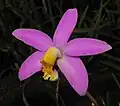
C. lundii Bolivia to Argentina 740 – 1000 meters
Subgenus Cattleyella
Image Name Distribution Elevation (m)
C. araguaiensis Brazil 395 – 610 meters
Subgenus Maximae
Image Name Distribution Elevation (m)
C. maxima S Ecuador to N Peru 10 – 1500 meters
Natural hybrids
Currently accepted natural hybrids are:[ 13]
Cattleya × adrienne (= Cattleya pumila × Cattleya jongheana) (Brazil)Cattleya × albanensis Cattleya × amanda Cattleya × binotii (= ) (Brazil)Cattleya × brasiliensis (= C. bicolor × C. harrisoniana ) (Brazil)Cattleya × braunae Cattleya × britoi (= C. crispata x C. mirandae ) (Brazil - Minas Gerais)Cattleya × brymeriana (= C. violacea × C. wallisii ) (N. Brazil).Cattleya × calimaniana (Brazil)Cattleya × calimaniorum (NE Brazil)Cattleya × carassana (Brazil)Cattleya × cattleyioides (Brazil)Cattleya × cipoensis (Brazil)Cattleya × colnagiana (Brazil).Cattleya × cristinae (Brazil).Cattleya × cypheri Cattleya × dasilvae Cattleya × dayana (= C. forbesii × C. guttata ) (Brazil).Cattleya × deckeri Cattleya × delicata Cattleya × diamantinensis (= C. pfisteri × C. sincorana) (Brazil).Cattleya × dolosa (= C. loddigesii × C. walkeriana ) (Brazil).Cattleya × dukeana (= C. bicolor × C. guttata ) (SE. Brazil).Cattleya × duveenii (= C. guttata × C. harrisoniana ) (SE. Brazil).Cattleya × elegans Cattleya × ericoi Cattleya × feldmanniana Cattleya × fidelensis (Brazil - Rio de Janeiro).Cattleya × frankeana Cattleya × gaezeriana Cattleya × gerhard-santosii Cattleya × gottoana Cattleya × gransabanensis (= C. jenmanii × C. lawrenceana ) (Venezuela).Cattleya × gravesiana (= C. lueddemanniana × C. mossiae ) (Venezuela).Cattleya × hardyana (= C. dowiana var.aurea × C. warscewiczii ) (Colombia).Cattleya × heitoriana Cattleya × hummeliana Cattleya × hybrida (= C. guttata × C. loddigesii ) (SE. Brazil).Cattleya × imperator (= C. granulata × C. labiata ) (NE. Brazil).Cattleya × intricata (= C. intermedia × C. leopoldii ) (S. Brazil).Cattleya × irrorata Cattleya × isaacii Cattleya × isabella (= C. forbesii × C. intermedia ) (SE. Brazil).Cattleya × itabapoanaensis Cattleya × jetibaensis Cattleya × joaquiniana (= C. bicolor × C. walkeriana ) (Brazil) .Cattleya × kautskyi (= C. harrisoniana × C. warneri ) (SE. Brazil).Cattleya × kerchoveana Cattleya × labendziana Cattleya × lambari Cattleya × lilacina Cattleya × lucieniana (= C. forbesii × C. granulosa ) (SE. Brazil).Cattleya × macguiganii Cattleya × measuresii (= C. aclandiae × C. walkeriana ) (E. Brazil).Cattleya × mesquitae (= C. nobilior × C. walkeriana ) (Brazil).Cattleya × mingaensis Cattleya × mixta (= C. guttata × C. schofieldiana ) (Brazil).Cattleya × moduloi (C. schofieldiana × C. warneri ) (Brazil).Cattleya × mucugensis Cattleya × neocalimaniana Cattleya × neocalimaniorum Cattleya × neoreginae Cattleya × nesyana Cattleya × occhioniana Cattleya × odiloniana Cattleya × patrocinii (= C. guttata × C. warneriana ) (SE. Brazil).Cattleya × picturata (= C. guttata × C. intermedia ) (SE. Brazil).Cattleya × pittiana Cattleya × porphyritis Cattleya × porphyrophlebia Cattleya × raganii Cattleya × resplendens (= C. granulosa × C. schilleriana ) (NE. Brazil)Cattleya × rigbyana Cattleya × ruschii Cattleya × sancheziana Cattleya × schroederiana Cattleya × schunkiana Cattleya × schunkii Cattleya × scita (= C. intermedia × C. tigrina ) (S. Brazil).Cattleya × sgarbii Cattleya × sororia Cattleya × tenuata (= C. elongata × C. tenuis ) (Brazil) .Cattleya × varelae Cattleya × venosa (= C. forbesii × C. harrisoniana ) (Brazil).Cattleya × verelii Cattleya × victoria-regina ( C. guttata × C. labiata ) (NE. Brazil).Cattleya × victoriacarolinae Cattleya × wetmorei Cattleya × whitei Cattleya × wilsoniana (= C. bicolor × C. intermedia ). (Brazil).Cattleya × wyattiana (= C. crispa × C. lobata ). (Brazil).Cattleya × zaslawskii (= C. harpophylla × C. praestans ). (Brazil).Cattleya × zayrae (= C. amethystoglossa × C. elongata ). (Bahia, Brazil)
Nothogenera
Hybrids of Cattleya and other genera are placed in the following nothogenera :
Cultivation
Cattleya mossiae fo. coerulea Cattleyas need light, but not direct sunlight; in case of intense sunlight, shade must be provided.[ 14] Day temperatures must be between 25–30 °C (77–86 °F) and night temperatures not lower than 10–12 °C (50–53.6 °F).[ 14] Must be between 40–70% with good ventilation; however plants must not be exposed to air currents.[ 15] Water only if substrate is dry. It can be done once a week, but it all depends on the environmental conditions and the season.[ 15] Cattleyas can survive without fertilizing. However, it is advisable to use nitrogen-based fertilizers without urea ; fertilizers must be applied during the growth season.[ 15] [ 15]
References
1 2 "Kew World Checklist of Selected Plant Families" . Royal botanic Gardens Kew. Retrieved 21 February 2017 .↑ Sunset Western Garden Book , 1995:606–607↑ "Alphabetical list of standard abbreviations of all generic names occurring in current use in orchid hybrid registration as at 31st December 2007" (PDF) . Royal Horticultural Society.↑ Buzatto, Cristiano Roberto; Ferreira, Priscila Porto Alegre; Welker, Cassiano Aimberê Dorneles; Seger, Guilherme Dubal dos Santos; Hertzog, Anelise; Singer, Rodrigo B. (2010). "O gênero Cattleya Lindl. (Orchidaceae: Laeliinae) no Rio Grande do Sul, Brasil" . Revista Brasileira de Biociências (in Portuguese). 8 (4). ISSN 1980-4849 . ↑ Withner, C. (1988). The Cattleyas and Their Relatives . Vol. 1: The Cattleyas. Timber Press. pp. 29– 30. ISBN 9780881920994 . ↑ Schweinfurth, C., "Orchidaceae, Orchids of Peru", Fieldiana, Botany 30(3): 535 ↑ "Cattleya, Queen of the Orchids: The Showy Cattleya, Queen of the Orchids, BEGINNERS' HANDBOOK - XV" . www.aos.org . Retrieved 29 June 2017 .↑ Van den Berg, Cássio (2014). "Reaching a compromise between conflicting nuclear and plastid phylogenetic trees: a new classification for the genus Cattleya (Epidendreae; Epidendroideae; Orchidaceae)" . Phytotaxa . 186 (2): 75. doi :10.11646/phytotaxa.186.2.2 ISSN 1179-3163 . ↑ "Laelia gracilis - IOSPE PHOTOS" . www.orchidspecies.com . Retrieved 28 June 2017 .↑ "Cattleya hispidula - IOSPE PHOTOS" . www.orchidspecies.com . Retrieved 28 June 2017 .↑ "Cattleya gracilis (Pabst) Van den Berg — The Plant List" . www.theplantlist.org . Retrieved 28 June 2017 .↑ van den Berg, Cássio (2016). "Nomenclatural notes on Laeliinae-VI. Further combinations in Cattleya (Orchidaceae)" Neodiversity . 9 (1): 4– 5. doi :10.13102/neod.91.2 (inactive 11 July 2025). {{cite journal}}: CS1 maint: DOI inactive as of July 2025 (link)1 2 "Cattleya - World Checklist of Selected Plant Families: Royal Botanic Gardens, Kew" . apps.kew.org . Archived from the original on 8 September 2009. Retrieved 1 July 2017 .1 2 Schoser, Gustav (1993). Orchid Growing Basics 64 . ISBN 9780806903620 . 1 2 3 4 "Cattleyas for the Beginner - Part 1" . www.aos.org . Retrieved 3 July 2017 .
External links
Taxon identifiers
Cattleya
Authority control databases: National




 Media related to Cattleya at Wikimedia Commons
 Data related to Cattleya at Wikispecies