Shrira-Pesenson equation
The Shrira–Pesenson equation (abbreviated as SP equation) is a nonlinear partial differential equation governing the evolution of transverse perturbations of finite length and amplitude on the front of a planar soliton:

where is the transverse perturbation of the 1-D soliton, is the linear transverse wave speed, is the transverse Laplace operator, and are nonlinearity coefficients, and is an effective viscosity — all determined by explicit integral formulas over the soliton profile.


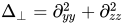


The equation applies universally to broad classes of nonlinear evolution equations that admit single-parameter soliton solutions; its coefficients differ for different soliton families, but the structure of the equation is the same. It arises in a wide range of physical contexts — including fluid dynamics, plasma physics, solid-state physics, and nonlinear optics — wherever a nominally one-dimensional solitary wave propagates in a medium that is weakly non-one-dimensional.
The equation describes the mechanism by which a slightly bent soliton front evolves into shock waves — shocks-on-soliton propagating along the front[1][2]. In the stable regime (negative dispersion), the SP equation reduces to the Burgers equation, describing the formation and internal structure of soliton-shocks — analogous to Whitham's concept of "shock-shocks"[3][4] — and extends the Mach-type irregular interaction of shock waves[3][4] to the oblique interaction of solitons,[5] thus describing the triple-point structure observed in soliton reflection.

In the unstable regime (positive dispersion), the equation describes soliton self-focusing and provides the instability threshold and growth rate.
History
The linear form of the equation for transverse perturbations of finite length was derived by Pesenson in 1983.[6] The nonlinear generalization was presented jointly by Shrira and Pesenson at the Second International Workshop on Nonlinear and Turbulent Processes in Physics (1983).[1] The equation was named the "Shrira–Pesenson equation" in the review article by Kivshar and Pelinovsky in Physics Reports (2000).[7]
Background
Many types of one-dimensional (1-D) nonlinear waves in dispersive media (e.g., shallow-water waves, magnetosonic and ion-sound waves in plasma, etc.) are described by the Korteweg–de Vries (KdV) equation, which is notable as the prototypical example of an integrable partial differential equation that has various explicit solutions, and in particular, soliton solutions.
The stability and dynamics of such soliton solutions are well studied in 1-D cases. However, in reality, transverse perturbations of the phase and amplitude of the 1-D soliton are always present and the problem of transverse stability and self-focusing is of great practical importance (for an early artistic representation of 2-D wavefronts by Hiroshige see Figure 1).

To study the stability and dynamics of solitons with respect to transverse perturbations, Kadomtsev and Petviashvili[8] generalized the KdV equation to weakly non-one-dimensional waves (Figure 2) by deriving what is now known as the Kadomtsev–Petviashvili (KP) equation and establishing within its framework the transverse instability of planar KdV solitons for media with positive dispersion. In subsequent work, Zakharov[9] derived the dispersion relation for infinitesimal transverse perturbations of the KdV soliton using the inverse scattering transform.
The two-dimensional dynamics of solitons were described by Ostrovsky and Shrira[10][11] by extending to solitons the geometrical optics approach originally developed by Whitham[3] for refraction of shock waves. Miles[5] and Newell and Redekopp[12] discovered soliton resonances for the oblique interaction of weakly two-dimensional solitons. A connection between soliton resonances and Mach reflection of shock waves was noted in Miles (1977).[5]
The geometrical optics approach of Ostrovsky and Shrira,[10] which assumed adiabatic evolution and did not account for the finite wavelength of the transverse perturbations, reduced the problem of two-dimensional soliton dynamics to a nonlinear hyperbolic system of equations. The solution of this system develops an infinite derivative, thus preventing a description of the evolution of perturbations beyond such a singularity and limiting the applicability of the geometrical optics approach.
Earlier approaches assumed small, infinitely long transverse perturbations; the perturbations are finite both in amplitude and in wavelength.[6][1] The Shrira-Pesenson equation captures simultaneously both the finite amplitude and the finite ratio of the soliton width to the transverse perturbation wavelength, thus going beyond the framework of earlier approaches.[2]

Physical significance
Two broad classes of nonlinear evolution equations were considered in Pesenson (1983)[6] — a dispersive KP-type class and a hyperbolic Klein–Gordon-type class:

where is a nonlinear integro-differential operator chosen so that the equation admits stable traveling solitary wave solutions , where , and is the transverse Laplace operator. These classes include, in particular, non-one-dimensional versions of the KdV (KP equation), Modified KdV equation (MKdV), Burgers, Boussinesq, Benjamin–Ono, and Klein–Gordon equations.


Through a multi-scale asymptotic expansion in the small parameter — the ratio of the soliton width to the transverse perturbation wavelength — it was shown[6] that the dynamics of small perturbations on the front of planar solitons belonging to classes (2) and (3) satisfy the linearized Burgers equation. The dispersion relation of this equation describes decaying oscillations when 1-D solitons are transversely stable, and furnishes the instability threshold wavenumber and growth rate when they are not.[6] Explicit dispersion relations were computed for the KP, modified KP, Klein–Gordon, and Zabolotskaya–Khokhlov equations.[6]
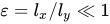
Extension of the asymptotic procedure to third order in Shrira and Pesenson (1984)[1] yielded the nonlinear equation governing perturbations of finite length and amplitude — equation (1) of the first section of this article. The complete derivation — including explicit shock-wave solutions, the generalization of quasioptics, and treatment of the sine-Gordon kink — is given in Pesenson (1991).[2] The equation was shown to be universal: its structure is the same for all single-parameter soliton families belonging to classes (2) and (3), with coefficients that differ by soliton family.[1][2]
In the single-wave approximation for the stable case (negative dispersion), the SP equation reduces to the nonlinear Burgers equation for the perturbation amplitude :[2]


This Burgers equation describes the formation of shock waves on the soliton front — soliton-shocks analogous to Whitham's "shock-shocks"[3] — and shows that the internal structure of these soliton-shocks is determined by high-frequency dissipation due to diffraction and energy radiation into the tail. The shock wave corresponds to a triple point in the Mach-type reflection of oblique solitons (Figure 3).
The comprehensive review by Kivshar and Pelinovsky[7] surveyed self-focusing and transverse instabilities of solitary waves across related models, and included a detailed analysis of the Shrira–Pesenson equation in Section 5.3.2.

It is applicable across a broad spectrum of physical systems — surface and internal waves in fluid dynamics and plasma physics,[2] nonlinear waves in solid-state and condensed-matter physics,[13] and spatial optical solitons in nonlinear optics and photonics[7] — in all cases describing the universal behavior of transverse perturbations of finite amplitude and length on the front of planar solitons.
See also
- Soliton
- Korteweg–de Vries equation
- Kadomtsev–Petviashvili equation
- Benjamin–Ono equation
- Sine–Gordon equation
- Burgers equation
- Nonlinear Schrödinger equation
- Modified KdV equation
- Davey–Stewartson equation
- List of nonlinear partial differential equations
- Nonlinear partial differential equation
- Quasioptics
References
- 1 2 3 4 5 Shrira, V. I.; Pesenson, M. Z. (1984). "Soliton stability with respect to transverse perturbations of finite length and amplitude". In Sagdeev, R. Z. (ed.). Nonlinear and Turbulent Processes in Physics. Vol. 2. New York: Harwood Academic Publishers. pp. 1061–1068.
- 1 2 3 4 5 6 Pesenson, M. Z. (1991). "Nonlinear waves traveling upon a front of solitons". Physics of Fluids A. 3 (12): 3001–3006. Bibcode:1991PhFlA...3.3001P. doi:10.1063/1.857843.
- 1 2 3 4 Whitham, G. B. (1957). "A new approach to problems of shock dynamics, Part I: Two-dimensional problems". Journal of Fluid Mechanics. 2 (2): 146–171. Bibcode:1957JFM.....2..145W. doi:10.1017/S002211205700004X.
- 1 2 Whitham, G. B. (1974). Linear and Nonlinear Waves. New York: Wiley-Interscience.
- 1 2 3 Miles, J. W. (1977). "Obliquely interacting solitary waves". Journal of Fluid Mechanics. 79: 157–169. Bibcode:1977JFM....79..157M. doi:10.1017/S0022112077000081.
- 1 2 3 4 5 6 Pesenson, M. Z. (1983). "On the evolution of small transverse perturbations on the front of weakly non-one-dimensional solitons". Izvestiya Vysshikh Uchebnykh Zavedenii, Radiofizika (Soviet Radiophysics). 26 (4): 504–507.
- 1 2 3 Kivshar, Yu. S.; Pelinovsky, D. E. (2000). "Self-focusing and transverse instabilities of solitary waves". Physics Reports. 331 (4): 117–195. Bibcode:2000PhR...331..117K. doi:10.1016/S0370-1573(99)00106-4.
- ↑ Kadomtsev, B. B.; Petviashvili, V. I. (1970). "On the stability of solitary waves in weakly dispersive media". Soviet Physics Doklady. 15: 539–541. Bibcode:1970SPhD...15..539K.
- ↑ Zakharov, V. E. (1975). "Instability and nonlinear oscillations of solitons". Soviet Physics JETP Letters. 22: 172–173. Bibcode:1975JETPL..22..172Z.
- 1 2 Ostrovsky, L. A.; Shrira, V. I. (1976). "Instability and self-refraction of solitons". Soviet Physics JETP. 44 (4): 738–743. Bibcode:1976JETP...44..738O.
- ↑ Shrira, V. I. (1980). "Nonlinear refraction of solitons". Soviet Physics JETP. 52 (1): 44–49. Bibcode:1980JETP...52...44S.
- ↑ Newell, A. C.; Redekopp, L. G. (1977). "Breakdown of Zakharov–Shabat theory and soliton creation". Physical Review Letters. 38 (8): 377–380. Bibcode:1977PhRvL..38..377N. doi:10.1103/PhysRevLett.38.377.
- ↑ Pesenson, M. Z. (1990). "Non-one-dimensional solitary waves in condensed media". Fizika Tverdogo Tela (Soviet Physics — Solid State). 32 (5): 1467–1475.