Shara Murun Formation
| Shara Murun Formation | |
|---|---|
| Stratigraphic range: Middle Eocene (Sharamurunian) | |
| Type | Formation |
| Unit of | Erlian Basin |
| Sub-units | Upper member[1] Lower member[1] |
| Underlies | Ulan Gochu Formation |
| Overlies | Tukhum Formation |
| Location | |
| Region | Inner Mongolia |
| Country | China |
The Shara Murun Formation is a geologic formation in Inner Mongolia, northern China. The deposits of the Shara Murun Formation date to the Middle Eocene,[1] and preserve fossils of a diverse, perissodactyl-dominated[2] mammal fauna. The fossil fauna of the Shara Murun Formation is the type fauna of the Sharamurunian, one of the Asian land mammal ages (ALMAs).[1]
Research history

The deposits of the Shara Murun Formation are situated in the Erlian Basin, a structural basin located in central Inner Mongolia in northern China,[1][3][4] close to the border between China and Mongolia.[3][4] The first study on the Erlian Basin was published by the Russian geologist Vladimir Obruchev in 1892.[4] The basin was later extensively studied by the Central Asiatic Expeditions of the American Museum of Natural History,[1][4] over the course of five field seasons[4] in the 1920s.[1] The researchers of the Central Asiatic Expeditions were responsible for naming most of the formations in the basin, including the Shara Murun Formation.[4] Later studies and field expeditions in the Erlian Basin were conducted by the Sino-Soviet Paleontological Expedition in 1959–1960, the Regional Geological Survey of the Nei Mongol Autonomous Region in the 1960s and 1970s, and the Institute of Vertebrate Paleontology and Paleoanthropology, American Museum of Natural History, and Carnegie Museum of Natural History since the 1980s.[4]
The Erlian Basin preserves near-continuous sedimentary layers from the late Paleocene to the early Oligocene.[1][4] The Shara Murun Formation preserves strata of Middle Eocene age.[1] It overlies the Tukhum Formation and underlies the Ulan Gochu Formation.[4]
Because the Eocene sediments in the Erlian Basin are near-continuous, there has been much debate historically over where certain stratigraphic units end and others begin.[3] The Asian land mammal ages (ALMA) of the Eocene are mainly based on the different fossil faunas found in the Erlian Basin;[1][4] the fauna of the Shara Murun Formation is the type fauna of the Sharamurunian ALMA.[1] Debate on the stratigraphy have complicated reconstructions of the Asian Eocene, since definitions and interpretations of the stratigraphic units impact the definitions of the land mammal ages.[1][3] In some cases, different researchers have used entirely different frameworks and stratigraphic unit names.[3] Much work has been done in the 21st century to establish a functional framework, though some stratigraphic issues still remain.[1]
Depositional environment
The Erlian Basin experienced a subtropical and humid climate during the Eocene. The vegetation was highly diverse and dominated by deciduous trees and shrubs.[5]
Fossil fauna
Mammals
Artiodactyla
| Genus/family | Species | Locality | Notes/affinities | Images |
|---|---|---|---|---|
| Archaeomeryx[6] | A. optatus[6][7] | Ula Usu[6] | A ruminant. | |
| Brachyhyops[1] | B. neimonngoliensis[1] | Twin Oboes[1] | An entelodont. | |
| Lophiomeryx[1] | L. angarae[1] | Twin Oboes[1] | A ruminant. | |
| Tapiruloides[8] | T. usuensis[8] | Ula Usu[8] | A tapirulid. | |
| Ulausuodon[7] | U. parvus[7] | An anthracothere. |
Hyaenodontia
| Genus/family | Species | Locality | Notes/affinities | Images |
|---|---|---|---|---|
| Propterodon[7] | P. cf. morrisi[7] | |||
| "Pterodon"[1][7] | "P". hyaenoides[1] | Spring Camp[1] | 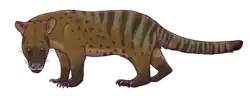 |
Lagomorpha
| Genus/family | Species | Locality | Notes/affinities | Images |
|---|---|---|---|---|
| Desmatolagus[1] | D. vetustus[1] | Twin Oboes[1] | ||
| D. sp.[7] | ||||
| Gobiolagus[1] | G. andrewsi[1] | Twin Oboes[1] | ||
| G. tolmachovi[7] |
Mesonychia
| Genus/family | Species | Locality | Notes/affinities | Images |
|---|---|---|---|---|
| Mongolestes[1] | M. hadrodens[1] | Twin Oboes[1] | A mesonychid. |  |
Perissodactyla
| Genus/family | Species | Locality | Notes/affinities | Images |
|---|---|---|---|---|
| Amynodontidae[1] | Amynodontidae indet. | Spring Camp[1] | Indeterminate amynodont fossils. | |
| Cadurcodon[1] | C. ardynensis[1] | East of Spring Camp[1] | An amynodont. | |
| Caenolophus[4] | C. obliquus | Ula Usu[4] | An amynodont. | |
| C. promissus | Ula Usu[4] | |||
| Deperetella[1][4] | D. cristata[4] | Ula Usu[4] | A deperetellid. | |
| D. cf. cristata[1] | Twin Oboes[1] | About 25% larger than the D. cristata fossils from Ula Usu.[4] | ||
| Eomoropus[1] | E. major[1] | Twin Oboes[1] | An eomoropid. | |
| Gigantamynodon[4] | G. promissus[4] | Ula Usu[4] | An amynodont. Regarded as a nomen dubium.[4] | |
| Juxia[1][4] | J. sharamurenensis[1] | Ula Usu[4] Twin Oboes[1] East of Spring Camp[1] |
A paracerathere. | |
| Lushiamynodon[4] | L. sharamurenensis[4] | Ula Usu[4] | An amynodont. Lushiamynodon is likely synonymous with Sharamynodon. L. sharamurenensis is fragmentarily known.[9] | |
| Metamynodontini[1] | Metamynodontini indet. | Twin Oboes[1] | Amynodonts. Some fossils have historically been referred to the genus Metamynodon, otherwise treated as a solely North American genus.[9] | |
| Pachytitan[4] | P. ajax[4] | North of Baron Sog Lamasery[4] | A brontothere. | |
| Pappaceras[1] | P. minuta[1] | East of Spring Camp[1] | A rhinocerotoid. | |
| Parabrontops[1] | P. cf. gobiensis[1] | Spring Camp[1] | A brontothere. | |
| Rhinotitan[4][10] | R. andrewsi[4][10] | Ula Usu[4] | A brontothere. | |
| R. kaiseni[4][10] | Ula Usu[4] | |||
| Rhodopagus?[4] | R.? minimus[4] | Ula Usu[4] | A rhinocerotoid (hyracodont?). R. minimus was originally described as a species of Caenolophus.[4] | |
| Sharamynodon[1] | S. mongoliensis[1] | Ula Usu[4] Spring Camp[1] North of Baron Sog Lamasery[4] |
An amynodont. | |
| "Sianodon"[4] | S. ulausensis[4] | Ula Usu[4] | An amynodont. The genus Sianodon is a synonym of Cadurcodon, but S. ulausensis likely belongs to a new genus.[9] | |
| Titanodectes[1] | T. minor[1] | Spring Camp[1] | A brontothere. The species T. ingens was previously also considered to be from the Shara Murun; following reassessments, only T. minor is represented in the Shara Murun.[1] | |
| Triplopus[1][4] | T.? progressus[4] | Ula Usu[4] | A rhinocerotoid. T. progressus was originally described as a species of Caenolophus.[4] | |
| T. turgaiensis[1] | Twin Oboes[1] |
Olseniidae
| Genus/family | Species | Locality | Notes/affinities | Images |
|---|---|---|---|---|
| Olsenia[11] | O. mira[11] | Enigmatic ungulate-like mammal; previously treated as a mesonychid.[11] |
Pholidota
| Genus/family | Species | Locality | Notes/affinities | Images |
|---|---|---|---|---|
| Cryptomanis?[1] | C. gobiensis[1] | Twin Oboes[1] | Alternatively classified as a creodont.[1] It is unclear if these fossils are from the Shara Murun or Ulan Gochu formation.[1] |
Rodentia
| Genus/family | Species | Locality | Notes/affinities | Images |
|---|---|---|---|---|
| Youmys[7] | Y. cavioides[7] |
Reptiles
| Genus/family | Species | Locality | Notes/affinities | Images |
|---|---|---|---|---|
| Arretosaurus[1] | A. ornatus[1] | Twin Oboes[1] | An arretosaurid lizard. |
References
- 1 2 3 4 5 6 7 8 9 10 11 12 13 14 15 16 17 18 19 20 21 22 23 24 25 26 27 28 29 30 31 32 33 34 35 36 37 38 39 40 41 42 43 44 45 46 47 48 49 50 51 52 53 54 55 56 57 58 59 60 61 62 63 64 65 66 67 68 69 70 71 72 Bai, Bin; Li, Qian; Zhou, Xin-Ying; Wang, Xiao-Yang; Xu, Ran-Cheng; Zhang, Xin-Yue; Quan, Shuo-Shuo; Meng, Jin; Wang, Yuan-Qing (2025). "Litho- and Biostratigraphy of the East Mesa in Shara Murun Region of the Erlian Basin, Inner Mongolia, China, and the subdivision of the Ulangochuian Asian Land Mammal Age". American Museum Novitates. 2025 (4034). doi:10.1206/4034.1. ISSN 0003-0082.
- ↑ Bai, Bin; Meng, Jin; Janis, Christine M.; Zhang, Zhao‐Qun; Wang, Yuan‐Qing (2020). "Perissodactyl diversities and responses to climate changes as reflected by dental homogeneity during the Cenozoic in Asia". Ecology and Evolution. 10 (13): 6333–6355. doi:10.1002/ece3.6363. ISSN 2045-7758. PMC 7381588. PMID 32724516.
- 1 2 3 4 5 Wang, Yuan-Qing; Meng, Jin; Jin, Xun (2012). "Comments on Paleogene localities and stratigraphy in the Erlian Basin, Nei Mongol, China". Vertebrate PalAsiatica. 50 (3): 181–203.
- 1 2 3 4 5 6 7 8 9 10 11 12 13 14 15 16 17 18 19 20 21 22 23 24 25 26 27 28 29 30 31 32 33 34 35 36 37 38 39 40 41 42 43 44 45 46 47 Bai, Bin; Wang, Yuan-Qing; Li, Qian; Wang, Hai-Bing; Mao, Fang-Yuan; Gong, Yan-Xin; Meng, Jin (2018). "Biostratigraphy and Diversity of Paleogene Perissodactyls from the Erlian Basin of Inner Mongolia, China". American Museum Novitates. 3914 (3914): 1–60. doi:10.1206/3914.1. ISSN 0003-0082.
- ↑ Jin, Jianhua; Liao, Wenbo; Wang, Bosun; Peng, Shaolin (2003). "Global change in Cenozoic and evolution of flora in Chin". Guangxi Zhiwu. 23 (3): 217–225. ISSN 1000-3142.
- 1 2 3 Vislobokova, I. A.; Trofimov, B. A. (2002). "Archaeomeryx (Archaeomerycidae, Ruminantia): Morphology, Ecology, and Role in the Evolution of the Artiodactyla". Paleontological Journal. 36 (Suppl. 5). ISSN 0031-0301.
- 1 2 3 4 5 6 7 8 9 10 Tsubamoto, Takehisa (2000). The Pondaung mammal fauna: an analysis of a terrestrial mammal fauna in the latest middle Eocene of central Myanmar (Southeast Asia) (PDF) (PhD thesis).
- 1 2 3 Bai, Bin; Wang, Yuan-Qing; Theodor, Jessica M.; Meng, Jin (2023). "Small artiodactyls with tapir-like teeth from the middle Eocene of the Erlian Basin, Inner Mongolia, China". Frontiers in Earth Science. 11 1117911. Bibcode:2023FrEaS..1117911B. doi:10.3389/feart.2023.1117911. ISSN 2296-6463.
- 1 2 3 Averianov, Alexander; Danilov, Igor; Jin, Jianhua; Wang, Yingyong (2017). "A new amynodontid from the Eocene of South China and phylogeny of Amynodontidae (Perissodactyla: Rhinocerotoidea)". Journal of Systematic Palaeontology. 15 (11): 927–945. doi:10.1080/14772019.2016.1256914. ISSN 1477-2019.
- 1 2 3 Mihlbachler, Matthew C. (2008). "Species Taxonomy, Phylogeny, and Biogeography of the Brontotheriidae (Mammalia: Perissodactyla)". Bulletin of the American Museum of Natural History. 501. doi:10.1206/0003-0090(2008)501[1:STPABO]2.0.CO;2.
- 1 2 3 Erfurt, Jörg; Averianov, Alexander (2005). "Enigmatic ungulate-like mammals from the Eocene of Central Asia". Naturwissenschaften. 92 (4): 182–187. doi:10.1007/s00114-004-0605-x. ISSN 0028-1042.