ShaoLin (PlayStation game)
| ShaoLin | |
|---|---|
 European PlayStation cover art | |
| Developer | Polygon Magic |
| Publishers | |
| Platform | PlayStation |
| Release | |
| Genre | Fighting RPG |
| Modes | Single-player, multiplayer |
ShaoLin, released in Japan as Lord of Fist[a], is a 1999 PlayStation video game developed by Polygon Magic and published by Media Works in Japan and by THQ in Europe.
The game combines elements of a 3D fighting game with role-playing mechanics and features both single-player and multiplayer modes.[1]
Plot
Based on wuxia fiction, the story follows the life of a martial artist progressing through a series of combat challenges across multiple regions of 19th-century Qing dynasty China, including Guangzhou, Shanghai, Taiyuan, Cangzhou, Fuzhou, and Changsha, among a few fictional locations created for the game.[1][2]
The selected martial art determines the character's backstory, starting location, and progression path.[3]
Across the various storylines, players encounter opponents including martial artists and members of a gang led by the game's primary antagonist, Han Lao Tai.[1][3]
Gameplay
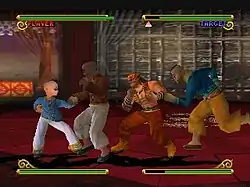
ShaoLin includes six martial arts for the player to choose from: Shaolin, Jeet Kune Do, T'ai Chi Chuan, Eight Extremities Fist, Hung Gar, and Drunken Boxing.[4]
Story mode
In story mode, players begin by selecting a martial art, gender, and character name; the default character name is Jun.[5].[3] Players then control a martial artist who travels through different regions, interacts with non-player characters, and engages in combat encounters that advance progression.[1][3]
The mode includes character development systems in which performance is influenced by factors such as food and sleep, as well as progression in mastering the selected martial art.[6]
More than 50 enemies appear in story mode; defeated opponents can be unlocked for use in versus mode.[6]
Versus mode
The game includes a versus mode with multiple match configurations. Available formats include matches against the computer and two-, four-, and eight-player matches.[5]
Four-player and eight-player matches require the use of PlayStation Multitap accessories, with eight-player matches requiring two Multitaps.[5]
Versus matches include multiple rule sets: Battle Royal (free-for-all), Team Battle (team-based), and Battle of the Schools (style-based matches).[5]
Development
ShaoLin was developed by Polygon Magic for the PlayStation using an original game engine designed to support real-time multiplayer combat.[1]
The development team stated that the game was influenced by Hong Kong action cinema, with the intention of recreating a cinematic martial arts experience in interactive form. The game's environments are fully 3D and depict a fictionalized version of early 19th-century China.[1]
Character designs were created with contributions from anime artist Hirotoshi Sano.[1]
A North American release was planned but was cancelled in April 2001.[7]
Reception
David Mohr of M! Games found the fighting dull and basic, role-playing elements poorly fleshed out, and level-ups distributed arbitrarily.[8]
The French magazine Consoles + criticized the game for its choppy animation and flawed gameplay, although it noted positive aspects such as multiplayer battles and the inclusion of multiple martial arts, giving the game a score of 20/100.[9]
Notes
- ↑ Japanese title: ロード・オブ・フィス (Rōdo Obu Fisu)
References
- 1 2 3 4 5 6 7 Lauren Fielder (1999). "Shao Lin Preview". GameSpot. Retrieved 10 November 2025.
- ↑ Shaolin manual. THQ. p. 10. Retrieved 26 May 2026.
- 1 2 3 4 Shaolin manual. THQ. p. 4. Retrieved 26 May 2026.
- ↑ Shaolin manual. THQ. p. 9. Retrieved 11 March 2026.
- 1 2 3 4 "ShaoLin". "GiantBomb". Retrieved 26 May 2026.
- 1 2 Moira Muldoon (2000). "Shao Lin Update". GameSpot. Retrieved 11 March 2026.
- ↑ GameStop Staff (2001). "Shao Lin Gets Canned". GameSpot. Retrieved 2026-05-26.
- ↑ Mohr, David. "Shaolin – im Klassik-Test (PS)". M! Games. Retrieved 11 March 2026.
- ↑ "Speedy Gonzatest - Consoles+". Abandonware Magazines. 2000. Retrieved 17 March 2026.

External links
- 1999 video games
- 3D fighting games
- Martial arts video games
- MediaWorks games
- Multiplayer and single-player video games
- PlayStation (console) games
- PlayStation (console)-only games
- Polygon Magic games
- Role-playing video games
- THQ games
- Video games developed in Japan
- Video games set in the 19th century
- Video games set in the Qing dynasty