Statement
Given a root system  in a Euclidean space with an inner product
 , and the usual bilinear form
 , with a fixed base
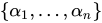 , there exists a Lie algebra
 generated by the
 elements
 (for
 ) and relations:





We also have that is a finite-dimensional semisimple Lie algebra with the Cartan subalgebra  and that the root system of is .
The square matrix  is called the Cartan matrix. Thus, with this notion, the theorem states that, given a Cartan matrix A, there exists a unique (up to an isomorphism) finite-dimensional semisimple Lie algebra
 associated to
 . The construction of a semisimple Lie algebra from a Cartan matrix can be generalized by weakening the definition of a Cartan matrix. The (generally infinite-dimensional) Lie algebra associated to a generalized Cartan matrix is called a Kac–Moody algebra.
Sketch of proof
The proof here is taken from (Serre 1966, Ch. VI, Appendix.) and (Kac 1990, Theorem 1.2.).[1][2] Let 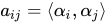 and then let
 be the Lie algebra generated by (1) the generators and (2) the relations:
 ,


Let  be the free vector space spanned by
 , V the free vector space with a basis
 and
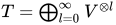 the tensor algebra over it. Consider the following representation of a Lie algebra:
- :{\widetilde {\mathfrak {g}}}\to {\mathfrak {gl}}(T)}

given by: for  ,

 inductively,
 inductively.
It is not trivial that this is indeed a well-defined representation and that has to be checked by hand. From this representation, one deduces the following properties: let  (resp.
 ) the subalgebras of generated by the
 's (resp. the
 's).
- (resp. ) is a free Lie algebra generated by the 's (resp. the 's).
- As a vector space,
 .
 where
 and, similarly,
 .
- (root space decomposition)
 .
For each ideal  of , one can easily show that is homogeneous with respect to the grading given by the root space decomposition; i.e.,
 . It follows that the sum of ideals intersecting trivially, it itself intersects trivially. Let
 be the sum of all ideals intersecting trivially. Then there is a vector space decomposition:
 . In fact, it is a -module decomposition. Let

Then it contains a copy of , which is identified with and

where  (resp.
 ) are the subalgebras generated by the images of 's (resp. the images of 's).
One then shows: (1) the derived algebra  here is the same as in the lead, (2) it is finite-dimensional and semisimple and (3)
 .